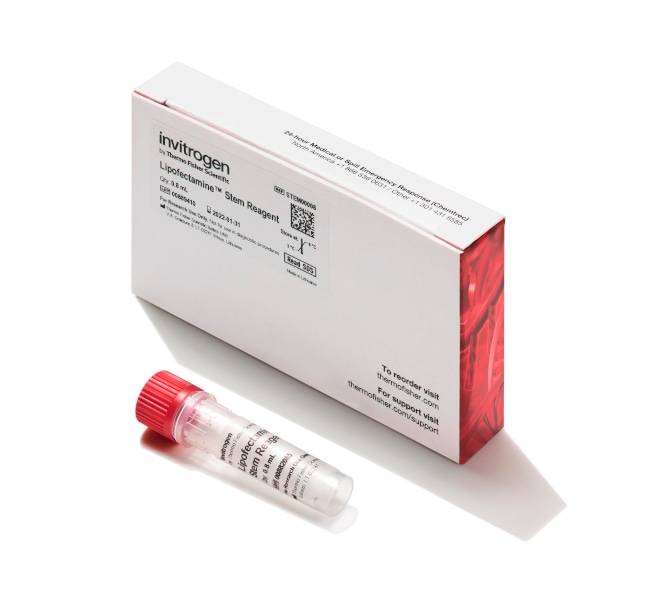
Lipofectamine™ 干细胞转染试剂
Invitrogen17万+抗体限时买二赠一,靶点广,灵活用!
Lipofectamine™ 干细胞转染试剂
Invitrogen™

Lipofectamine™ 干细胞转染试剂

Lipofectamine 干细胞转染试剂经优化可在多种干细胞中以较少的早期分化实现较高效率。能够共递送 DNA、RNA 和 Cas9 核糖核蛋白 (RNP) 复合物了解更多信息
Have Questions?
更改视图buttonViewtableView
货号数量
STEM000080.75 mL
STEM000151.5 mL
STEM000030.3 mL
STEM000010.1 mL
货号 STEM00008
价格(CNY)
7,468.95
飞享价
Ends: 31-Dec-2025
8,910.00
共减 1,441.05 (16%)
0.75 mL
添加至购物车
数量:
0.75 mL
价格(CNY)
7,468.95
飞享价
Ends: 31-Dec-2025
8,910.00
共减 1,441.05 (16%)
0.75 mL
添加至购物车
Lipofectamine 干细胞转染试剂经优化可在多种干细胞中以较少的早期分化实现较高效率。能够共递送 DNA、RNA 和 Cas9 核糖核蛋白 (RNP) 复合物。Lipofectamine 干细胞试剂可兼容多种培养基系统,包括无饲养层的培养基系统,有助于支持和简化干细胞培养工作流程。研究人员可在多能干细胞 (PSC) 和神经干细胞 (NSC) 中获得高达 80% 或更高的转染效率,在间充质干细胞 (MSC) 中获得高达 45% 的转染效率。

由于这些细胞的灵敏性,在不抑制细胞活力和细胞生长的情况下转染干细胞可能具有挑战性。Lipofectamine 干细胞试剂是一种低毒性试剂,需要少量核酸,使您的干细胞保持健康并继续增殖而不诱导分化。Lipofectamine 干细胞试剂:

卓越性能—在 iPSC、hESC、NSC 和 MSC 中的效率比其他试剂高 3 倍
通用型—DNA、RNA、Cas9 蛋白和共转染使用一种试剂
对细胞作用温和—维持细胞增殖,不会诱导细胞分化
灵活—可转染贴壁细胞或悬浮细胞—是电穿孔的替代方法

在干细胞中实现高效基因编辑
基因编辑应用通常需要具有以下能力共递送 DNA、RNA 和/或蛋白至细胞中。Lipofectamine 干细胞转染试剂设计用于共递送 CRISPR/Cas9 复合物至人干细胞中,以进行高效基因编辑。该试剂可用于转染大 DNA 质粒,例如整体式 CRISPR/Cas9 载体,并共递送一系列 RNA,例如具有 tracr/crRNA 复合物的大 Cas9 mRNA 或单向 (sg) RNA 以及蛋白,例如与 tracr/crRNA 或 sgRNA 结合的 Cas9 蛋白。

电穿孔的低毒性替代方法
通过电穿孔方法转染干细胞可能具有挑战性和复杂性。电穿孔方案推荐使用单细胞悬浮培养,以确保较高效率和较低毒性。采用反向转染方案,证明 Lipofectamine 干细胞转染试剂是干细胞电穿孔的有效且毒性较低的替代方法。该技术只需少量核酸即可实现较高转染效率,与电穿孔相等,同时支持继续增殖而不诱导分化。

仅供科研使用。不可用于诊断程序。
规格
分类无动物来源
适用于(应用)转染
产品线Lipofectamine™
产品类型转染试剂
数量0.75 mL
血清兼容性
运输条件室温
细胞类型干细胞
样品类型细胞
转染技术脂质转染
Unit Size0.75 mL
内容与储存
请避光冷藏 (2–8°C) 储存。

常见问题解答 (FAQ)

With Lipofectamine Stem Transfection Reagent, how can I improve the transfection efficiency in my stem cells?

To obtain the highest percent of stem cells transfected with Lipofectamine Stem Transfection Reagent, we highly recommend that you follow cell culture conditions that promote formation of a monolayer versus clumps of cells. If the density of your stem cells is greater than 50% or they are being grown as colonies in other media, more Lipofectamine Stem Transfection Reagent may improve transfection efficiency. For additional details, please refer to the Lipofectamine Stem Transfection Reagent protocol pertinent to your cell type and media on the product page (https://www.thermofisher.com/order/catalog/product/STEM00008?ICID=search-product), under Documents, Product Literature.

Can I co-transfect plasmid and Cas9 protein (RNP) with Lipofectamine Stem Transfection Reagent?

Yes. Lipofectamine Stem Transfection Reagent can be used to co-deliver multiple payloads, including DNA, mRNA, and Cas9 protein (RNP) into stem cells.

At what density should I plate my stem cells before transfecting them using Lipofectamine Stem Transfection Reagent?

Cell confluency can impact the amount of Lipofectamine Stem Transfection Reagent that is needed for efficient transfection. Stem cells that are near confluency do not transfect well. Plating density should be such that cells are not overgrown 24 hours after transfection. To obtain the highest percent of stem cells transfected, we highly recommend that you dissociate both colony type and monolayer cultures into small clumps of 3-5 cells. If you are growing human pluripotent stem cells in a 24-well plate in Essential 8 Medium on Vitronectin, plate the cells to achieve 30-60% confluency on the day of transfection. For additional details, please refer to the Lipofectamine Stem Transfection Reagent protocol pertinent to your cell type and media on the product page (https://www.thermofisher.com/order/catalog/product/STEM00008?ICID=search-product), under Documents, Product Literature.

Can I use Lipofectamine Stem Transfection Reagent to transfect neural stem cells (NSCs)?

Yes. Lipofectamine Stem Transfection Reagent can be used to transfect a wide range of stem cell types, while supporting continued proliferation without inducing differentiation. It is our recommended solution for transfecting neural stem cells.

I used Lipofectamine Stem Transfection Reagent. Why are only the outer cells of my stem cell colonies transfected ?

For cells that have aggregated into large colonies, transfection attempts may result in ONLY the outer cells of the colonies being successfully transfected. Transfection in suspension at the time of passaging and re-plating can maximize access of the reagent to all the cells and increase transfection efficiency. We recommend cell culture conditions that promote formation of a monolayer versus clumps of cells. To avoid cell aggregates that form large colonies, gently dissociate colonies to small clumps of 3-5 cells to promote efficient transfection. Follow recommended seeding densities for the cell culture medium and passaging reagents used so that cells are at the recommended starting confluency of 30-60% at the time of transfection and have room to grow for 24-48 hours during transfection.