Search


引用和文献 (190)
Invitrogen™
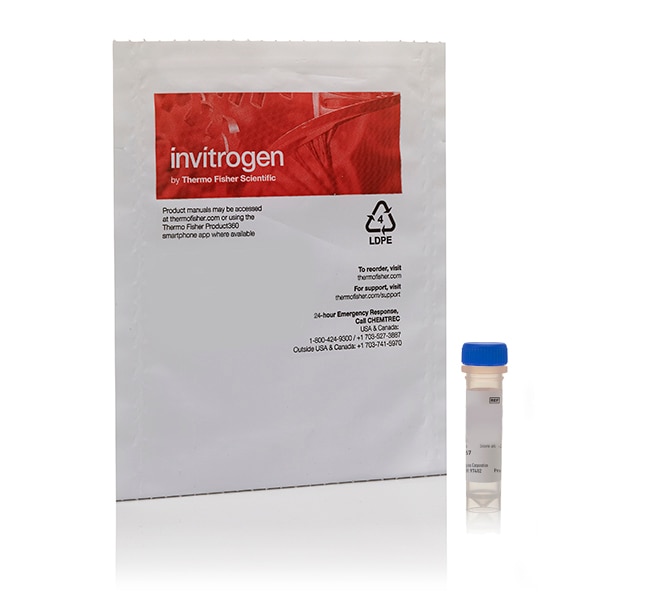
Monomeric Cyanine Nucleic Acid Stains
Monomeric Cyanine Nucleic Acid stains are five spectrally distinct dyes for ultrasensitive fluorescence detection of nucleic acid in imaging and flow cytometry. They have bright fluorescence signals, low background, and strong binding affinity with nucleic acid.
Have Questions?
更改视图

| 货号 | 染料类型 | 发射 | 激发波长范围 |
|---|---|---|---|
| T3605 | TO-PRO-3 Iodide | 661 nm | 642 nm |
| P3581 | 细胞不可透过性 | 435 nm | 455 nm |
| T3602 | TO-PRO-1 Iodide | 531 nm | 515 nm |
| Y3603 | 细胞不可透过性 | 509 nm | 491 nm |
| Y3607 | 细胞不可透过性 | 631 nm | 612 nm |
货号 T3605
价格(CNY)
4,540.00
飞享价
Ends: 31-Dec-2026
6,305.00共减 1,765.00 (28%)
1 mL
染料类型:
TO-PRO-3 Iodide
发射:
661 nm
激发波长范围:
642 nm
价格(CNY)
4,540.00
飞享价
Ends: 31-Dec-2026
6,305.00共减 1,765.00 (28%)
1 mL
Monomeric Cyanine Nucleic Acid stains allow ultrasensitive fluorescence detection of double-stranded nucleic acids. These high-affinity dyes have low background and bright fluorescence when bound to nucleic acid. They are ideally suited for nuclear staining in flow cytometry and fluorescence microscopy applications in fixed cells, along with nucleic acid detection on solid supports and in electrophoresis applications.
These five spectrally distinct monomeric cyanine nucleic acid stains are high sensitivity fluorescent probes for nucleic acid staining. The carbocyanine monomers have very strong binding affinity for dsDNA, with dissociation constants in the micromolar range. These dyes each comprise a single cyanine dye and a cationic side chain. The carbocyanine monomers are spectrally analogous to the corresponding dimeric cyanine dyes; however, with only two positive charges and one intercalating unit, these dyes exhibit somewhat reduced affinity for nucleic acids relative to the cyanine dimers.
Features of the monomeric cyanine nucleic acid stains:
• High affinity—strong binding affinity for dsDNA with dissociation constants in the micromolar range
• Low background—negligible fluorescence when not bound to nucleic acids
• Large fluorescence enhancement—20- to 1800-fold fluorescence enhancements upon binding to DNA
• Bright fluorescence—high extinction coefficients and fluorescence quantum yields resulting in very bright fluorescence signals
Like their dimeric counterparts, these monomeric cyanine dyes are typically impermeant to viable cells and can be used as dead cell indictors, although YO-PRO-1 (Cat. No. Y3603) can be permeant to apoptotic cells, providing a convenient indicator of apoptosis. The monomeric cyanine stains have wide applicability due to their low background and bright fluorescence. Uses include staining of nucleic acids on solid supports, prestaining of samples for gel or capillary electrophoresis, viability detection, and counterstaining in multiple-label experiments.
The fluorescence spectra of the five monomeric cyanine nucleic acid stains cover the entire visible wavelength range and each dye differs in extinction coefficient and quantum yield. These dyes may also be used with ultraviolet trans- or epi-illuminator excitation sources. TO-PRO-1, PO-PRO-1, and YO-PRO-1 dyes exhibit secondary ultraviolet excitation peaks near 275 nm. The monomeric cyanine nucleic acid stains exhibit large degrees of fluorescence enhancement upon binding to DNA (or RNA), varying from 400- to 1800-fold for the “1-series” and 20- to 200-fold for the “3-series.” Consequently, the fluorescence of unbound dye is negligible under most experimental detection conditions.
The monomeric cyanine nucleic acid stains are supplied in a unit size of 1 mL as 1 mM solutions in dimethylsulfoxide (DMSO).
PO-PRO™-1 Iodide (435/455)
The blue-fluorescent PO-PRO-1 stain has excitation/emission maxima ∼435/455 nm when bound to nucleic acid. It can be excited by ultraviolet (UV) excitation sources and the He-Cd 442 nm laser.
YO-PRO™-1 Iodide (491/509)
The green-fluorescent YO-PRO-1 stain has excitation/emission maxima ∼491/509 nm when bound to nucleic acid. It can be excited by ultraviolet (UV) excitation sources and the Ar 488 nm laser. YO-PRO-1 stain has been used to identify apoptotic cells. Apoptotic cells become permeant to YO-PRO-1, but remain impermeant to propidium iodide (Cat. No. P3566) and other dead cell stains. Live cells are not stained with YO-PRO-1, allowing them to be used in subsequent experiments. The YO-PRO-1 nucleic acid stain is also included as an apoptosis indicator in the Vybrant Apoptosis Assay Kit #4 (Cat. No. V13243) and Chromatin Condensation/Membrane Permeability/Dead Cell Apoptosis Kit (Cat. No. V23201).
TO-PRO™-1 Iodide (515/531)
The green-fluorescent TO-PRO-1 stain has excitation/emission maxima ∼515/531 nm when bound to nucleic acid. It can be excited by ultraviolet (UV) excitation sources and the Ar 514 nm laser.
YO-PRO™-3 Iodide (612/631)
The orange-fluorescent YO-PRO-3 stain has excitation/emission maxima ∼612/631 nm when bound to nucleic acid. It can be excited by the He-Ne 594 nm laser.
TO-PRO™-3 Iodide (642/661)
The far-red-fluorescent TO-PRO-3 stain has excitation/emission maxima ∼642/661 nm with fluorescence similar to Alexa Fluor 647 or Cy5 dyes. The long-wavelength fluorescence of TO-PRO-3 stain is well separated from that of commonly used fluorophores, such as the Alexa Fluor dyes, Oregon Green, fluorescein (FITC), rhodamine (TRITC), Texas Red, coumarin (AMCA), Marina Blue, and Pacific Blue dyes. Additionally, long-wavelength light–absorbing dyes such as TO-PRO-3 stain have the advantage that their fluorescence is usually not obscured by the autofluorescence of tissues.
TO-PRO-3 stain is useful as a nuclear counterstain and dead cell indicator in fluorescence microscopy and flow cytometry, and is among the highest-sensitivity probes for nucleic acid detection. TO-PRO-3 gives strong and selective staining of the nucleus in cultured cells and in paraffin sections. Simultaneous labeling with a green-fluorescent SYTO dye and cell-impermeant TO-PRO-3 stain is frequently used to assess cell viability. TO-PRO-3 has a much higher extinction coefficient than DNA-bound propidium iodide and has been used for unique applications such as detecting microbial cells and microorganisms in soil environments.
TO-PRO-3 is also available as room-temperature-stable, ready-to-use solutions:
• NucRed™ Dead 647 ReadyProbes™ Reagent (Cat. No. R37113)
• TO-PRO™ 3 Ready Flow™ Reagent (Cat. No. R37170)
仅供科研使用。不可用于诊断程序。
规格
细胞渗透性非细胞通透性
颜色Red
最大浓度1 mM
检测方法Fluorescence
染料类型TO-PRO-3 Iodide
发射661 nm
激发波长范围642 nm
适用于(应用)Fluorescence Assays
适用于(设备)荧光显微镜
形式液体
产品线TO-PRO
数量1 mL
运输条件Room Temperature
储存缓冲液DMSO
标签类型Fluorescent Dye
产品类型核酸染色剂
亚细胞定位Nucleic Acids, Nucleus
Unit Size1 mL
内容与储存
在冷柜(-5°C 至 -30°C)中避光储存。
常见问题解答 (FAQ)
What is the suggested working concentration for Monomeric Cyanine Nucleic Acid Stains (Cat. Nos. T3605, P3581, T3602, Y3603, Y3607) for fluorescence microscopy?
What is the suggested working concentration for Monomeric Cyanine Nucleic Acid Stains (Cat. Nos. T3605, P3581, T3602, Y3603, Y3607) for flow cytometry?
引用和文献 (190)
引用和文献
Abstract
Fluorometric broad-range screening of compounds with affinity for nucleic acids.
Journal:Analytical chemistry
PubMed ID:15828780
The C-type lectin receptor Endo180 displays internalization and recycling properties distinct from other members of the mannose receptor family.
Journal:J Biol Chem
PubMed ID:12068012
Endo180/urokinase plasminogen activator receptor-associated protein together with the mannose receptor, the phospholipase A(2) receptor, and DEC-205/MR6-gp200 comprise the four members of the mannose receptor family. These receptors have a unique structural composition due to the presence of multiple C-type lectin-like domains within a single polypeptide backbone. In addition, they are
TGFbeta/activin/nodal signaling is necessary for the maintenance of pluripotency in human embryonic stem cells.
Journal:Development
PubMed ID:15703277
'Human embryonic stem cells (hESCs) self-renew indefinitely and give rise to derivatives of all three primary germ layers, yet little is known about the signaling cascades that govern their pluripotent character. Because it plays a prominent role in the early cell fate decisions of embryonic development, we have examined the
A high-throughput, cell-based screening method for siRNA and small molecule inhibitors of mTORC1 signaling using the In Cell Western technique.
Journal:Assay Drug Dev Technol
PubMed ID:20085456
'The mTORC1 pathway is a central regulator of cell growth, and defective mTORC1 regulation plays a causative role in a variety of human diseases, including cancer, tumor syndromes such as the tuberous sclerosis complex (TSC) and lymphangioleiomyomatosis (LAM), and metabolic diseases such as diabetes and obesity. Given the importance of
Chitin is a size-dependent regulator of macrophage TNF and IL-10 production.
Journal:J Immunol
PubMed ID:19265136
'Chitin is a ubiquitous polysaccharide in fungi, insects, and parasites. We hypothesized that chitin is a size-dependent regulator of innate immunity. To test this hypothesis, we characterized the effects of chitins of different sizes on murine bronchoalveolar or peritoneal macrophages. In these studies, large chitin fragments were inert, while both