Search


引用和文献 (7)
Invitrogen™
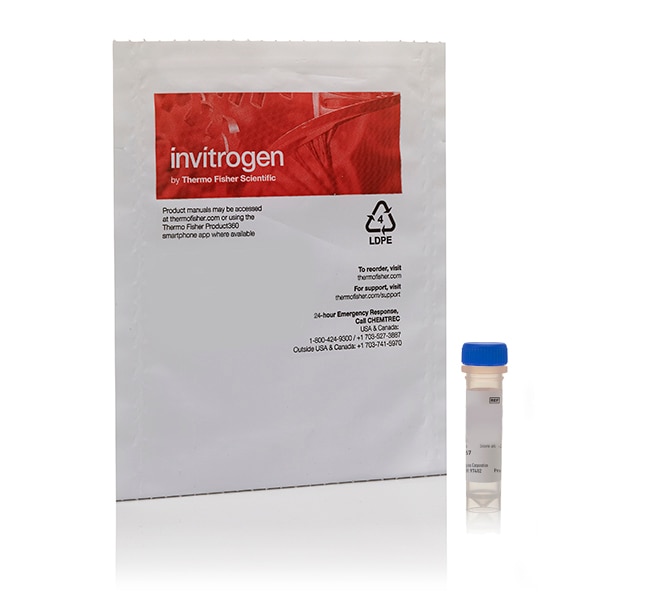
TransFluoSpheres™ 羧基修饰微球,1.0 μm(488/645),2% 固体含量
微球(又称乳胶微球或乳胶颗粒), 是胶体粒度范围内的球形颗粒, 由诸如聚苯乙烯等非晶态聚合物形成。我们的 Molecular Probes™ TransFluoSpheres™ 微珠使用高质量了解更多信息
| 货号 | 数量 |
|---|---|
| T8883 | 0.5 mL |
货号 T8883
价格(CNY)
8,195.00
0.5 mL
数量:
0.5 mL
价格(CNY)
8,195.00
0.5 mL
微球(又称乳胶微球或乳胶颗粒), 是胶体粒度范围内的球形颗粒, 由诸如聚苯乙烯等非晶态聚合物形成。我们的 Molecular Probes™ TransFluoSpheres™ 微珠使用高质量、超纯聚苯乙烯加工而成,标记有两种(或更多)荧光染料,所形成的微球可由氩离子激光的 488 nm 或 514 nm 光谱线激发,但发射波长更长,从而促进多色实验且允许使用宽带激发和发射光滤波器。TransFluoSpheres™ 微球即使在做荧光显微检测高强度激发照射时也很少、甚至不发生光漂白。
TransFluoSpheres™ 微球技术规格:
•标记 (Ex/Em):深红色荧光(488/645)
• 标称微珠直径:1.0 µm
• 偶联表面:羧酸盐
•固体:2%
羧化物偶联表面特性
羧化物修饰的 FluoSpheres™ 微珠表面有高密度的游离羧酸,这使得它们适合于通过诸如碳二亚胺(EDAC)等水溶性碳化二亚胺类试剂共价偶合蛋白质和其他含有胺基的生物分子。
微球的关键应用:
• 仪器校准(流式细胞仪、显微镜、HTS、HCS)
• 流量检测(微流体、血流、水流和气流)
• 细胞生物学示踪剂(细胞分化与细胞示踪)
• 免疫分析(凝集试验、ELISA、颗粒捕获及对比试剂)
荧光微球选择
在我们提供的全部荧光微球产品中,您将发现各式各样的微球:
•10 种荧光颜色
• 10 种标称微珠直径:0.02 µm、0.04 µm、0.1 µm、0.2 µm、0.5 µm、1.0 µm、2.0 µm、4.0 µm、10.0 µm 和 15.0 µm
•蛋白偶联的四种表面改性:羧酸盐、硫酸盐、醛硫酸盐、胺
•另外与链霉素亲和素、NeutrAvidin、生物素、铕和铂预偶联的微球
未染色微球选择
我们还提供数百种 UltraClean™ 无表面活性剂的微球选项,用于研究和商业应用。
我们将为您定制微球产品’
我们将根据要求准备定制订单。我们的定制偶联服务高效且保密, 而且我们绝对保证质量。我们获得了 ISO 9001:2000 认证。
仅供研究使用。不适用于动物或人类的治疗或诊断。
TransFluoSpheres™ 微球技术规格:
•标记 (Ex/Em):深红色荧光(488/645)
• 标称微珠直径:1.0 µm
• 偶联表面:羧酸盐
•固体:2%
羧化物偶联表面特性
羧化物修饰的 FluoSpheres™ 微珠表面有高密度的游离羧酸,这使得它们适合于通过诸如碳二亚胺(EDAC)等水溶性碳化二亚胺类试剂共价偶合蛋白质和其他含有胺基的生物分子。
微球的关键应用:
• 仪器校准(流式细胞仪、显微镜、HTS、HCS)
• 流量检测(微流体、血流、水流和气流)
• 细胞生物学示踪剂(细胞分化与细胞示踪)
• 免疫分析(凝集试验、ELISA、颗粒捕获及对比试剂)
荧光微球选择
在我们提供的全部荧光微球产品中,您将发现各式各样的微球:
•10 种荧光颜色
• 10 种标称微珠直径:0.02 µm、0.04 µm、0.1 µm、0.2 µm、0.5 µm、1.0 µm、2.0 µm、4.0 µm、10.0 µm 和 15.0 µm
•蛋白偶联的四种表面改性:羧酸盐、硫酸盐、醛硫酸盐、胺
•另外与链霉素亲和素、NeutrAvidin、生物素、铕和铂预偶联的微球
未染色微球选择
我们还提供数百种 UltraClean™ 无表面活性剂的微球选项,用于研究和商业应用。
我们将为您定制微球产品’
我们将根据要求准备定制订单。我们的定制偶联服务高效且保密, 而且我们绝对保证质量。我们获得了 ISO 9001:2000 认证。
仅供研究使用。不适用于动物或人类的治疗或诊断。
仅供科研使用。不可用于诊断程序。
规格
产品线TransFluoSpheres
数量0.5 mL
运输条件室温
表面改性羧基
颜色深红色
直径(公制)1 μm
材质聚苯乙烯
产品类型羧基修饰微球
Unit Size0.5 mL
内容与储存
避光储存在冰箱 (2–8°C) 中。
常见问题解答 (FAQ)
洗涤和离心后,我的微球只留下了极少量的沉淀且溶液呈透明状。为什么会出现这种现象?
我的微球已保存超过一年,我想知道它们是否仍可正常使用,有什么好办法来核实它们的功能是否完好?
我不慎冷冻了自己的微球,还可继续使用么?
在我的实验体系中,蛋白包被的微球出现非特异性结合。有什么产品可以帮助减少这些非特异性作用吗?
我应该使用哪种方法来分散聚集体?
引用和文献 (7)
引用和文献
Abstract
A single amino acid in the cytoplasmic domain of the beta 2 integrin lymphocyte function-associated antigen-1 regulates avidity-dependent inside-out signaling.
Journal:J Biol Chem
PubMed ID:11134023
'The leukocyte-specific beta(2) integrin lymphocyte function-associated antigen-1 (LFA-1) (alpha(L)/beta(2)) mediates activation-dependent adhesion to intercellular adhesion molecule (ICAM)-1. In leukocytes, LFA-1 requires activation by intracellular messengers to bind ICAM-1. We observed malfunctioning of LFA-1 activation in leukemic T cells and K562-transfected cells. This defective inside-out integrin activation is only restricted to
DC-SIGN-ICAM-2 interaction mediates dendritic cell trafficking.
Journal:Nat Immunol
PubMed ID:11017109
'Dendritic cells (DCs) are recruited from blood into tissues to patrol for foreign antigens. After antigen uptake and processing, DCs migrate to the secondary lymphoid organs to initiate immune responses. We now show that DC-SIGN, a DC-specific C-type lectin, supports tethering and rolling of DC-SIGN-positive cells on the vascular ligand
Comparison of methods for monitoring bacterial transport in the subsurface.
Journal:J Microbiol Methods
PubMed ID:11576686
'The purpose of this study was to compare in a laboratory experiment, a suite of methods developed to track viable bacteria during field transport experiments. The criteria for development and selection of these methods included: (1) the ability to track bacteria within the environment from which they were isolated; (2)
Identification of DC-SIGN, a novel dendritic cell-specific ICAM-3 receptor that supports primary immune responses.
Journal:Cell
PubMed ID:10721994
Contact between dendritic cells (DC) and resting T cells is essential to initiate a primary immune response. Here, we demonstrate that ICAM-3 expressed by resting T cells is important in this first contact with DC. We discovered that instead of the common ICAM-3 receptors LFA-1 and alphaDbeta2, a novel DC-specific
DC-SIGN, a dendritic cell-specific HIV-1-binding protein that enhances trans-infection of T cells.
Journal:Cell
PubMed ID:10721995
Dendritic cells (DC) capture microorganisms that enter peripheral mucosal tissues and then migrate to secondary lymphoid organs, where they present these in antigenic form to resting T cells and thus initiate adaptive immune responses. Here, we describe the properties of a DC-specific C-type lectin, DC-SIGN, that is highly expressed on