Search


引用和文献 (3)
Invitrogen™
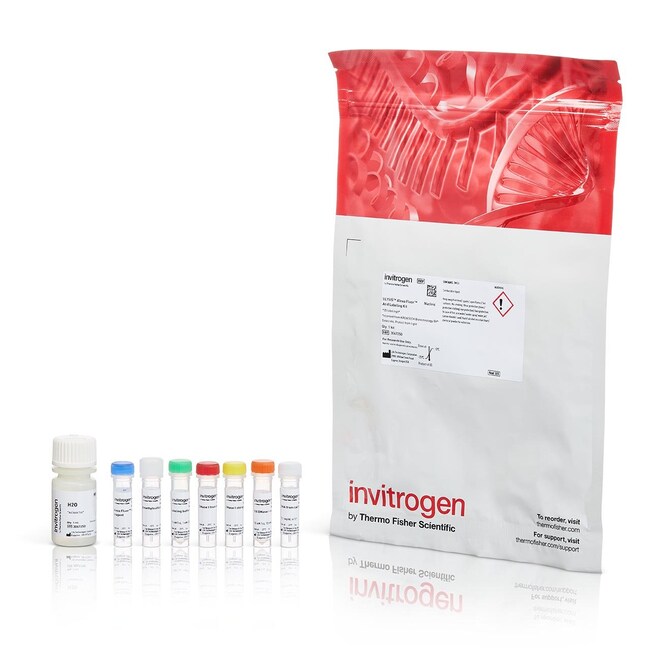
ULYSIS™ Alexa Fluor™ Nucleic Acid Labeling Kit
Achieve unparalleled precision and sensitivity in your fluorescence-based applications from FISH to real-time PCR. With a streamlined, non-enzymatic labeling process and a broad selection of vibrant dyes, ULYSIS kits ensure your nucleic acids are ready for any challenge.
Have Questions?
更改视图

| 货号 | 标签或染料 | 激发/发射 |
|---|---|---|
| U21654 | Alexa Fluor™ 594 | 588/615 nm |
| U21660 | Alexa Fluor™ 647 | 650/670 nm |
货号 U21654
价格(CNY)
8,876.00
1 kit
标签或染料:
Alexa Fluor™ 594
激发/发射:
588/615 nm
价格(CNY)
8,876.00
1 kit
ULYSIS nucleic acid labeling kits provide a unique method for attaching a fluorescent dye to nucleic acids. The labeling reagent in the kit reacts with the N7 of guanine to form a stable coordination complex, and the reaction is simple and fast - just heat denature DNA (5 minutes), add the label (react for 15 minutes), then purify.
Features include:
- Labeling reaction complete in as little as 15 minutes
- Available in several Alexa Fluor dye colors
- Non-enzymatic labeling—avoids the potential biases and limitations associated with enzymatic labeling methods
- Flexibility—compatible with a wide range of experimental conditions and protocols
- High sensitivity—provides strong fluorescence signals, enabling detection of low-abundance targets
Reliable labeling with the Universal Linkage System
This series of ULYSIS kits was developed to enable rapid and simple coupling of Alexa Fluor dyes to purine bases in nucleic acid polymers. The method, the Universal Linkage System (ULS), makes use of a platinum dye complex that forms a stable adduct with the N7 position of guanine and, to a lesser extent, adenine bases in DNA, RNA, PNA, and oligonucleotides. The result is a reliable nonenzymatic method for nucleic acid labeling.
Labeling is fast and easy
The labeling reaction typically takes only 15 minutes, and separation of the labeled nucleic acids from the unreacted ULS complex can be accomplished with a simple spin-column procedure. DNA longer than ∼1,000 base pairs require a 10-minute DNase digestion before labeling, which both optimizes labeling and fragments the probe for efficient hybridization.
仅供科研使用。不可用于诊断程序。
规格
颜色Red
激发/发射588/615 nm
适用于(应用)Dot blot, Northern blot, Southern blot, RNA in situ hybridization, DNA in situ hybridization, Multicolor fluorescence in situ hybridization (mFISH), Comparative genome hybridization (CGH), Microarray analysis
包括标签或染料是
标记方法直接标记
产品线Alexa Fluor、Ulysis
产品类型核酸标记试剂盒
数量1 Kit
运输条件室温
检测方法荧光
最终产品类型探针(标记 RNA)、探针(标记 DNA)、寡核苷酸(标记)
产品规格试剂盒
标记目标DNA(通用)、寡核苷酸、RNA(通用)
标签或染料Alexa Fluor™ 594
样品类型RNA
Unit Size1 kit
内容与储存
储存在冰箱中(-5至 -30°C)并避光保存。
需要但不包括:基于凝胶过滤的离心柱,用于从过量标记试剂中纯化标记的 DNA
需要但不包括:基于凝胶过滤的离心柱,用于从过量标记试剂中纯化标记的 DNA
常见问题解答 (FAQ)
ULYSIS标记是否兼容于基因芯片分析?
可以将ULYSIS核酸标记试剂盒标记的探针保存起来以后使用吗?
对于使用ULYSIS核酸标记试剂盒进行RNA标记,你们有什么诀窍吗?
ULYSIS试剂盒可以用来标记长于1000碱基对的探针甚至质粒吗?
ULYSIS标记的DNA在高温时稳定吗?
引用和文献 (3)
引用和文献
Abstract
Chromosome and replisome dynamics in E. coli: loss of sister cohesion triggers global chromosome movement and mediates chromosome segregation.
Journal:Cell
PubMed ID:15960977
'Chromosome and replisome dynamics were examined in synchronized E. coli cells undergoing a eukaryotic-like cell cycle. Sister chromosomes remain tightly colocalized for much of S phase and then separate, in a single coordinate transition. Origin and terminus regions behave differently, as functionally independent domains. During separation, sister loci move far
Three-color FISH analysis of TMPRSS2/ERG fusions in prostate cancer indicates that genomic microdeletion of chromosome 21 is associated with rearrangement.
Journal:Neoplasia
PubMed ID:16820092
The recent description of novel recurrent gene fusions in approximately 80% of prostate cancer (PCa) cases has generated increased interest in the search for new translocations in other epithelial cancers and emphasizes the importance of understanding the origins and biologic implications of these genomic rearrangements. Analysis of 15 PCa cases
Evaluation of cadmium-induced transcriptome alterations by three color cDNA labeling microarray analysis on a T-cell line.
Journal:Toxicology
PubMed ID:12160620
Beside heavy metals, cadmium (Cd(2+)) is a ubiquitous toxic metal with a well established apoptotic and genotoxic effect, chronic exposure of which has been involved in a variety of pathological conditions. In the present study, we investigated by 1455 genes cDNA microarrays the toxic and apoptotic effect of Cd(2+), on