Search

Invitrogen™
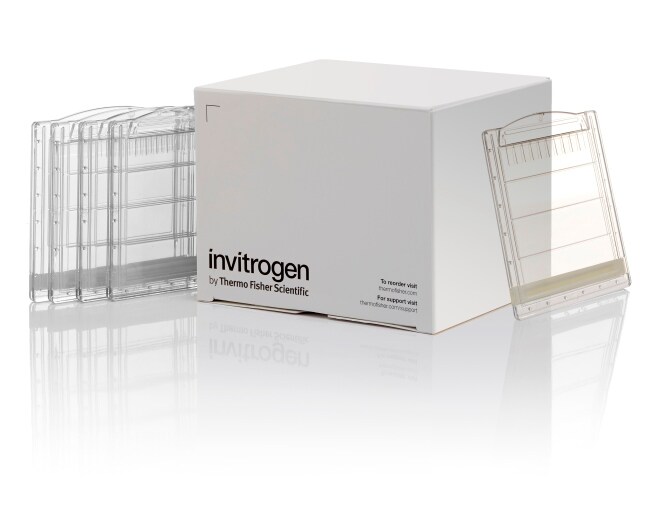
Novex™ Value™ 4-20%, Tris-甘氨酸, 1.0 mm, 小型蛋白预制胶, 10 孔
Novex™ Value Tris-Glycine Mini Gels provide a great balance of price and performance for your protein separation needs. Novex Value了解更多信息
| 货号 | 数量 |
|---|---|
| XV04200PK20 | 20 支/包 |
货号 XV04200PK20
价格(CNY)
2,367.00
20 gels (1 box)
数量:
20 支/包
价格(CNY)
2,367.00
20 gels (1 box)
Novex™ Value Tris-Glycine Mini Gels provide a great balance of price and performance for your protein separation needs. Novex Value Tris-Glycine polyacrylamide gels provide good separation and resolution of your proteins in an affordable gel that is based on traditional Laemmli protein electrophoresis. Each box contains 20 gels.
Features of the Novex Value gels include:
• Excellent balance of value and performance—great for qualitative analysis (e.g., screening, protein purification verification)
• Fast run conditions—separate your proteins using constant voltage in less than 60 minutes
• Options for native and denaturing protein assays
Choose the right gel format for your experiments
Novex Value Tris-Glycine gels come in a fixed 10% option as well 4–12% and 4–20% gradients.
Run your proteins in native or denatured form
Novex Value Tris-Glycine gels do not contain SDS and can be used to run your proteins in native or denatured form. For denatured proteins, we recommend using Novex Tris-Glycine SDS Sample Buffer and Novex Tris-Glycine SDS Running Buffer. For native proteins, we recommend using Novex Tris-Glycine Native Sample Buffer and Novex Tris-Glycine Native Running Buffer.
For transferring your proteins to membrane, we recommend using Novex Tris-Glycine Transfer Buffer. Transfers can be done using the Mini Blot Module or the iBlot™ Gel Transfer Device.
Features of the Novex Value gels include:
• Excellent balance of value and performance—great for qualitative analysis (e.g., screening, protein purification verification)
• Fast run conditions—separate your proteins using constant voltage in less than 60 minutes
• Options for native and denaturing protein assays
Choose the right gel format for your experiments
Novex Value Tris-Glycine gels come in a fixed 10% option as well 4–12% and 4–20% gradients.
Run your proteins in native or denatured form
Novex Value Tris-Glycine gels do not contain SDS and can be used to run your proteins in native or denatured form. For denatured proteins, we recommend using Novex Tris-Glycine SDS Sample Buffer and Novex Tris-Glycine SDS Running Buffer. For native proteins, we recommend using Novex Tris-Glycine Native Sample Buffer and Novex Tris-Glycine Native Running Buffer.
For transferring your proteins to membrane, we recommend using Novex Tris-Glycine Transfer Buffer. Transfers can be done using the Mini Blot Module or the iBlot™ Gel Transfer Device.
仅供科研使用。不可用于诊断程序。
规格
描述Novex™ Value™ 4 至 20% Tris-甘氨酸小型凝胶,20 片凝胶,厚度为 0.039 英寸,凝胶尺寸为 8 x 8 cm,凝胶,用于蛋白凝胶电泳,12 个月有效期,2 至 8°C 储存温度
适用于(应用)蛋白质凝胶电泳
适用于(设备)Mini Gel Tank 小型胶电泳槽
配方凝胶
凝胶厚度1.0 mm
长度(公制)8 cm
凝胶长度(公制)8 cm
材料Tris-甘氨酸体系
分离模式分子量
数量20 支/包
推荐应用变性,天然
上样容量达 25 µL
有效期12个月
运输条件经批准可在室温下或置于湿冰上运输
储存要求储存在 4°C 下。有效期为 12 个月。
厚度1.0 mm
厚度(英制)0.039 in.
厚度(公制)1.0 mm
孔设计1D 孔
宽度(公制)8 cm
凝胶宽度(公制)8 cm
凝胶百分比4 至 20%
凝胶尺寸小型
凝胶类型Tris-甘氨酸体系
产品线Novex Value
产品类型梯度胶 PAGE
分离范围20 至 200 kDa
分离类型变性,天然
分离蛋白质
孔10孔
Unit Size20 gels (1 box)
内容与储存
储存在冷藏冰箱 (2–8°C) 中。
根据凝胶类型,有效期长达 12 个月。
根据凝胶类型,有效期长达 12 个月。