Search


引用和文献 (21)
Gibco™
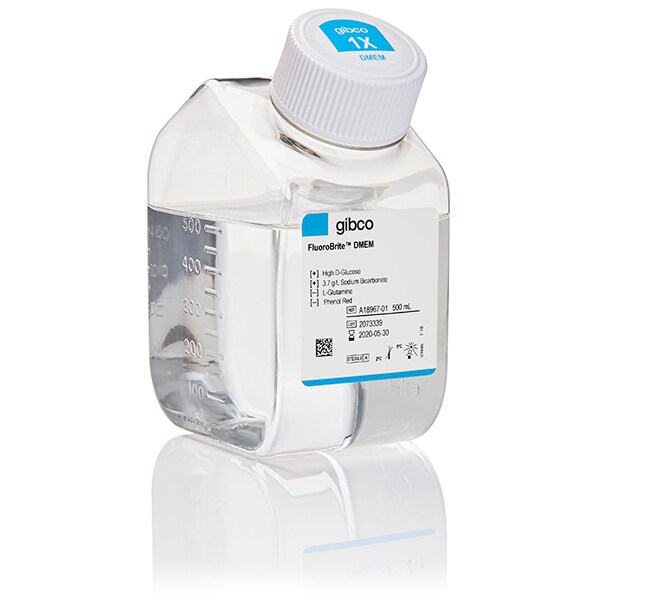
FluoroBrite™ DMEM
Gibco™ FluoroBrite™ DMEM features a background fluorescence that is comparable to PBS and 90% lower than that emitted by standard phenol red–free DMEM.
Have Questions?
更改视图

| 货号 | 数量 |
|---|---|
| A1896701 | 500 mL |
| A1896702 | 10 x 500 mL |
货号 A1896701
价格(CNY)
689.00
飞享价
Ends: 31-Dec-2026
861.00共减 172.00 (20%)
Each
数量:
500 mL
价格(CNY)
689.00
飞享价
Ends: 31-Dec-2026
861.00共减 172.00 (20%)
Each
Gibco™ FluoroBrite™ DMEM features a background fluorescence that is comparable to PBS and 90% lower than that emitted by standard phenol red–free DMEM. Formulated to include the required nutrients for routine cell culture when supplemented with 10% fetal bovine serum and 4 mM L-glutamine or GlutaMAX™ Supplement, FluoroBrite™ DMEM is designed to enhance the signal-to-noise ratio of fluorophores, enabling researchers to visualize even the weakest fluorescent events in an environment that promotes optimum cell health. Additional features include:
- Enhancement of fluorescence signal during live-cell imaging
- DMEM-based to help preserve cell health
Live-cell fluorescence microscopy is an essential technique for the visualization of fundamentally important and physiologically relevant biological events. A key challenge with this technique is the ability to image weak fluorophores without causing cell damage, photobleaching, or undesirable changes to cell health. FluoroBrite™ DMEM helps address these issues.
仅供科研使用。不可用于诊断程序。
规格
最大浓度1 X
生产质量cGMP-compliant under the ISO 13485 standard
产品类型DMEM(Dulbecco 改良 Eagle 培养基)
数量500 mL
有效期自生产之日起 12 个月
分类非动物源性
形式液体
血清水平标准血清
无菌无菌过滤
加有添加剂High Glucose
不加添加剂No Glutamine, 不含 HEPES, 无酚红, 不含丙酮酸钠
Unit SizeEach
内容与储存
Store in refrigerator (2–8°C). Protect from light.
常见问题解答 (FAQ)
我知道有些培养基进行荧光成像的效果不佳,该如何选择培养基呢?
使用荧光染料标记活细胞时,我是否需要考虑培养基中酚红的影响?
What is the osmolality of Fluorobrite DMEM?
I understand that some media are worse than others for fluorescence imaging. How do I choose?
Should I be concerned about phenol red in my media when labeling my live cells with fluorescent dyes?
引用和文献 (21)
引用和文献
Abstract
Open source software for quantification of cell migration, protrusions, and fluorescence intensities.
Journal:
PubMed ID:25847537
'Cell migration is frequently accompanied by changes in cell morphology (morphodynamics) on a range of spatial and temporal scales. Despite recent advances in imaging techniques, the application of unbiased computational image analysis methods for morphodynamic quantification is rare. For example, manual analysis using kymographs is still commonplace, often caused by
A BRCA1-interacting lncRNA regulates homologous recombination.
Journal:
PubMed ID:26412854
Long non-coding RNAs (lncRNAs) are important players in diverse biological processes. Upon DNA damage, cells activate a complex signaling cascade referred to as the DNA damage response (DDR). Using a microarray screen, we identify here a novel lncRNA, DDSR1 (DNA damage-sensitive RNA1), which is induced upon DNA damage. DDSR1 induction
Axonal autophagosomes recruit dynein for retrograde transport through fusion with late endosomes.
Journal:
PubMed ID:25940348
Efficient degradation of autophagic vacuoles (AVs) via lysosomes is an important cellular homeostatic process. This is particularly challenging for neurons because mature acidic lysosomes are relatively enriched in the soma. Although dynein-driven retrograde transport of AVs was suggested, a fundamental question remains how autophagosomes generated at distal axons acquire dynein
The Nurr1 Activator 1,1-Bis(3'-Indolyl)-1-(p-Chlorophenyl)Methane Blocks Inflammatory Gene Expression in BV-2 Microglial Cells by Inhibiting Nuclear Factor ?B.
Journal:
PubMed ID:25858541
NR4A family orphan nuclear receptors are an important class of transcription factors for development and homeostasis of dopaminergic neurons that also inhibit expression of inflammatory genes in glial cells. The identification of NR4A2 (Nurr1) as a suppressor of nuclear factor ?B (NF-?B)-related neuroinflammatory genes in microglia and astrocytes suggests that
Posttranslational Modification of HOIP Blocks Toll-Like Receptor 4-Mediated Linear-Ubiquitin-Chain Formation.
Journal:
PubMed ID:26578682
Linear ubiquitination is an atypical posttranslational modification catalyzed by the linear-ubiquitin-chain assembly complex (LUBAC), containing HOIP, HOIL-1L, and Sharpin. LUBAC facilitates NF-?B activation and inflammation upon receptor stimulation by ligating linear ubiquitin chains to critical signaling molecules. Indeed, linear-ubiquitination-dependent signaling is essential to prevent pyogenic bacterial infections that can lead