Search
Invitrogen
HIF1A Monoclonal Antibody (mgc3)
{{$productOrderCtrl.translations['antibody.pdp.commerceCard.promotion.promotions']}}
{{$productOrderCtrl.translations['antibody.pdp.commerceCard.promotion.promocode']}}: {{promo.promoCode}} {{promo.promoTitle}} {{promo.promoDescription}}. {{$productOrderCtrl.translations['antibody.pdp.commerceCard.promotion.learnmore']}}
{{$ctrl.translations['antibody.pdp.skuNotes.additionalInformation']}}:
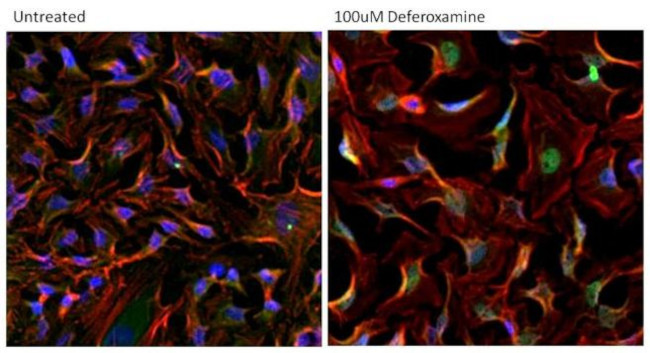
图: 1 / 31
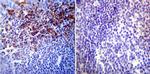
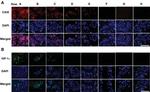
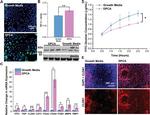
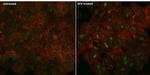
HIF1A Antibody (MA1-516) in ICC/IF
Immunofluorescent analysis of HIF-1 alpha (green) in HeLa cells either left untreated (left panel) or treated with 100uM Deferoxamine mesylate for ~16 hours (right panel). Formalin-fixed cells were permeabilized with 0.1% Triton X-100 in TBS for 15 minutes at room temperature and blocked with 0.3% BSA for 15 minutes at room temperature. Cells were probed with a HIF-1 alpha monoclonal antibody (Product # MA1-516) at a dilution of 1:100 for at least 1 hour at room temperature, washed with PBS, and incubated with a DyLight 488-conjugated goat... View More
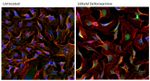
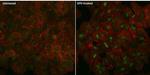
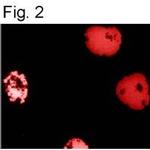
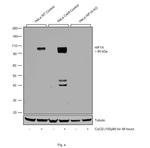
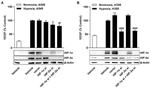
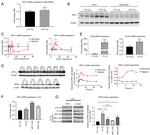
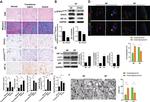
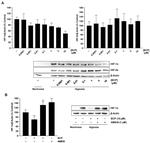
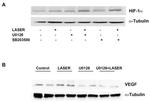
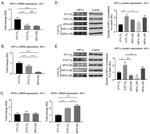
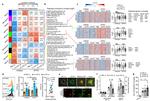
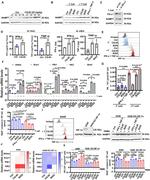
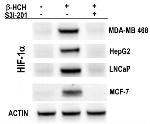
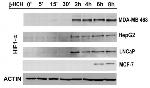
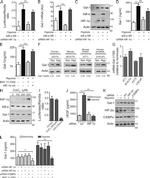
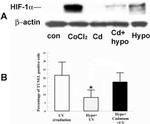
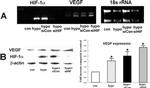
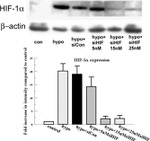
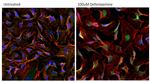
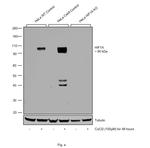
Please note: We are reviewing Western blot images included in the antibody testing data in our catalog, including those provided by third parties. Unless expressly labeled or annotated as “raw-unedited”, Western blot images included in the antibody testing data in our catalog may have been edited, optimized or otherwise adjusted for presentation.







产品信息
MA1-516
应用
建议稀释比
已发表文章
产品规格
种属反应
Bovine,
Human,
Mouse,
Non-human primate,
Pig
已发表种属
Bovine,
Human,
Mouse,
Rabbit,
Rat
宿主/亚型
Mouse
/ IgG1
分类
Monoclonal
类型
Antibody
克隆号
mgc3
抗原
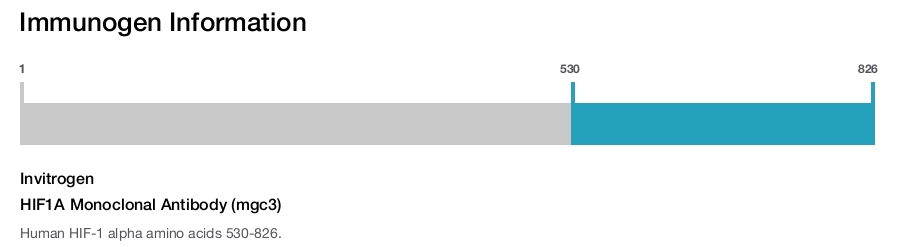
Human HIF-1 alpha amino acids 530-826.
偶联物
Unconjugated
Unconjugated
Unconjugated
形式
Liquid
浓度
1 mg/mL
规格
100 µg
纯化类型
Protein A
保存液
PBS, pH 7.4, with 1mg/mL BSA
内含物
0.05% sodium azide
保存条件
-20°C, Avoid Freeze/Thaw Cycles
运输条件
Ambient (domestic); Wet ice (international)
RRID
产品详细信息
MA1-516 detects hypoxia-inducible factor 1 alpha (HIF-1 alpha) from human, non-human primate, bovine, mouse and porcine cells. This antibody does not cross-react with ARNT or the related HIF-2 alpha.
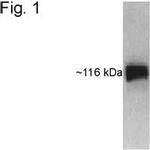
MA1-516 has been successfully used in Western blot, immunofluorescence, immunoprecipitation, immunocytochemistry, and gel shift procedures. By Western blot, this antibody detects an ~116 kDa protein representing HIF-1 alpha after hypoxic induction in COS cells. Immunofluorescence staining of HIF-1 alpha in COS-7 cells with MA1-516 yields nuclear staining after exposing cells to 1% oxygen for 4 hours. In gel shift assays, MA1-516 has been successfully used only with mouse HIF-1 alpha.
Antibodies to this protein (and modification) were previously sold as part of a Thermo Scientific Cellomics High Content Screening Kit. This replacement antibody is now recommended for researchers who need an antibody for high content cell based assays. It has been thoroughly tested and validated for cellular immunofluorescence (IF) applications. Further optimization including the selection of the most appropriate fluorescent Dylight conjugated secondary antibody may have to be performed for your high content assay.
靶标信息
HIF1-alpha (HIF1A) is a subunit of HIF1, which is a transcription factor found in mammalian cells cultured under reduced oxygen tension. HIF-1 is a heterodimer consisting of an alpha and beta subunit, both belonging to the basic-helix-loop-helix Per-aryl hydrocarbon receptor nuclear translocator-Sim (PAS) family of transcription factors. HIF1 functions as a transcriptional regulator of the adaptive response to hypoxia. Under hypoxic conditions, HIF-1 activates the transcription of over 40 genes, including erythropoietin, glucose transporters, glycolytic enzymes, vascular endothelial growth factor, HILPDA, and other genes whose protein products increase oxygen delivery or facilitate metabolic adaptation to hypoxia. HIF1-alpha regulates hypoxia-mediated apoptosis, cell proliferation and tumor angiogenesis. Hypoxia which induces p53 protein accumulation, directly interacts with HIF1-alpha and reduces hypoxia-induced expression of HIF1-alpha by promoting MDM2-mediated ubiquitination and proteasomal degradation under hypoxic conditions. Recent studies suggest that induction of NOX4 by HIF1-alpha contributes to maintain ROS levels after hypoxia and hypoxia-induced proliferation. In humans, it is located on the q arm of chromosome 14. The C-terminal of HIF1A binds to p300. p300/CBP-HIF complexes participate in the induction of hypoxia-responsive genes, including VEGF. Hypoxia contributes significantly to the pathophysiology of major categories of human disease, including myocardial and cerebral ischemia, cancer, pulmonary hypertension, congenital heart disease and chronic obstructive pulmonary disease.
仅用于科研。不用于诊断过程。未经明确授权不得转售。
生物信息学
蛋白别名: ARNT interacting protein; ARNT-interacting protein; ARNT2; basic-helix-loop-helix-PAS protein MOP1; class E basic helix-loop-helix protein 78; HIF; hif 1; hif 1a; HIF-1-alpha; HIF-1alpha 786; HIF1-alpha; hypoxia inducible factor 1 alpha subunit; hypoxia inducible factor 1, alpha subunit (basic helix-loop-helix transcription factor); hypoxia-inducible factor 1 alpha; hypoxia-inducible factor 1, alpha subunit (basic helix-loop-helix transcription factor); hypoxia-inducible factor1alpha; member of PAS protein 1; member of PAS superfamily 1; PAS domain-containing protein 8; transcription factor; transcription factor; hypoxia-inducible factor 1a; unnamed protein product
基因别名: bHLHe78; HIF-1-alpha; HIF-1A; HIF-1alpha; HIF1; HIF1-ALPHA; HIF1alpha; MOP1; PASD8
UniProt ID: (Human) Q16665, (Mouse) Q61221
Entrez Gene ID: (Bovine) 281814, (Human) 3091, (Pig) 396696, (Mouse) 15251
transcription factor activity, sequence-specific DNA binding
histone acetyltransferase binding
sequence-specific DNA binding
protein heterodimerization activity
RNA polymerase II regulatory region sequence-specific DNA binding
RNA polymerase II core promoter proximal region sequence-specific DNA binding
RNA polymerase II transcription factor activity, sequence-specific DNA binding
core promoter proximal region sequence-specific DNA binding
bacterial-type RNA polymerase transcriptional activator activity, sequence-specific DNA binding
bacterial-type RNA polymerase transcriptional repressor activity, sequence-specific DNA binding
transcription corepressor binding
transcription coactivator binding
transcriptional activator activity, RNA polymerase II transcription regulatory region sequence-specific binding
p53 binding
DNA binding
protein binding
ligand-dependent nuclear receptor binding
enzyme binding
protein kinase binding
protein domain specific binding
ubiquitin protein ligase binding
histone deacetylase binding
protein dimerization activity
Hsp90 protein binding
RNA polymerase II sequence-specific DNA binding transcription factor binding
E-box binding
transcription regulator activator activity
macromolecular complex binding
basic helix-loop-helix transcription factor
response to hypoxia
positive regulation of vascular endothelial growth factor production
axonal transport of mitochondrion
positive regulation of transcription, DNA-templated
positive regulation of transcription from RNA polymerase II promoter
positive regulation of transcription from RNA polymerase II promoter in response to hypoxia
cellular response to hypoxia
response to reactive oxygen species
cellular glucose homeostasis
epithelial to mesenchymal transition
positive regulation of endothelial cell proliferation
connective tissue replacement involved in inflammatory response wound healing
regulation of glycolytic process
regulation of transcription, DNA-templated
regulation of transcription from RNA polymerase II promoter
signal transduction
response to iron ion
regulation of gene expression
vascular endothelial growth factor production
positive regulation of gene expression
negative regulation of gene expression
positive regulation of epithelial cell migration
negative regulation of ossification
positive regulation of vascular endothelial growth factor receptor signaling pathway
oxygen homeostasis
positive regulation of chemokine production
regulation of transforming growth factor beta2 production
collagen metabolic process
cellular response to oxidative stress
positive regulation of blood vessel endothelial cell migration
positive regulation of erythrocyte differentiation
positive regulation of angiogenesis
positive regulation of glycolytic process
positive regulation of hormone biosynthetic process
elastin metabolic process
positive regulation of chemokine-mediated signaling pathway
cellular response to interleukin-1
cellular response to virus
positive regulation of cytokine production involved in inflammatory response
negative regulation of pri-miRNA transcription from RNA polymerase II promoter
positive regulation of pri-miRNA transcription from RNA polymerase II promoter
negative regulation of oxidative stress-induced neuron intrinsic apoptotic signaling pathway
negative regulation of reactive oxygen species biosynthetic process
regulation of protein neddylation
negative regulation of transcription from RNA polymerase II promoter
angiogenesis
blood vessel development
neural crest cell migration
embryonic placenta development
B-1 B cell homeostasis
vasculature development
heart looping
positive regulation of neuroblast proliferation
outflow tract morphogenesis
cardiac ventricle morphogenesis
lactate metabolic process
cellular iron ion homeostasis
lactation
positive regulation of cell proliferation
visual learning
positive regulation of endothelial cell migration
response to muscle activity
positive regulation of macroautophagy
neural fold elevation formation
cerebral cortex development
cell differentiation
negative regulation of bone mineralization
negative regulation of TOR signaling
embryonic hemopoiesis
tube development
positive regulation of vascular wound healing
positive regulation of insulin secretion involved in cellular response to glucose stimulus
regulation of cell proliferation
hemoglobin biosynthetic process
glucose homeostasis
positive regulation of apoptotic process
negative regulation of apoptotic process
negative regulation of neuron apoptotic process
positive regulation of gluconeogenesis
negative regulation of vasoconstriction
negative regulation of growth
muscle cell cellular homeostasis
mitochondrial iron ion transport
animal organ development
blood vessel morphogenesis
digestive tract morphogenesis
camera-type eye morphogenesis
positive regulation of smooth muscle cell proliferation
tissue remodeling
regulation of catalytic activity
cartilage development
positive regulation of multicellular organismal process
intestinal epithelial cell maturation
response to fungicide
epithelial cell differentiation involved in mammary gland alveolus development
iris morphogenesis
retina vasculature development in camera-type eye
positive regulation of stress granule assembly
regulation of thymocyte apoptotic process
negative regulation of thymocyte apoptotic process
dopaminergic neuron differentiation
circulatory system development
hypoxia-inducible factor-1alpha signaling pathway
positive regulation of sprouting angiogenesis
negative regulation of mesenchymal cell apoptotic process
Disclaimer

Clicking the images or links will redirect you to a website hosted by BenchSci that provides third-party scientific content. Neither the content nor the BenchSci technology and processes for selection have been evaluated by us; we are providing them as-is and without warranty of any kind, including for use or application of the Thermo Fisher Scientific products presented.

