Search
Invitrogen
Human VEGFR3 (Flt-4) His-tag Recombinant Protein
{{$productOrderCtrl.translations['antibody.pdp.commerceCard.promotion.promotions']}}
{{$productOrderCtrl.translations['antibody.pdp.commerceCard.promotion.promocode']}}: {{promo.promoCode}} {{promo.promoTitle}} {{promo.promoDescription}}. {{$productOrderCtrl.translations['antibody.pdp.commerceCard.promotion.learnmore']}}
{{$ctrl.translations['antibody.pdp.skuNotes.additionalInformation']}}:

产品信息
RP-88182
应用
建议稀释比
已发表文章
产品规格
种属
Human
Expression System
HEK293 cells
氨基酸序列
Human VEGFR3, amino acids Met1-Ile776 (Accession # NP_002011.2) with a C-terminal His-tag
标签
His-tag
分子量
130 kDa
分类
Recombinant
类型
Protein
纯度
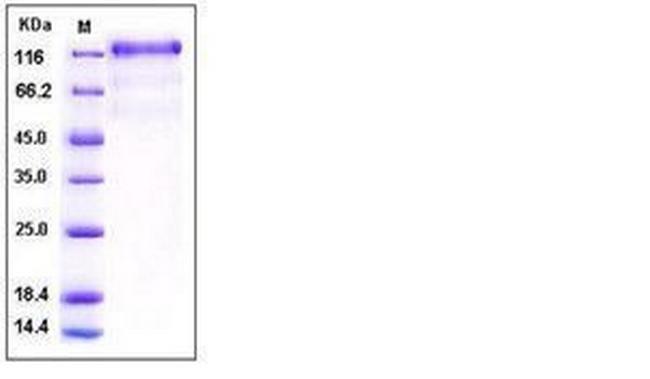
>97% as determined by SDS-PAGE.
内毒素浓度
<1.0 EU/µg
活性
1. Measured by its binding ability in a functional ELISA. 2. Immobilized human VEGF-C at 10 µg/mL (100 µL/well) can bind human VEGFR3-his. The EC50 of human VEGFR3-his is 0.011 µg/mL.
偶联物
Unconjugated
Unconjugated
Unconjugated
形式
Lyophilized
Amount
1 mg
纯化类型
purified
保存液
PBS, pH 7.4, with 5% mannitol, 5% trehalose, 0.01% Tween 80
内含物
no preservative
保存条件
-20°C, Avoid Freeze/Thaw Cycles
运输条件
Wet ice
产品详细信息
It is recommended that the protein be aliquoted for optimal storage.
Predicts a molecular mass of 86 kDa. As a result of glycosylation, rhVEGFR3 migrates as an approximately 130 kDa in non-reduced SDS-PAGE.
Reconstituted with sterile deionized water to 0.25 mg/mL
Concentration is measured by UV.
靶标信息
Vascular endothelial growth factor is a key regulator of blood vessel development in embryos and angiogenesis in adult tissues. Unlike VEGF, the related VEGFC stimulates the growth of lymphatic vessels through its specificl ymphatic endothelial receptor VEGFR-3. In 1998, Dumont showed that targeted inactivation of the VEGFR-3 gene in mice resulted in defective blood vessel development in early embryos. Vasculogenesis and angiogenesis occurred, but large vessels became abnormally organized with defective lumens, leading to fluid accumulation in the pericardial cavity and cardiovascular failure at embryonic day 9.5. Thus, VEGFR3 has an essential role in the development of theembryonic cardiovascular system before the emergence of the lymphatic vessels.
仅用于科研。不用于诊断过程。未经明确授权不得转售。
篇参考文献 (0)
您是否在文献中引用过该产品?请点击下方按钮邮件告知我们。
生物信息学
蛋白别名: alternatively spliced; Feline McDonough Sarcoma (FMS)-like tyrosine kinase 4; fms related tyrosine kinase 4; fms-like tyrosine kinase 4; primary congenital lymphedema; soluble VEGFR 3; sVEGFR 3; tyrosine-protein kinase receptor FLT4; unnamed protein product; VEGF R3; VEGF receptor-3
基因别名: CHTD7; FLT-4; FLT41; LMPH1A; LMPHM1; PCL; VEGFR-3; VEGFR3
UniProt ID: (Human) P35916
Entrez Gene ID: (Human) 2324
Disclaimer

Clicking the images or links will redirect you to a website hosted by BenchSci that provides third-party scientific content. Neither the content nor the BenchSci technology and processes for selection have been evaluated by us; we are providing them as-is and without warranty of any kind, including for use or application of the Thermo Fisher Scientific products presented.
