Search


引用和文献 (4)
Invitrogen™
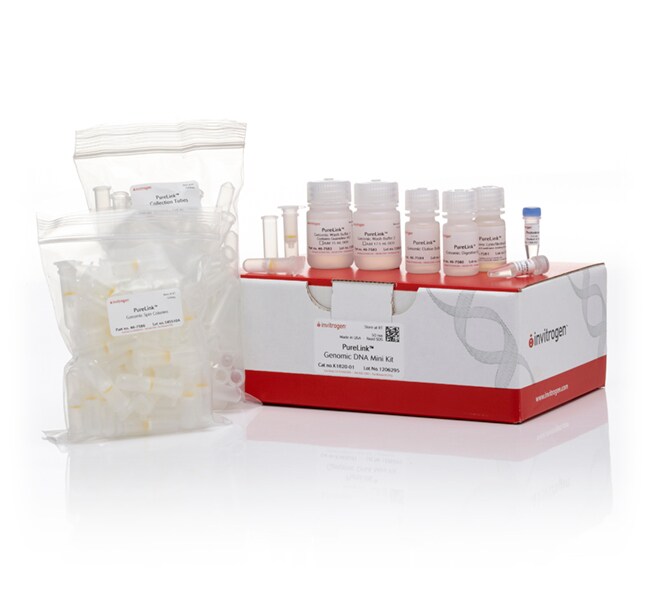
PureLink™ 基因组 DNA 小提试剂盒
PureLink™ 基因组 DNA 小提试剂盒可从多种样品类型中进行高得率、高纯度的基因组 DNA (gDNA) 提取。使用这种单一试剂盒可通过熟悉的硅胶微量离心机离心柱规格从血液、组织了解更多信息
Have Questions?
更改视图

| 货号 | 数量 |
|---|---|
| K182001 | 50 次制备 |
| K182000 | 10 次制备 |
| K182002 | 250 次反应 |
货号 K182001
价格(CNY)
1,431.00
飞享价
Ends: 31-Dec-2026
1,789.00共减 358.00 (20%)
Each
数量:
50 次制备
价格(CNY)
1,431.00
飞享价
Ends: 31-Dec-2026
1,789.00共减 358.00 (20%)
Each
PureLink™ 基因组 DNA 小提试剂盒可从多种样品类型中进行高得率、高纯度的基因组 DNA (gDNA) 提取。使用这种单一试剂盒可通过熟悉的硅胶微量离心机离心柱规格从血液、组织、细胞、细菌、拭子和血斑中纯化基因组 DNA。PureLink™ 基因组 DNA 小提试剂盒的特点包括:
•试剂盒灵活性—一个试剂盒可用于多种样品类型和规格
• 超净 gDNA—DNA 产物的污染极少,意味着成功的下游应用
• 改进的设计—优化的离心柱设计和缓冲液配方,可获得更佳的得率和纯度
多个样品源,一个试剂盒
PureLink™ 基因组 DNA 小提试剂盒可用于与多种不同的样品类型配合使用,每种样品类型都有手册中列出的自身优化方案。
优化的组分和方案
PureLink™ 基因组 DNA 小提试剂盒所包含的部件和方案根据目前正在使用的简单、常见的离心柱方法进行了改进(见图)。色谱柱是新配置的,可以更有效地结合和释放 DNA(见图)。每个样品源使用专门的裂解程序和优化的裂解缓冲液,该缓冲液配方可增强蛋白酶 K 活性并消除蛋白污染。离液盐缓冲液可促进 DNA 与色谱柱树脂的稳定结合,强效的洗涤缓冲液可去除所有痕量蛋白和盐。DNA 在低盐缓冲液中洗脱,以便储存中的 DNA pH 值稳定。
更高得率和纯度
使用 PureLink™ 基因组 DNA 试剂盒,无论样品类型如何(从细菌到组织到血液到培养细胞),均可预期获得高得率的高纯度 gDNA(通过 A260/A280 测量确定)(见图)。增强型 PureLink™ 裂解和洗涤缓冲液有助于一致地递送纯化的 gDNA 样品,A260/A280 和 A260/A230 吸光度读数比均为 ∼1.9,表明无可检出的蛋白或胍残留污染(如图所示)。
•试剂盒灵活性—一个试剂盒可用于多种样品类型和规格
• 超净 gDNA—DNA 产物的污染极少,意味着成功的下游应用
• 改进的设计—优化的离心柱设计和缓冲液配方,可获得更佳的得率和纯度
多个样品源,一个试剂盒
PureLink™ 基因组 DNA 小提试剂盒可用于与多种不同的样品类型配合使用,每种样品类型都有手册中列出的自身优化方案。
优化的组分和方案
PureLink™ 基因组 DNA 小提试剂盒所包含的部件和方案根据目前正在使用的简单、常见的离心柱方法进行了改进(见图)。色谱柱是新配置的,可以更有效地结合和释放 DNA(见图)。每个样品源使用专门的裂解程序和优化的裂解缓冲液,该缓冲液配方可增强蛋白酶 K 活性并消除蛋白污染。离液盐缓冲液可促进 DNA 与色谱柱树脂的稳定结合,强效的洗涤缓冲液可去除所有痕量蛋白和盐。DNA 在低盐缓冲液中洗脱,以便储存中的 DNA pH 值稳定。
更高得率和纯度
使用 PureLink™ 基因组 DNA 试剂盒,无论样品类型如何(从细菌到组织到血液到培养细胞),均可预期获得高得率的高纯度 gDNA(通过 A260/A280 测量确定)(见图)。增强型 PureLink™ 裂解和洗涤缓冲液有助于一致地递送纯化的 gDNA 样品,A260/A280 和 A260/A230 吸光度读数比均为 ∼1.9,表明无可检出的蛋白或胍残留污染(如图所示)。
仅供科研使用。不可用于诊断程序。
规格
适用于(应用)基因分型、实时荧光定量 PCR (qPCR)、Southern 印迹、测序、PCR
高通量能力不兼容高通量应用(手动)
制备规模100 µL - 1 mL 血样(中等规模)
产品线PureLink
产品类型基因组 DNA 迷你试剂盒
数量50 次制备
样品类型细菌, 血液, 细胞, 组织
规格小型
运输条件室温
靶标基因组 DNA 纯化
分离技术离心柱
Unit SizeEach
内容与储存
• 10 mL PureLink™ 基因组裂解/结合缓冲液
• 9 mL PureLink™ 基因组酶切缓冲液
• 10 mL PureLink™ 基因组洗涤缓冲液 1
• 7.5 mL PureLink™ 基因组洗涤缓冲液 2
• 10 mL PureLink™ 基因组洗脱缓冲液
• 1 mL RNase A (20 mg/mL)
• 1 mL 蛋白酶 K (20 mg/mL)
• 50 个 PureLink™ 离心柱(含收集管)
• 100 个 PureLink™ 收集管 (2.0 mL)
本试剂盒包含足以进行 50 次 DNA 制备的试剂。将所有组分储存在室温下。对于长期储存,蛋白酶 K 和 RNase A 可储存在 4°C 下。
• 9 mL PureLink™ 基因组酶切缓冲液
• 10 mL PureLink™ 基因组洗涤缓冲液 1
• 7.5 mL PureLink™ 基因组洗涤缓冲液 2
• 10 mL PureLink™ 基因组洗脱缓冲液
• 1 mL RNase A (20 mg/mL)
• 1 mL 蛋白酶 K (20 mg/mL)
• 50 个 PureLink™ 离心柱(含收集管)
• 100 个 PureLink™ 收集管 (2.0 mL)
本试剂盒包含足以进行 50 次 DNA 制备的试剂。将所有组分储存在室温下。对于长期储存,蛋白酶 K 和 RNase A 可储存在 4°C 下。
常见问题解答 (FAQ)
我想分离细菌的基因组DNA,该如何操作?
I want to isolate genomic DNA from bacteria. How do I do this?
Do you offer a kit that will allow me to sequentially isolate gDNA and total RNA from my tissue sample that is not an FFPE (formalin-fixed, paraffin-embedded) sample?
With the Oncomine BRCA Research Assay, which method do you recommend for isolating gDNA?
引用和文献 (4)
引用和文献
Abstract
Induced pluripotent stem cells from individuals with recessive dystrophic epidermolysis bullosa.
Journal:J Invest Dermatol
PubMed ID:21124339
'Recessive dystrophic epidermolysis bullosa (RDEB) is an inherited blistering skin disorder caused by mutations in the COL7A1 gene-encoding type VII collagen (Col7), the major component of anchoring fibrils at the dermal-epidermal junction. Individuals with RDEB develop painful blisters and mucosal erosions, and currently, there are no effective forms of therapy.
HBx genotype D represses GSTP1 expression and increases the oxidative level and apoptosis in HepG2 cells.
Journal:Mol Oncol
PubMed ID:19383368
'Epigenetics has been implicated in human cancer development. Epigenetic factors include HBx protein, which is able to induce hypermethylation and suppresses tumor suppressor genes. One of such tumor suppressor genes, GSTP1, shows reduced expression in many human cancers. Hypermethylation of GSTP1 is the most studied mechanism of its silence. In
Hematopoietic differentiation of induced pluripotent stem cells from patients with mucopolysaccharidosis type I (Hurler syndrome).
Journal:Blood
PubMed ID:21037085
Mucopolysaccharidosis type I (MPS IH; Hurler syndrome) is a congenital deficiency of a-L-iduronidase, leading to lysosomal storage of glycosaminoglycans that is ultimately fatal following an insidious onset after birth. Hematopoietic cell transplantation (HCT) is a life-saving measure in MPS IH. However, because a suitable hematopoietic donor is not found for
Pathways for ATP release by bovine ciliary epithelial cells, the initial step in purinergic regulation of aqueous humor inflow.
Journal:Am J Physiol Cell Physiol
PubMed ID:20926783
ATP release by nonpigmented (NPE) and pigmented (PE) ciliary epithelial cells is the enabling step in purinergic regulation of aqueous humor formation, but the release pathways are unknown. We measured ATP release from primary cultures of bovine mixed NPE and PE (bCE) cells and transformed bovine NPE and PE cells,