Search
Invitrogen
TALK-1 Polyclonal Antibody
{{$productOrderCtrl.translations['antibody.pdp.commerceCard.promotion.promotions']}}
{{$productOrderCtrl.translations['antibody.pdp.commerceCard.promotion.promocode']}}: {{promo.promoCode}} {{promo.promoTitle}} {{promo.promoDescription}}. {{$productOrderCtrl.translations['antibody.pdp.commerceCard.promotion.learnmore']}}
{{$ctrl.translations['antibody.pdp.skuNotes.additionalInformation']}}:
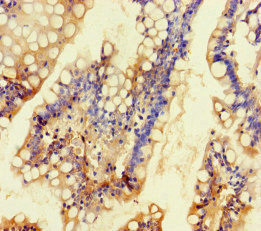
Please note: We are reviewing Western blot images included in the antibody testing data in our catalog, including those provided by third parties. Unless expressly labeled or annotated as “raw-unedited”, Western blot images included in the antibody testing data in our catalog may have been edited, optimized or otherwise adjusted for presentation.


产品信息
PA5-144235
产品规格
种属反应
Human
宿主/亚型
Rabbit
/ IgG
分类
Polyclonal
类型
Antibody
抗原
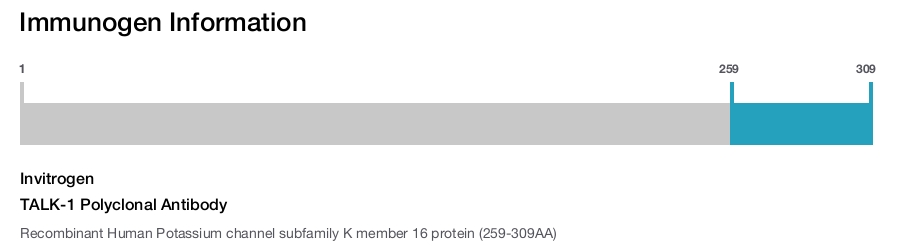
Recombinant Human Potassium channel subfamily K member 16 protein (259-309AA)
偶联物
Unconjugated
Unconjugated
Unconjugated
形式
Liquid
浓度
3.5 mg/mL
规格
100 µg
纯化类型
Protein G
保存液
PBS, pH 7.4, with 50% glycerol
内含物
0.03% Proclin 300
保存条件
-20°C or -80°C if preferred
运输条件
Ambient (domestic); Wet ice (international)
RRID
靶标信息
The KCNK16 gene encodes the TALK-1 channel, an abundant K+ channel transcript found in mouse and in human Beta-cells. There are four human TALK-1 transcript variants, including two that form functional K+ channels (TALK-1a (transcript variant 2) and TALK1-b (transcript variant 3). The TALK-1 structure includes 4 transmembrane domains, 2 extracellular loops, and intracellular N- and C-termini. The C-terminal tail of TALK-1 is a critical component that influences the magnitude of TALK-1 channel activation, while the N-terminus is important for protein interaction. TALK-1, two-pore domain K+ (K2p 16.1) channel is responsible for modulating glucose stimulated insulin secretion that relies on Beta-cell CA2+ influx. The channel produces outwardly rectifying, non-inactivating K+ currents, which are enhanced by elevations in extracellular pH. TALK-1 is thus pH-sensitive, with increased activity under alkaline conditions. In addition, it can be activated by singlet oxygen and nitric oxide.
仅用于科研。不用于诊断过程。未经明确授权不得转售。
篇参考文献 (0)
您是否在文献中引用过该产品?请点击下方按钮邮件告知我们。
生物信息学
蛋白别名: 2P domain potassium channel Talk-1; pancreatic potassium channel Talk-1; potassium channel, subfamily K, member 16; potassium channel, two pore domain subfamily K, member 16; TWIK-related alkaline pH-activated K(+) channel 1; two-pore-domain potassium channel subunit
基因别名: K2p16.1; TALK-1; TALK1
UniProt ID: (Human) Q96T55
Entrez Gene ID: (Human) 83795
potassium ion transport
endoplasmic reticulum calcium ion homeostasis
regulation of membrane potential
regulation of release of sequestered calcium ion into cytosol
regulation of insulin secretion involved in cellular response to glucose stimulus
potassium ion transmembrane transport
membrane repolarization during action potential
regulation of action potential
Disclaimer

Clicking the images or links will redirect you to a website hosted by BenchSci that provides third-party scientific content. Neither the content nor the BenchSci technology and processes for selection have been evaluated by us; we are providing them as-is and without warranty of any kind, including for use or application of the Thermo Fisher Scientific products presented.

