Search
Alomone Labs, LTD
TNF Receptor I (extracellular) Polyclonal Antibody
{{$productOrderCtrl.translations['antibody.pdp.commerceCard.promotion.promotions']}}
{{$productOrderCtrl.translations['antibody.pdp.commerceCard.promotion.promocode']}}: {{promo.promoCode}} {{promo.promoTitle}} {{promo.promoDescription}}. {{$productOrderCtrl.translations['antibody.pdp.commerceCard.promotion.learnmore']}}
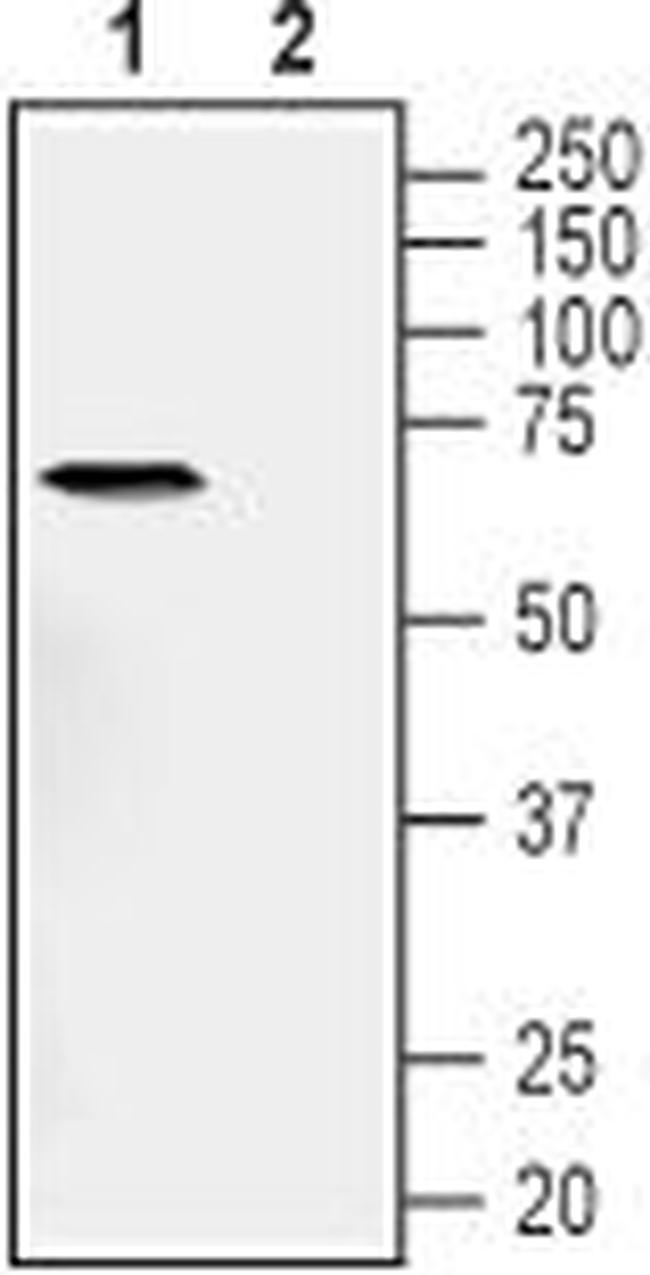
图: 1 / 3
TNF Receptor I (extracellular) Antibody (ANT-041-200UL) in WB
Western blot analysis of human PANC-1 pancreas ductal adenocarcinoma cell line lysate: - 1. Anti-Human TNF Receptor I (extracellular) Antibody (#ANT-041), (1:200). 2. Anti-Human TNF Receptor I (extracellular) Antibody , preincubated with Human TNF Receptor I (extracellular) Blocking Peptide (#BLP-NT041).
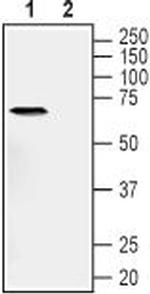
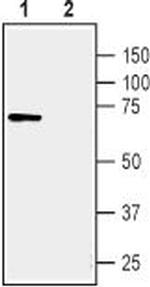
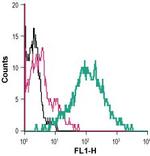
Please note: We are reviewing Western blot images included in the antibody testing data in our catalog, including those provided by third parties. Unless expressly labeled or annotated as “raw-unedited”, Western blot images included in the antibody testing data in our catalog may have been edited, optimized or otherwise adjusted for presentation.


产品信息
ANT-041-200UL
产品规格
种属反应
Human
宿主/亚型
Rabbit
/ IgG
分类
Polyclonal
类型
Antibody
抗原
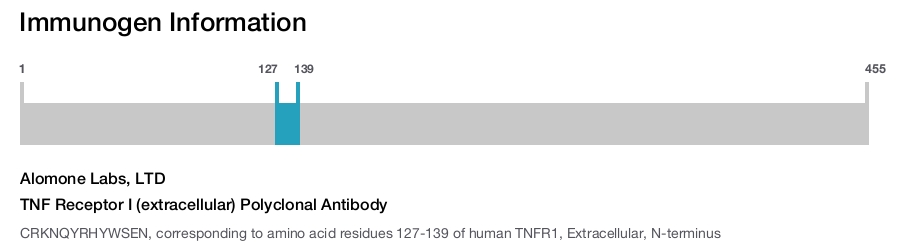
CRKNQYRHYWSEN, corresponding to amino acid residues 127-139 of human TNFR1, Extracellular, N-terminus
偶联物
Unconjugated
Unconjugated
Unconjugated
形式
Lyophilized
浓度
0.8 mg/mL
规格
160 µg
纯化类型
Antigen affinity chromatography
保存液
PBS, pH 7.4, with 1% BSA
内含物
0.05% sodium azide
保存条件
-20°C, Avoid Freeze/Thaw Cycles
运输条件
Ambient (domestic); Wet ice (international)
产品详细信息
Reconstitution: 25 µL, 50 µL or 0.2 mL double distilled water (DDW), depending on the sample size. The antibody ships as a lyophilized powder at room temperature. Upon arrival, it should be stored at -20C. The reconstituted solution can be stored at 4C for up to 1 week. For longer periods, small aliquots should be stored at -20C. Avoid multiple freezing and thawing. Centrifuge all antibody preparations before use (10000 x g 5 min).
靶标信息
TNFR1 (Tumor necrosis factor receptor 1) belongs to the tumor necrosis factor superfamily, and is one of the major TNF-alpha receptors. TNFR1 plays an important role in mediating, in cytokine mediated signaling, positive regulation of the NF-Kb pathway, positive regulation of angiogenesis, and negative regulation of gene expression. The extracellular domain of TNFR1 is also released into the circulatory system as soluble TNFR1 (sTNFR1). In humans, the TNFR1 gene is located on chromosome 12. Anti-apoptotic protein BCL2-associated athanogene 4 (BAG4/SODD) and adaptor proteins TRADD and TRAF2 have been shown to interact with TNFR1, and thus play regulatory roles in the signal transduction mediated by the receptor. Germline mutations of the extracellular domains of TNFR1 were found to be associated with the autosomal dominant periodic fever syndrome, and the impaired receptor clearance is thought to be a mechanism of the disease.
仅用于科研。不用于诊断过程。未经明确授权不得转售。
篇参考文献 (0)
您是否在文献中引用过该产品?请点击下方按钮邮件告知我们。
生物信息学
蛋白别名: CD120a antigen; MGC19588; n-smase activation assoc. factor; p62; p63; sCD120a; soluble CD120a; soluble TNFR1; sTNF RI; sTNFR I; sTNFR1; sTNFRI; TNF alpha gene; TNF-R1; TNF-RI; TNFR; TNFR I; TNFR-I; TNFR1 beta; tumor necrosis factor binding protein 1; Tumor necrosis factor receptor; tumor necrosis factor receptor type 1; tumor necrosis factor-alpha receptor; unnamed protein product
基因别名: CD120a; FPF; p55; p55-R; p60; TBP1; TNF-R; TNF-R-I; TNF-R55; TNFAR; TNFR1; TNFR55; TNFR60
UniProt ID: (Human) P19438
Entrez Gene ID: (Human) 7132
aortic valve development
pulmonary valve development
negative regulation of extracellular matrix constituent secretion
prostaglandin metabolic process
apoptotic process
inflammatory response
signal transduction
activation of NF-kappaB-inducing kinase activity
JAK-STAT cascade
extrinsic apoptotic signaling pathway via death domain receptors
intrinsic apoptotic signaling pathway in response to DNA damage
gene expression
regulation of gene expression
negative regulation of cardiac muscle hypertrophy
cytokine-mediated signaling pathway
tumor necrosis factor-mediated signaling pathway
positive regulation of I-kappaB kinase/NF-kappaB signaling
positive regulation of transcription from RNA polymerase II promoter
astrocyte activation
negative regulation of inflammatory response
positive regulation of inflammatory response
regulation of developmental process
regulation of multicellular organismal process
establishment of blood-brain barrier
cellular response to lipopolysaccharide
cellular response to mechanical stimulus
protein localization to plasma membrane
positive regulation of execution phase of apoptosis
positive regulation of apoptotic process involved in morphogenesis
regulation of establishment of endothelial barrier
Disclaimer

Clicking the images or links will redirect you to a website hosted by BenchSci that provides third-party scientific content. Neither the content nor the BenchSci technology and processes for selection have been evaluated by us; we are providing them as-is and without warranty of any kind, including for use or application of the Thermo Fisher Scientific products presented.

