Search
用合适的滤光片捕获荧光信号
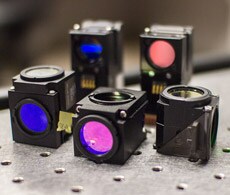
Filters help you control light during imaging
By placing filters in various spots in your epifluorescence microscope, you can define the wavelengths of light that excite your sample and the wavelengths that you detect in the fluorescence emission.
Learn about various filters used in epifluorescence imaging.
Why fluorescence microscopy uses filters
For epifluorescence microscopes, the excitation filter, dichroic beam-splitter, and emission filter will usually all be housed in the same cube and will be designed to match the spectra of a specific fluorophore or fluorescent protein. Occasionally the filters will not be in a cube, but will be on a wheel, referred to as a turret. Turrets allow you to mix and match your excitation and emission wavelengths. The ultimate goal is to collect the light you want from the fluorophore bound to your target and not any light from other parts of the system (ambient light, excitation source, etc.). We refer to unwanted light that makes it to the detector as background fluorescence.
The different kinds of filters used in epifluorescence imaging
In general, a filter set will be designed to capture the maximum excitation and emission wavelengths of a given fluorophore, but will not capture all of the fluorescence. Most modern filter sets are designed so that the excitation filter has a defined band of wavelengths that it allows through. This style of filter is referred to as a band-pass filter. Band-pass filters are normally identified by the middle-value wavelength and the width of a band. In a simple epifluorescence microscope setup, once the excitation light leaves the excitation filter it is reflected onto the target. The fluorophores in the target become excited and then emit light that is shifted towards the red end of the spectrum (compared to the excitation light). Not all of this emitted light will be captured by the detector—only what is allowed through the dichroic beam-splitter and also passes through the emission filter. Emission filters are usually band-pass or long-pass filters, depending on the specific fluorophore and imaging experiment. A long-pass filter may be desirable if you need all the light beyond a certain wavelength to pass through to the detector.

Figure 1. Excitation and emission spectra of a nuclear dye (DAPI) overlaid with the range of wavelengths passed through the filters for excitation (purple box) and emission (blue box). The black line depicts the transmission of the dichroic filter.
 | 滤光片可帮助您在成像时控制光线将滤光片组放在荧光显微镜的不同光点上,即可设定激发样品的光线波长,以及在荧光发射时检测到的波长。 详细了解荧光成像中使用的各种滤光片。 |
为何荧光显微镜需要使用滤光片
就荧光显微镜而言,激发滤光片、二向分色镜以及发射滤光片通常包含在同一立方体内,通常被设计来匹配特定荧光团或荧光蛋白的光谱。偶尔情况下,滤光片也可能不在立方体内,但会安装在一个转轮(称为滤光片转盘)上。滤光片转盘使您可以混合搭配尽可能匹配所需要的激发和发射波长。其终极目标是捕获到您希望从结合靶标的荧光基团束上捕获的光信号,同时漏过系统其他部分的任何光线(环境光、激发光源等)。我们在这里提到的出现在检测仪上不想要的光线被称为背景荧光.
荧光成像使用的滤光片的不同类型
通常情况下,滤光片组被设计成可用于捕获指定荧光团的最大激发和发射波长,但不会捕获所有的荧光。多数现代化滤光片组的设计旨在确保激发滤光片只允许指定波长区间的光线通过。这种类型的滤光片称为带通滤光片(band-pass filter)。带通滤光片通常通过中间波长和区间宽度确定。在较为简单的荧光显微镜装置中,一旦激发光线离开激发滤光片,即会照射到靶标上,靶标上的荧光基团随即变为激发状态,然后发射向光谱的红外端(相对于激发光线)迁移的光线。并非所有此类发射光线都会被检测器捕获到——仅那些允许通过二向分色镜且能通过发射滤光片的光线。发射滤光片通常为带通滤光片或长通滤光片,具体取决于特定的荧光团和成像实验。如果您希望让超过特定波长的光线通过检测器,可选择长通滤光片.

图 1. 通过激发滤光片(紫框)和发射滤光片(蓝框)的波长范围的细胞核染料(DAPI)的激发和发射光谱。黑线表示穿过二向分色镜。
Overview of Filters and Light Sources
This video describes how fluorescence filters work and the various light sources used for fluorescence excitation.
 | 滤光片和光源概述本视频描述了荧光滤光片的工作原理以及荧光激发所采用的各种光源。立即观看 |
仅供科研使用,不可用于诊断目的。