Search
荧光的物理属性
Fluorescence is a function of light energy
Fluorescent molecules by definition absorb light at one color (wavelength) and emit it at another. The difference in colors is called the Stokes shift. The cameras used in fluorescence microscopy allow the detection of signal beyond the wavelengths our eyes can see.
Learn about the physical properties that define fluorescence, including wavelength, how energy relates to fluorescence and fluorescent colors, and what defines a fluorescent molecule's spectra.
 | 荧光是一种光学能量的功能根据自身的定义,荧光分子会吸收某一颜色(或波长)的光线并发射其他颜色(或波长)的光线。这种颜色上的差异被称为斯托克斯位移。荧光显微镜之中使用的照相机可以检测出波长超出我们肉眼可见范围的信号。 了解决定荧光性质的物理属性,包括波长、与荧光和荧光颜色有关的能量,以及决定荧光分子光谱的因素等。 |
Topics in this section
The visible spectrum of light
When we talk about light in microscopy, it is usually noted as wavelength, even though photons (the packets of energy that make light) can act as both particles and waves. Visible light, or light that we can see with our eyes, is usually in the range of 400–700 nm and encompasses all colors in the rainbow, with blues starting at around 400 nm and reds finishing at around 700 nm.

Figure 1. The electromagnetic spectrum, with visible wavelengths and their corresponding colors highlighted.
Range of detection in fluorescence microscopy
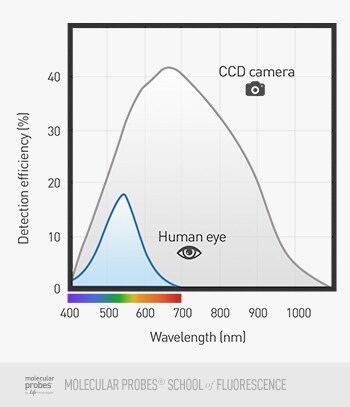
The range for fluorescence imaging extends a bit beyond where our eyes can see. Using this extended range is no problem because the CCD cameras that collect light emitted from our sample in a typical fluorescence microscopy setup have a wider range than our eyes do. In practical terms, imaging wavelengths for cell biology are usually in the range of 300–800 nm.
Figure 2. The range and efficiency of light detection for a CCD camera compared to that of the human eye.
What is fluorescence?
But what is special about the term fluorescence? Fluorescence refers to the physical property of an object absorbing light at one wavelength and then reemitting it at another wavelength. If a molecule absorbs the light of one wavelength and emits it in another (i.e., fluoresces), we call that molecule a fluorophore. Usually the wavelength the molecule emits will be lower energy than what it absorbed, so in simpler terms we could say that something absorbs blue light and emits green, or absorbs green light and emits red.
Further study: Watch "Introduction to Fluorescence"
Figure 3. The inverse relationship between energy and wavelength in the visible spectrum.

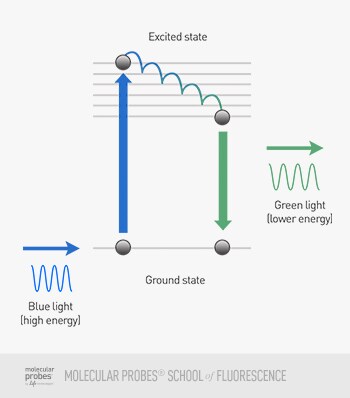
Figure 4. Simplified Jablonski diagram showing the energy state change of a fluorophore’s electron as it undergoes fluorescence, with the corresponding change in the color of light.
Where the fluorescent signal comes from
To understand this at a deeper level, we need to think about photons, the packets of energy that make up light. The magnitude of energy that a photon contains determines its color or, in physical terms, its wavelength. When the light (or photon) hits a fluorophore, the energy is transferred to the fluorophore’s electrons. The electrons are excited, but then rapidly lose that extra energy (that sounds like people too, doesn’t it?). The end result of this loss of energy is the emission of a photon of light, but that photon will have less energy than the original photon, so it will have a longer wavelength and be a different color. The emitted photons are the signal you need to collect as data during your imaging experiment.
Excitation and emission spectra
Most fluorophores don’t just absorb light at one discrete wavelength and emit light at another discrete wavelength: they usually absorb and emit a range of wavelengths. So when we think about using fluorophores in imaging, it’s useful to also think about the entire spectrum of their absorption and emission, while at the same time keeping in mind the maximum excitation and emission wavelengths. The maximum values are the peaks of the excitation and emission spectra.
Further study: Watch "Anatomy of Fluorescence Spectra"

Figure 5. Excitation and emission spectra of a nuclear dye (DAPI). Shows both the fraction of light absorbed by the dye over a range of wavelengths (excitation, shown in purple) as well as the light emitted from the dye over a range of wavelengths (emission, shown in blue).
The all-important Stokes shift
The difference between the excitation and emission maxima for a given fluorophore is called the Stokes shift. A fluorophore with a large Stokes shift will be much easier to use in your imaging then a fluorophore with a small Stokes shift. When there is only a small difference in wavelength between excitation and emission, it will be very difficult for you to see the emitted light from your labeled object as separate from the light used for excitation, and there will be more problems with background fluorescence.

Figure 6. A fluorophore with good separation between the excitation and emission maxima typically results in more reliable detection than a fluorophore with little separation. Compare the fluorophore with a large Stokes shift (purple and blue maximum peaks) to that of a fluorophore with a small Stokes shift (orange and red peaks).
可见光谱
在我们讨论显微镜中的光线时,通常会注明波长,尽管光量子(形成光线的能量团)同时以微粒和波动的形式存在。可见光或者说我们的肉眼能看见的光通常处于400–700 nm范围内,并且包含彩虹中的全部七种颜色(以约400 nm的蓝光开始,以约700 nm的红光结束)。

图1. 电磁光谱及其可见光波长及对应的颜色。
荧光显微镜的检测范围
 | 荧光成像的检测范围略微超出我们肉眼可见的范围。使用这一扩展范围的光线没有任何问题,因为在常规的荧光检测实验中采集样品发出光线的CCD照相机具有超出我们肉眼可见光范围的检测范围。实际上,细胞生物学成像波长范围通常介于300–800 nm之间。 图 2. CCD照相机与肉眼的光线检测范围和效率比较。 |
荧光是什么?
关于荧光这个术语有何特别之处?荧光指的是一种物体吸收特定波长的光线,然后再发射出其他波长的光线的物理性质。如果某种分子能够吸收某个波长的光线并发射另外一种波长的光线(即荧光),我们便将这种分子称为荧光团。通常情况下,该波长发射的光线能量都要低于其吸收的光线能量,因此简单来讲就是我们可以说,某些物体能够吸收蓝光发射出绿光,或者吸收绿光发射出红光。 深入研究课程:观看“荧光简介” 图 3. 可见光谱的能量与波长的反比关系。 |  |
图 4. 简化的贾布朗斯基图(Jablonski diagram),表明荧光团的电子在接收到荧光照射后,能量状态发生改变,同时光线的颜色也发生变化。 | 荧光信号的来源为了更深层次地理解这一部分内容,我们需要思考一下构成光线的能量微粒——光量子。光量子所含的能量等级决定了光线的颜色、物理形态及其波长。当某一束光线(光量子)射中荧光团之后,能量被传递到荧光团的电子上,电子受到激发,但很快就会失去多余的能量,结果就导致这部分损失的能量以光线光量子的形式发射出去,但这时候发出的光量子能量就要比原来的光量子低,因此波长变长,光线变为另一种颜色。在成像实验中,这部分发射的光量子就是您需要作为数据采集的信号。 |

激发和发射光谱
大多数荧光团并不单单吸收某个离散波长的光线并发射另一离散波长的光线:它们通常吸收和发射某个波长范围内的光线。因此在我们考虑成像使用的荧光时,最好还要考虑到它们的完整吸收和发射光谱,同时留意其最大激发波长和最大发射波长。所谓的最大值,即激发光谱和发射光谱的峰值。
深入研究课程: 观看“荧光光谱揭秘”

图 5. 细胞核染料(DAPI)的激发和发射光谱。图中显示了染料吸收的某个波长范围内的光线(激发,显示为紫色)以及染料发射某个波长范围内的光线(发射,显示为蓝色)。
至关重要的斯托克斯位移
指定荧光团的最大激发和发射光谱之间的差值被称为斯托克斯位移。相对于斯托克斯位移较小的荧光团,斯托克斯位移较大的荧光团更易于在成像实验中使用。当激发和发射光谱之间的差值很小时,很难从用于激发的光线中观察到标记对象上发射的光线,而且会存在更严重的背景荧光问题。

图 6. 相对于最大激发和发射光谱之间的间距较小的荧光团,间距较大的荧光团检测起来更可靠。将斯托克斯位移较大的荧光团(紫色和蓝色最大波长峰值)与斯托克斯位移较小的荧光团(橙色和红色波长峰值)相比较。
Introduction to Fluorescence
This video provides an easy to understand overview of the basic principles of fluorescence and is suitable for beginners or for those that need a quick refresh.
Anatomy of Fluorescence Spectra
This video describes the principle behind fluorescence spectra and how they can be used to determine properties of a fluorescent molecule.
 | 荧光简介本视频以通俗易懂的方式对荧光的基本原理进行了概述,适于荧光初学者或者希望快速回顾荧光知识的人士。立即观看 |
 | 荧光光谱揭秘本视频介绍了荧光光谱的原理以及如何利用荧光光谱测定荧光分子的性质。 立即观看 |
仅供科研使用,不可用于诊断目的。