Search
Additional Information:
{{banner.description}}
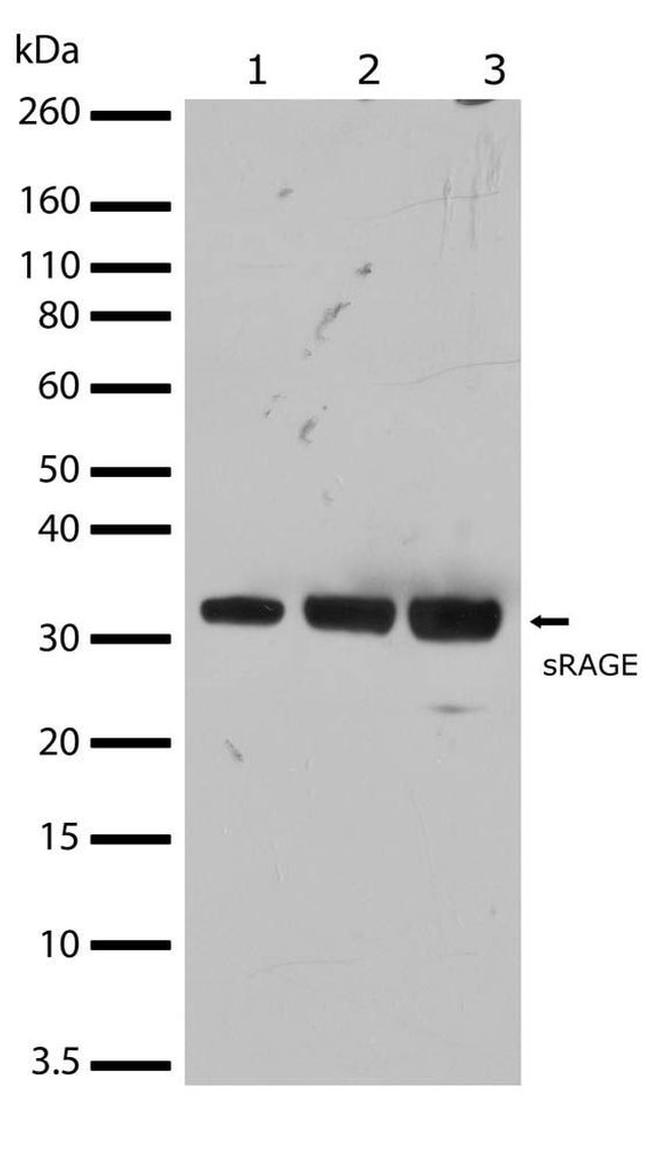
图: 1 / 1
RAGE Antibody (710339) in WB
Western blot analysis of RAGE in whole cell extracts from HepG2 (lane 1), Jurkat (lane2), and MDAMB-231 (lane3) cells using a RAGE Recombinant Rabbit Superclonal™ Antibody (Product # 710339) at a dilution of 2 µg/mL. Samples were detected using chemiluminescence (ECL). Results show a band at ~32kDa.
Please note: We are reviewing Western blot images included in the antibody testing data in our catalog, including those provided by third parties. Unless expressly labeled or annotated as “raw-unedited”, Western blot images included in the antibody testing data in our catalog may have been edited, optimized or otherwise adjusted for presentation.

产品信息
710339
产品规格
种属反应
Human
宿主/亚型
Rabbit
/ IgG
Expression System
Expi293
分类
Recombinant Superclonal
类型
Antibody
克隆号
17HCLC
抗原
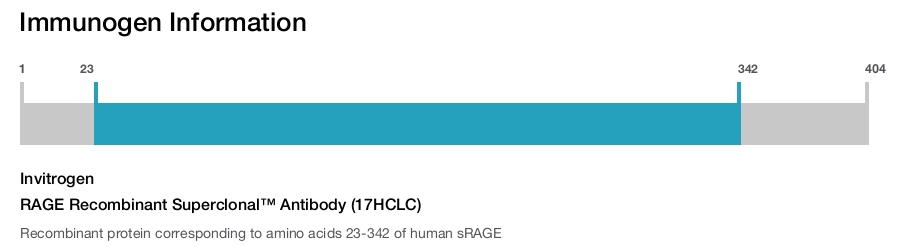
Recombinant protein corresponding to amino acids 23-342 of human sRAGE
偶联物
Unconjugated
Unconjugated
Unconjugated
形式
Liquid
浓度
0.5 mg/mL
规格
100 µg
纯化类型
Protein A
保存液
PBS, pH 7.2-7.4
内含物
0.09% sodium azide
保存条件
Store at 4°C short term. For long term storage, store at -20°C, avoiding freeze/thaw cycles.
运输条件
Wet ice
RRID
产品详细信息
This antibody is predicted to react with mouse, rat, non-human primate and rabbit based on sequence homology.
Recombinant rabbit Superclonal™ antibodies are unique offerings from Thermo Fisher Scientific. They are comprised of a selection of multiple different recombinant monoclonal antibodies, providing the best of both worlds - the sensitivity of polyclonal antibodies with the specificity of monoclonal antibodies - all delivered with the consistency only found in a recombinant antibody. While functionally the same as a polyclonal antibody - recognizing multiple epitope sites on the target and producing higher detection sensitivity for low abundance targets - a recombinant rabbit Superclonal™ antibody has a known mixture of light and heavy chains. The exact population can be produced in every lot, circumventing the biological variability typically associated with polyclonal antibody production. Note: Formerly called “Recombinant polyclonal antibody”, this product is now rebranded as “Recombinant Superclonal™ antibody”. The physical product and the performance remain unchanged.
靶标信息
The Receptor for Advanced Glycation End-products (RAGE) is a gene located on human chromosome 6p21.3, encoding a transmembrane receptor belonging to the immunoglobulin superfamily. RAGE is expressed in various tissues, with significant levels in the lungs, and plays a crucial role in cellular signaling and inflammation. As a receptor, RAGE binds multiple ligands, including advanced glycation end-products (AGEs), amyloid-beta peptide, high mobility group box 1 (HMGB1), and S100/calgranulin proteins, facilitating diverse pathological processes like inflammation, cancer progression, and neurodegeneration. The interaction between RAGE and its ligands triggers intracellular signaling pathways such as NF-kB activation, leading to inflammatory responses and oxidative stress. In the context of chronic diseases like diabetes, Alzheimer's, and cardiovascular diseases, RAGE is a critical mediator, linking metabolic disturbance to cellular dysfunction. Therapeutic targeting of RAGE signaling is under investigation, aiming to mitigate its contribution to inflammatory and degenerative diseases.
仅用于科研。不用于诊断过程。未经明确授权不得转售。
篇参考文献 (0)
您是否在文献中引用过该产品?请点击下方按钮邮件告知我们。
生物信息学
蛋白别名: advanced glycosylation end product receptor; advanced glycosylation end product-specific receptor; RAGE-4 ORF3; RAGEdelex2-6; RAGEdelex3; RAGEdelex3-10; RAGEdelex3-7; RAGEdelex8&int9; RAGEint4; RAGEint4&9; RAGEint9&delex11; RAGEv1; RAGEv8; receptor for advanced glycation end-products; soluble receptor; sRAGE; unnamed protein product
基因别名: RAGE; SCARJ1; sRAGE
UniProt ID: (Human) Q15109
Entrez Gene ID: (Human) 177
beta-amyloid binding
DNA binding
RNA binding
transmembrane signaling receptor activity
scavenger receptor activity
protein binding
signaling receptor activity
histone binding
identical protein binding
S100 protein binding
macromolecular complex binding
advanced glycation end-product receptor activity
binding, bridging
microglial cell activation
positive regulation of cytokine production
regulation of T cell mediated cytotoxicity
phagocytosis
inflammatory response
cell surface receptor signaling pathway
learning or memory
positive regulation of cell proliferation
response to wounding
glucose mediated signaling pathway
astrocyte development
regulation of cell adhesion
positive regulation of cell migration
neuron projection development
negative regulation of interleukin-10 production
positive regulation of chemokine production
positive regulation of interleukin-1 beta production
positive regulation of interleukin-12 production
positive regulation of interleukin-6 production
positive regulation of tumor necrosis factor production
positive regulation of heterotypic cell-cell adhesion
intracellular signal transduction
positive regulation of activated T cell proliferation
transcytosis
positive regulation of cell differentiation
positive regulation of JNK cascade
astrocyte activation
regulation of synaptic plasticity
regulation of inflammatory response
positive regulation of DNA metabolic process
negative regulation of multicellular organismal process
positive regulation of ERK1 and ERK2 cascade
cellular response to glucose stimulus
regulation of spontaneous synaptic transmission
transport across blood-brain barrier
regulation of long-term synaptic potentiation
negative regulation of long-term synaptic potentiation
negative regulation of long term synaptic depression
regulation of p38MAPK cascade
positive regulation of p38MAPK cascade
regulation of NIK/NF-kappaB signaling
positive regulation of NIK/NF-kappaB signaling
positive regulation of amyloid precursor protein catabolic process
negative regulation of blood circulation
positive regulation of endothelin production
response to amyloid-beta
cellular response to beta-amyloid
positive regulation of DNA-dependent DNA replication
positive regulation of monocyte extravasation
regulation of CD4-positive, alpha-beta T cell activation
positive regulation of double-strand break repair
positive regulation of dendritic cell differentiation
Disclaimer

Clicking the images or links will redirect you to a website hosted by BenchSci that provides third-party scientific content. Neither the content nor the BenchSci technology and processes for selection have been evaluated by us; we are providing them as-is and without warranty of any kind, including for use or application of the Thermo Fisher Scientific products presented.

