Search
Invitrogen
TPH1 Polyclonal Antibody
{{$productOrderCtrl.translations['antibody.pdp.commerceCard.promotion.promotions']}}
{{$productOrderCtrl.translations['antibody.pdp.commerceCard.promotion.viewpromo']}}
{{$productOrderCtrl.translations['antibody.pdp.commerceCard.promotion.promocode']}}: {{promo.promoCode}} {{promo.promoTitle}} {{promo.promoDescription}}. {{$productOrderCtrl.translations['antibody.pdp.commerceCard.promotion.learnmore']}}
Additional Information:
{{banner.description}}

图: 1 / 2
TPH1 Antibody (PA5-28929) in ICC/IF
Immunocytochemistry-Immunofluorescence analysis of Tryptophan Hydroxylase was performed in SK N SH cells fixed in 4% paraformaldehyde at RT for 15 min. Green: Tryptophan Hydroxylase Polyclonal Antibody (Product # PA5 28929) diluted at 1:1000. Blue: Hoechst 33342 staining. Scale bar = 10 µm.



产品信息
PA5-28929
产品规格
宿主/亚型
Rabbit
/ IgG
分类
Polyclonal
类型
Antibody
抗原
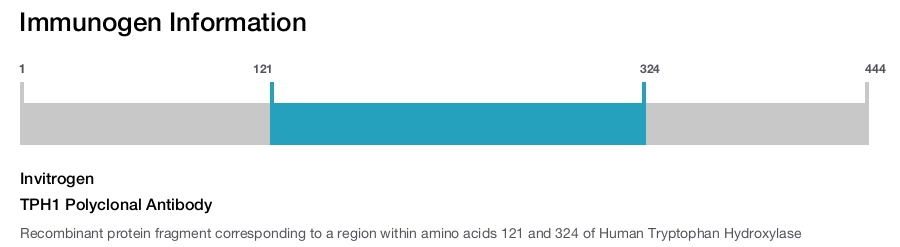
Recombinant protein fragment corresponding to a region within amino acids 121 and 324 of Human Tryptophan Hydroxylase
偶联物
Unconjugated
Unconjugated
Unconjugated
形式
Liquid
浓度
1.03 mg/mL
规格
103 µg
保存条件
Store at 4°C short term. For long term storage, store at -20°C, avoiding freeze/thaw cycles.
运输条件
Wet ice
RRID
产品详细信息
Recommended positive controls: 293T, A431, H1299, HeLa, HepG2, Molt-4, Raji.
Predicted reactivity: Mouse (96%), Rat (96%), Japanese Medaka (89%), Xenopus laevis (90%), Dog (99%), Rabbit (98%), Chicken (93%).
Store product as a concentrated solution. Centrifuge briefly prior to opening the vial.
靶标信息
Tryptophan hydroxylase (TPH) catalyzes the 5-hydroxylation of tryptophan, which is the first step in the biosynthesis of indoleamines (serotonin and melatonin) (Martinez et al., 2001). In mammals, serotonin biosynthesis occurs predominantly in neurons which originate in the Raphe nuclei of the brain, and melatonin synthesis takes place within the pineal gland. Although TPH catalyzes the same reaction within the Raphe nuclei and the pineal gland, TPH activity is rate-limiting for serotonin but not melatonin biosynthesis. Serotonin functions mainly as a neurotransmitter, whereas melatonin is the principal hormone secreted by the pineal gland. The activity of TPH is enhanced by phosphorylation by cAMP-dependent protein kinase (PKA) and Ca2+/calmodulin kinase II (CAM K II) (Jiang et al., 2000; Johansen et al., 1996). Both PKA and CAM K II phosphorylate Ser58 which lies within the regulatory domain of TPH (Kuhn et al., 1997).
⚠WARNING: This product can expose you to chemicals including mercury, which is known to the State of California to cause birth defects or other reproductive harm. For more information go to www.P65Warnings.ca.gov.
仅用于科研。不用于诊断过程。未经明确授权不得转售。
篇参考文献 (0)
您是否在文献中引用过该产品?请点击下方按钮邮件告知我们。
Disclaimer

Clicking the images or links will redirect you to a website hosted by BenchSci that provides third-party scientific content. Neither the content nor the BenchSci technology and processes for selection have been evaluated by us; we are providing them as-is and without warranty of any kind, including for use or application of the Thermo Fisher Scientific products presented.

