Search
Proteintech
ULK1 Polyclonal Antibody
{{$productOrderCtrl.translations['antibody.pdp.commerceCard.promotion.promotions']}}
{{$productOrderCtrl.translations['antibody.pdp.commerceCard.promotion.viewpromo']}}
{{$productOrderCtrl.translations['antibody.pdp.commerceCard.promotion.promocode']}}: {{promo.promoCode}} {{promo.promoTitle}} {{promo.promoDescription}}. {{$productOrderCtrl.translations['antibody.pdp.commerceCard.promotion.learnmore']}}
Additional Information:
{{banner.description}}
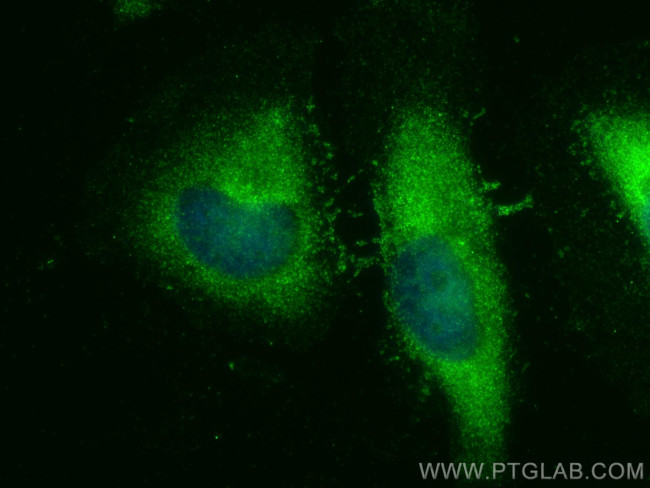


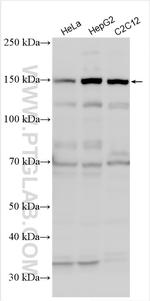

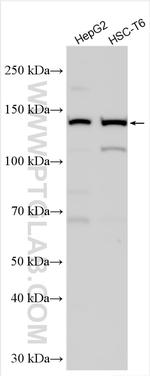
Please note: We are reviewing Western blot images included in the antibody testing data in our catalog, including those provided by third parties. Unless expressly labeled or annotated as “raw-unedited”, Western blot images included in the antibody testing data in our catalog may have been edited, optimized or otherwise adjusted for presentation.


产品信息
27352-1-AP
应用
建议稀释比
已发表文章
产品规格
种属反应
Human,
Mouse,
Rat
宿主/亚型
Rabbit
/ IgG
分类
Polyclonal
类型
Antibody
抗原
ULK1 fusion protein Ag22397
偶联物
Unconjugated
Unconjugated
Unconjugated
形式
Liquid
浓度
0.65 mg/mL
规格
97.5 µg
纯化类型
Antigen affinity chromatography
保存液
PBS, pH 7.3, with 50% glycerol
内含物
0.02% sodium azide
保存条件
-20°C
运输条件
Wet ice
产品详细信息
Immunogen sequence: SRKDLIGHGA FAVVFKGRHR EKHDLEVAVK CINKKNLAKS QTLLGKEIKI LKELKHENIV ALYDFQEMAN SVYLVMEYCN GGDLADYLHA MRTLSEDTIR LFLQQIAGAM RLLHSKGIIH RDLKPQNILL SNPAGRRANP NSIRVKIADF GFARYLQSNM MAATLCGSPM YMAPEVIMSQ HYDGKADLWS IGTIVYQCLT GKAPFQASSP QDLRLFYEKN KTLVPTIPRE TSAPLRQLLL ALLQRNHKDR MDFDEFFHHP FLDASPSVRK SPPVPVPSYP SSGSGSSSSS SSTSHLASPP SLGEMQQLQK TLASPADTAG FLHSSRDSGG SKDSSCDTDD FVMVPAQFPG DLVAEAPSAK PPPDSLMCSG SSLVASAGLE SHGRTPSPSP PCSSSPSPSG RAGPFSSSRC GASVPIPVPT QVQNYQRIER NLQSPTQFQT PRSSAIRRSG
靶标信息
ULK1 is a serine/threonine protein kinase that plays critical role during initial stages of autophagy which is a vital response to nutrient starvation. The conserved C-terminal domain (CTD) of ULK1 controls the regulatory function and localization of the protein. Knockdown of ULK1 inhibits the autophagic response as well as inhibiting rapamycin-induced autophagy consistent with a role downstream of mTOR. ULK1 forms a complex with FIP200 and ATG13 and this complex is essential for starvation-induced autophagy. Both FIP200 and ATG13 are critical for correct localization of ULK1 to the pre-autophagosome and stability of ULK1 protein. ULK1 is phosphorylated by the mTOR pathway in a nutrient starvation-regulated manner.
仅用于科研。不用于诊断过程。未经明确授权不得转售。
篇参考文献 (0)
您是否在文献中引用过该产品?请点击下方按钮邮件告知我们。
生物信息学
蛋白别名: APG1; ATG 1; ATG1; Autophagy-related protein 1 homolog; C. elegans; EC:2.7.11.1; FLJ38455; Serine/threonine-protein kinase ULK1; Serine/threonine-protein kinase Unc51.1; ULK 1; UNC 51; Unc-51-like kinase 1
基因别名: AU041434; KIAA0722; mKIAA0722; ULK1; Unc51.1
UniProt ID: (Mouse) O70405
Entrez Gene ID: (Rat) 360827, (Mouse) 22241
molecular_function
protein kinase activity
protein serine/threonine kinase activity
ATP binding
Rab GTPase binding
protein kinase binding
protein complex binding
nucleotide binding
protein binding
kinase activity
transferase activity
transferase activity, transferring phosphorus-containing groups
Hsp90 protein binding
non-receptor serine/threonine protein kinase
autophagosome assembly
Ras protein signal transduction
axonogenesis
protein localization
regulation of autophagy
positive regulation of autophagy
positive regulation of macroautophagy
cerebellar granule cell differentiation
radial glia guided migration of cerebellar granule cell
neuron projection regeneration
neuron projection development
receptor internalization
cellular response to nutrient levels
response to starvation
protein autophosphorylation
negative regulation of collateral sprouting
axon extension
regulation of neurotrophin TRK receptor signaling pathway
protein phosphorylation
autophagy
signal transduction
regulation of gene expression
regulation of cell death
phosphorylation
peptidyl-serine phosphorylation
mitophagy in response to mitochondrial depolarization
Disclaimer

Clicking the images or links will redirect you to a website hosted by BenchSci that provides third-party scientific content. Neither the content nor the BenchSci technology and processes for selection have been evaluated by us; we are providing them as-is and without warranty of any kind, including for use or application of the Thermo Fisher Scientific products presented.

