Search
Invitrogen
Human M-CSF Recombinant Protein
{{$productOrderCtrl.translations['antibody.pdp.commerceCard.promotion.promotions']}}
{{$productOrderCtrl.translations['antibody.pdp.commerceCard.promotion.promocode']}}: {{promo.promoCode}} {{promo.promoTitle}} {{promo.promoDescription}}. {{$productOrderCtrl.translations['antibody.pdp.commerceCard.promotion.learnmore']}}

产品信息
14-8789-80
产品规格
Expression System
Insect cells
分类
Recombinant
类型
Protein
偶联物
Unconjugated
Unconjugated
Unconjugated
形式
Liquid
浓度
0.1 mg/mL
Amount
25 µg
保存条件
-80°C
运输条件
Dry ice
产品详细信息
Description: Human Macrophage Colony Stimulating Factor (M-CSF, also called CSF-1) is a ~36 kDa disulfide-linked homodimer produced by a variety of cells including fibroblasts, macrophages, bone marrow stromal cells and endothelial cells. M-CSF regulates macrophage survival, proliferation and differentiation. M-CSF also enhances macrophage killing of tumor cells and microorganisms and regulates cytokine production from macrophages.
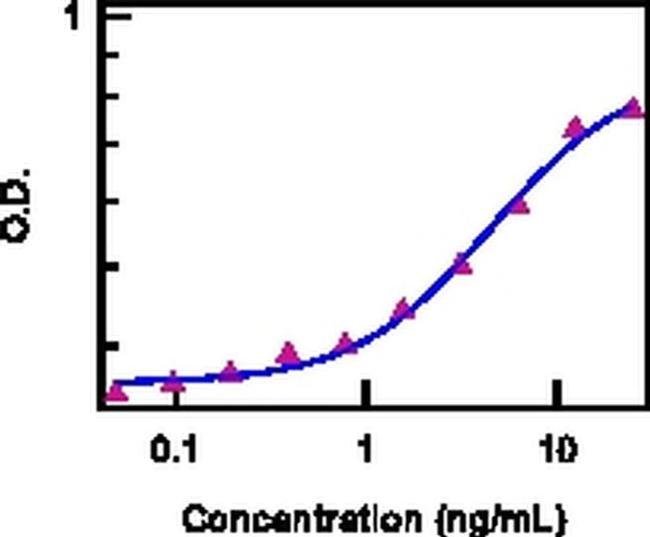
Applications Reported: Recombinant human M-CSF is biologically active and can promote proliferation of M-NFS-60 cells in culture.
Applications Tested: The bioactivity of this protein, as determined in a cell proliferation assay on M-NFS-60 cells, is 3 ng/mL. This corresponds to a specific activity of 3.3 X 10e5 Units/mg.
Source: Human M-CSF Glu34-Ser190 accession # NM-172211 expressed in insect cells with a C-terminal 6X His tag.
Bioactivity: The bioactivity of this protein, as determined in a cell proliferation assay on M-NFS-60 cells, is 3 ng/mL. This corresponds to a specific activity of 3.3 X 10e5 Units/mg.
Endotoxin: Less than 0.01 ng/ug cytokine as determined by the LAL assay. Purity: >98% as determined by SDS-PAGE.
Storage and handling: For best recovery, always quick-spin vial prior to opening. For dilution of current stock, always include carrier protein (1% BSA or 10% FBS) in the buffered saline diluent.
Purity: Greater than 90%, as determined by SDS-PAGE.
Aggregation: Less than 10%, as determined by HPLC.
Filtration: 0.2 µm post-manufacturing filtered.
靶标信息
M-CSF (Macrophage colony-stimulating factor, CSF-1) is a survival factor essential for the proliferation and development of monocytes, macrophages, and osteoclast progenitor cells. M-CSF also induces VEGF (vascular endothelial growth factor) secretion by macrophages, thereby mediating mobilization of endothelial progenitor cells and neovascularization. M-CSF is present as several bioactive isoforms that differ in potency and stability. The full-length protein is synthesized as a membrane-spanning protein that can be expressed on the cell surface or further cleaved and modified in the secretory vesicle. Further, M-CSF is a disulfide-bonded homodimer which is processed into one of two isoforms, a glycoprotein or a proteoglycan that has been modified by the addition of chondroitin sulfate to each subunit. Binding of M-CSF to its receptor, c-Fms (CSF-1R or CD115) induces dimerization of the receptor followed by internalization and degradation of the complex. Functionally, M-CSF is known to stimulate differentiation of hematopoietic stem cells to monocyte-macrophage cell populations in culture. M-CSF acts through the CSF receptor 1. Although human M-CSF shows activity on mouse cells, mouse CSF shows no activity on human cells.
仅用于科研。不用于诊断过程。未经明确授权不得转售。
篇参考文献 (0)
您是否在文献中引用过该产品?请点击下方按钮邮件告知我们。
Disclaimer

Clicking the images or links will redirect you to a website hosted by BenchSci that provides third-party scientific content. Neither the content nor the BenchSci technology and processes for selection have been evaluated by us; we are providing them as-is and without warranty of any kind, including for use or application of the Thermo Fisher Scientific products presented.
