Search
Proteintech
DNER Polyclonal Antibody
{{$productOrderCtrl.translations['antibody.pdp.commerceCard.promotion.promotions']}}
{{$productOrderCtrl.translations['antibody.pdp.commerceCard.promotion.viewpromo']}}
{{$productOrderCtrl.translations['antibody.pdp.commerceCard.promotion.promocode']}}: {{promo.promoCode}} {{promo.promoTitle}} {{promo.promoDescription}}. {{$productOrderCtrl.translations['antibody.pdp.commerceCard.promotion.learnmore']}}
Additional Information:
{{banner.description}}


产品信息
24362-1-AP
应用
建议稀释比
已发表文章
产品规格
种属反应
Human,
Mouse
宿主/亚型
Rabbit
/ IgG
分类
Polyclonal
类型
Antibody
抗原
Recombinant protein
偶联物
形式
Liquid
纯化类型
Antigen affinity chromatography
保存液
PBS with 50% glycerol
内含物
0.02% sodium azide
保存条件
-20°C
运输条件
Wet ice
产品详细信息
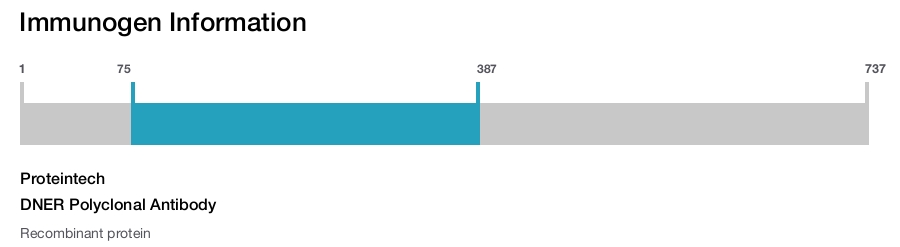
Immunogen sequence: EPGYSCTCPA GISGANCQLV ADPCASNPCH HGNCSSSSSS SSDGYLCICN EGYEGPNCEQ ALPSLPATGW TESMAPRQLQ PVPATQEPDK ILPRSQATVT LPTWQPKTGQ KVVEMKWDQV EVIPDIACGN ASSNSSAGGR LVSFEVPQNT SVKIRQDATA SLILLWKVTA TGFQQCSLID GRSVTPLQAS GGLVLLEEML ALGNNHFIGF VNDSVTKSIV ALRLTLVVKV STCVPGESHA NDLECSGKGK CTTKPSEATF SCTCEEQYVG TFCEEYDACQ RKPCQNNASC IDANEKQDGS NFTCVCLPGY TGE
靶标信息
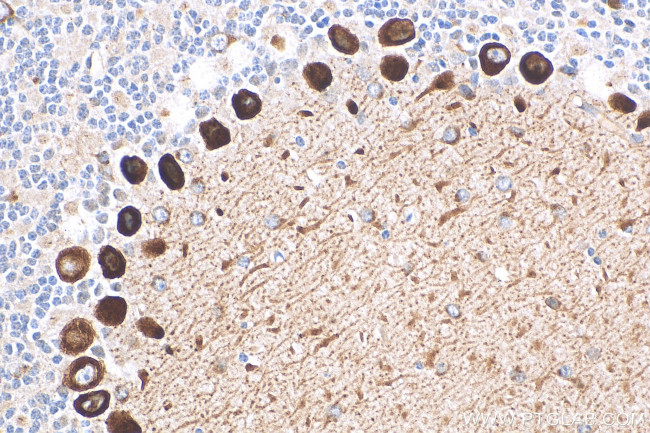
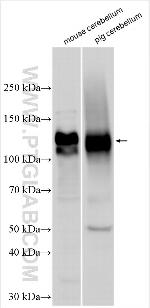
DNER (Delta-notch-like EGF-related receptor), also known as Delta-notch-like EGF repeat-containing transmembrane protein, is a neuron-specific, atypical Notch ligand expressed in dendrites and cell bodies of neurons throughout the central nervous system. DNER contains ten extracellular EGF-like domains that are highly homologous to those of the Notch ligand, Delta. In the cerebellum, DNER is predominantly expressed in Purkinje cells. DNER mediates neuron-glia interaction during astrocytogenesis through a direct interaction with Notch 1 at Purkinje cell/Bergmann glia contacts. This interaction activates a Deltex-dependent Notch signaling pathway in Bergmann glia and may regulate Bergmann glial morphogenesis. DNER is crucial for the functional and morphological maturation of Bergmann glia. DNER-knockout mice are characterized by motor discoordination and cerebellum retardation in morphogenesis.
仅用于科研。不用于诊断过程。未经明确授权不得转售。
篇参考文献 (0)
您是否在文献中引用过该产品?请点击下方按钮邮件告知我们。
生物信息学
蛋白别名: Brain EGF repeat-containing transmembrane protein; Delta and Notch-like epidermal growth factor-related receptor; delta-notch-like EGF repeat-containing transmembrane; H_NH0150O02.1; transmembrane protein Bet; unnamed protein product; WUGSC:H_NH0150O02.1
基因别名: A930026D19Rik; BET; Bret; DNER; UNQ26; UNQ262/PRO299
UniProt ID: (Human) Q8NFT8, (Mouse) Q8JZM4
Entrez Gene ID: (Human) 92737, (Mouse) 227325
Disclaimer

Clicking the images or links will redirect you to a website hosted by BenchSci that provides third-party scientific content. Neither the content nor the BenchSci technology and processes for selection have been evaluated by us; we are providing them as-is and without warranty of any kind, including for use or application of the Thermo Fisher Scientific products presented.

