Search
Invitrogen
JNK1/JNK3 Recombinant Rabbit Monoclonal Antibody (JJ08-86)
{{$productOrderCtrl.translations['antibody.pdp.commerceCard.promotion.promotions']}}
{{$productOrderCtrl.translations['antibody.pdp.commerceCard.promotion.promocode']}}: {{promo.promoCode}} {{promo.promoTitle}} {{promo.promoDescription}}. {{$productOrderCtrl.translations['antibody.pdp.commerceCard.promotion.learnmore']}}
{{$ctrl.translations['antibody.pdp.skuNotes.additionalInformation']}}:
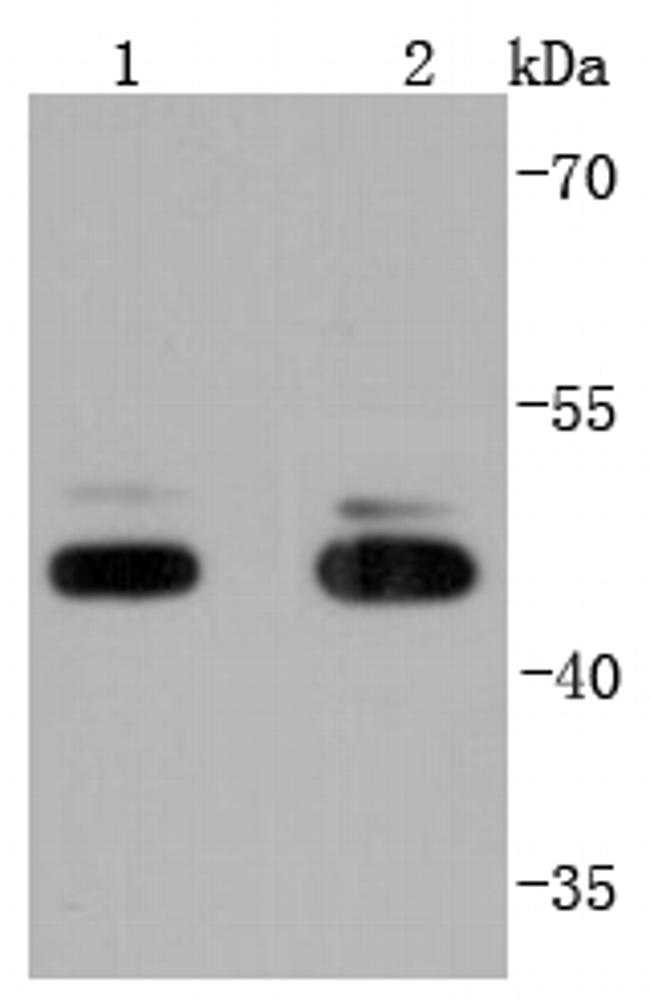
Please note: We are reviewing Western blot images included in the antibody testing data in our catalog, including those provided by third parties. Unless expressly labeled or annotated as “raw-unedited”, Western blot images included in the antibody testing data in our catalog may have been edited, optimized or otherwise adjusted for presentation.

产品信息
MA5-32453
产品规格
种属反应
Human,
Mouse,
Rat
宿主/亚型
Rabbit
/ IgG
Expression System
HEK293 cells
分类
Recombinant Monoclonal
类型
Antibody
克隆号
JJ08-86
抗原
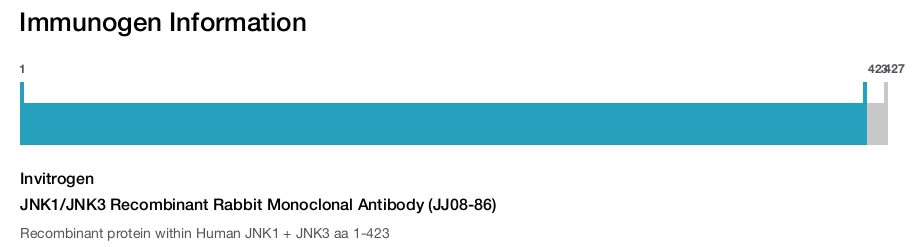
Recombinant protein within Human JNK1 + JNK3 aa 1-423.
偶联物
Unconjugated
Unconjugated
Unconjugated
形式
Liquid
浓度
1 mg/mL
规格
100 µg
纯化类型
Protein A
保存液
TBS, pH 7.4, with 40% Glycerol, 0.05% BSA
内含物
0.05% sodium azide
保存条件
Store at 4°C short term. For long term storage, store at -20°C, avoiding freeze/thaw cycles.
运输条件
Ambient (domestic); Wet ice (international)
RRID
产品详细信息
Recombinant rabbit monoclonal antibodies are produced using in vitro expression systems. The expression systems are developed by cloning in the specific antibody DNA sequences from immunoreactive rabbits. Then, individual clones are screened to select the best candidates for production. The advantages of using recombinant rabbit monoclonal antibodies include: better specificity and sensitivity, lot-to-lot consistency, animal origin-free formulations, and broader immunoreactivity to diverse targets due to larger rabbit immune repertoire.
靶标信息
The protein encoded by this gene is a member of the MAP kinase family. MAP kinases act as an integration point for multiple biochemical signals, and are involved in a wide variety of cellular processes such as proliferation, differentiation, transcription regulation and development. This kinase is activated by various cell stimuli, and targets specific transcription factors, and thus mediates immediate-early gene expression in response to cell stimuli. The activation of this kinase by tumor-necrosis factor alpha (TNF-alpha) is found to be required for TNF-alpha induced apoptosis. This kinase is also involved in UV radiation induced apoptosis, which is thought to be related to cytochrome c-mediated cell death pathway. Studies of the mouse counterpart of this gene suggested that this kinase play a key role in T cell proliferation, apoptosis and differentiation. Several alternatively spliced transcript variants encoding distinct isoforms have been reported.
仅用于科研。不用于诊断过程。未经明确授权不得转售。
篇参考文献 (0)
您是否在文献中引用过该产品?请点击下方按钮邮件告知我们。
生物信息学
蛋白别名: c-Jun N-terminal kinase 1; c-Jun N-terminal kinase 3; c-jun NH2-terminal kinase; JNK1 beta1 protein kinase; JNK3 alpha protein kinase; JNK3 beta1 protein kinase; JNK3 beta2 protein kinase; JUN N-terminal kinase; MAP kinase 10; MAP kinase 8; MAP kinase p49 3F12; MAPK 10; MAPK 8; MAPK8; p54 gamma; p54-beta; protein kinase mitogen-activated 8; SAPK gamma; SAPK-beta; SAPK/Erk/kinase 2; Stress activated protein kinase beta; stress-activated protein kinase 1; stress-activated protein kinase 1b; stress-activated protein kinase 1c; stress-activated protein kinase JNK1; stress-activated protein kinase JNK3; unnamed protein product
基因别名: C230008H04Rik; JNK; JNK-46; JNK1; JNK1A2; JNK21B1/2; JNK3; JNK3A; JNK3B1; JNK3B2; p493F12; p54bSAPK; PRKM10; PRKM8; SAPb; SAPK(beta); SAPK1; SAPK1b; SAPK1c; SAPKC; Serk2
UniProt ID: (Human) P53779, (Human) P45983, (Mouse) Q61831, (Rat) P49187, (Mouse) Q91Y86, (Rat) P49185
Entrez Gene ID: (Human) 5602, (Human) 5599, (Mouse) 26414, (Rat) 25272, (Mouse) 26419, (Rat) 116554
protein kinase activity
JUN kinase activity
MAP kinase activity
MAP kinase kinase activity
protein binding
ATP binding
protein serine kinase activity
protein serine/threonine kinase activity
enzyme binding
protein phosphatase binding
histone deacetylase regulator activity
histone deacetylase binding
protein serine/threonine kinase binding
protein serine/threonine/tyrosine kinase activity
kinase activity
kinesin binding
MAPK cascade
protein phosphorylation
signal transduction
JNK cascade
response to light stimulus
Fc-epsilon receptor signaling pathway
regulation of circadian rhythm
cellular senescence
negative regulation of transcription from RNA polymerase II promoter
JUN phosphorylation
locomotor rhythm
neurotransmitter receptor transport to postsynaptic membrane
vesicle-mediated transport in synapse
response to oxidative stress
response to UV
response to mechanical stimulus
positive regulation of gene expression
regulation of macroautophagy
peptidyl-serine phosphorylation
peptidyl-threonine phosphorylation
positive regulation of cyclase activity
positive regulation of cell killing
negative regulation of protein binding
regulation of protein localization
cellular response to amino acid starvation
cellular response to oxidative stress
cellular response to reactive oxygen species
positive regulation of apoptotic process
negative regulation of apoptotic process
positive regulation of protein metabolic process
stress-activated MAPK cascade
cellular response to lipopolysaccharide
cellular response to mechanical stimulus
energy homeostasis
positive regulation of NLRP3 inflammasome complex assembly
positive regulation of establishment of protein localization to mitochondrion
ossification
neuron migration
positive regulation of neuroblast proliferation
double-strand break repair
regulation of transcription, DNA-templated
integrin-mediated signaling pathway
neuromuscular junction development
regulation of gene expression
positive regulation of cardiac muscle cell apoptotic process
positive regulation of cell migration
positive regulation of microtubule polymerization
neuron projection development
positive regulation of protein ubiquitination
positive regulation of proteasomal ubiquitin-dependent protein catabolic process
positive regulation of glial cell apoptotic process
ERBB signaling pathway
response to hydrogen peroxide
regulation of mRNA stability
positive regulation of neuron apoptotic process
NLRP3 inflammasome complex assembly
regulation of neuron differentiation
positive regulation of DNA replication
regulation of centrosome cycle
response to cadmium ion
determination of dorsal identity
dendrite morphogenesis
modulation of synaptic transmission
SMAD protein signal transduction
mRNA destabilization
protein localization to tricellular tight junction
protein poly-ADP-ribosylation
cellular response to hydrogen peroxide
cellular response to nitric oxide
positive regulation of podosome assembly
cellular response to oxygen-glucose deprivation
type B pancreatic cell apoptotic process
neuronal stem cell population maintenance
programmed necrotic cell death
regulation of dense core granule transport
protein localization to site of double-strand break
positive regulation of determination of dorsal identity
positive regulation of neuron migration
positive regulation of apoptotic signaling pathway
glial cell apoptotic process
response to steroid hormone
neuron development
cellular response to interleukin-1
cellular response to beta-amyloid
cellular hyperosmotic response
Disclaimer

Clicking the images or links will redirect you to a website hosted by BenchSci that provides third-party scientific content. Neither the content nor the BenchSci technology and processes for selection have been evaluated by us; we are providing them as-is and without warranty of any kind, including for use or application of the Thermo Fisher Scientific products presented.

