Search
Disclaimer

Clicking the images or links will redirect you to a website hosted by BenchSci that provides third-party scientific content. Neither the content nor the BenchSci technology and processes for selection have been evaluated by us; we are providing them as-is and without warranty of any kind, including for use or application of the Thermo Fisher Scientific products presented.
Invitrogen
KCNK16 (extracellular) Polyclonal Antibody
{{$productOrderCtrl.translations['antibody.pdp.commerceCard.promotion.promotions']}}
{{$productOrderCtrl.translations['antibody.pdp.commerceCard.promotion.viewpromo']}}
{{$productOrderCtrl.translations['antibody.pdp.commerceCard.promotion.promocode']}}: {{promo.promoCode}} {{promo.promoTitle}} {{promo.promoDescription}}. {{$productOrderCtrl.translations['antibody.pdp.commerceCard.promotion.learnmore']}}
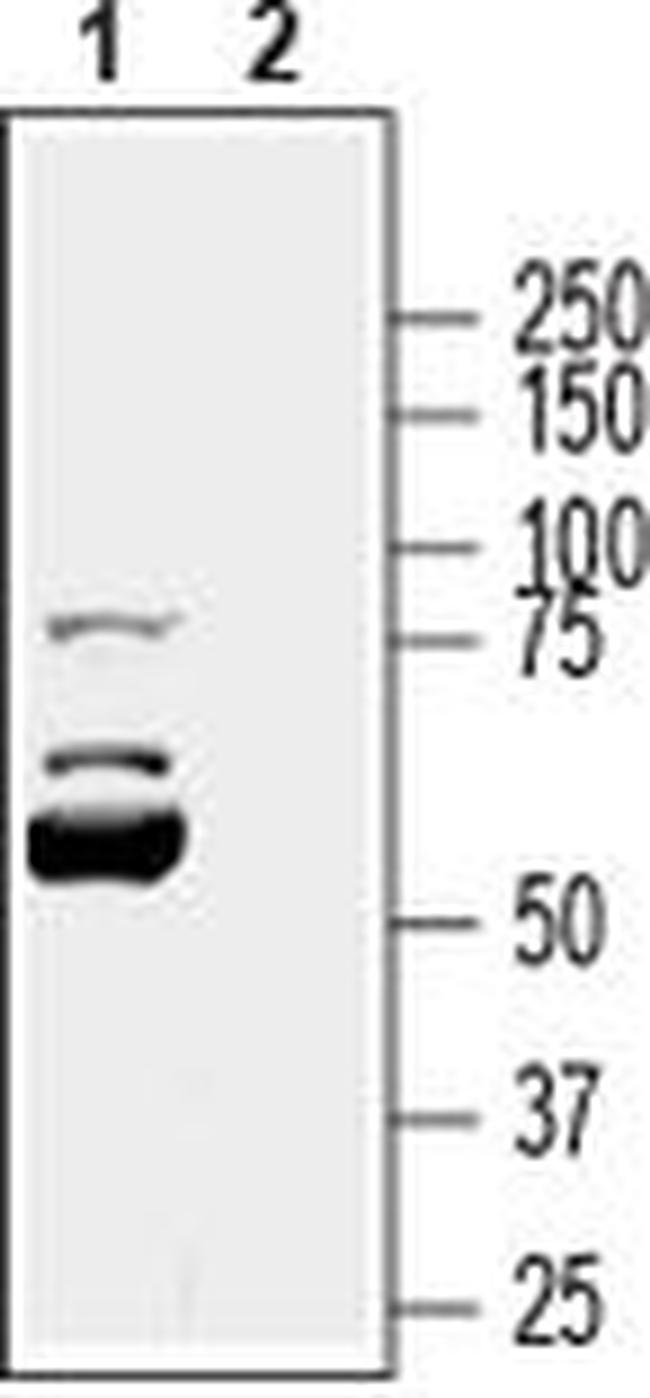
图: 1 / 2
KCNK16 (extracellular) Antibody (PA5-111887) in WB
Western Blot analysis of TALK-1 was performed in human PANC-1 pancreas ductal adenocarcinoma cell line lysate. Lane 1: KCNK16 (extracellular) Antibody (Product # PA5-111887) at a dilution of 1:600. Lane 2: KCNK16 (extracellular) Antibody preincubated with the negative control antigen.


产品信息
PA5-111887
产品规格
宿主/亚型
Rabbit
/ IgG
分类
Polyclonal
类型
Antibody
抗原
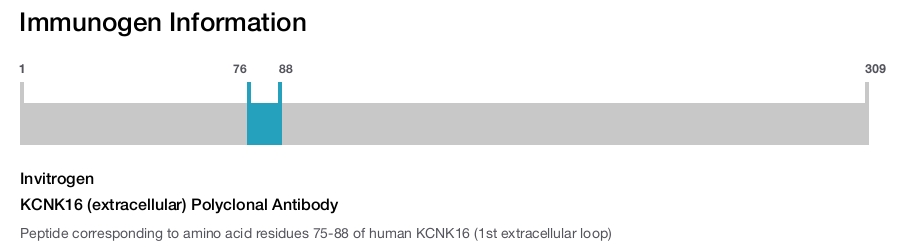
Peptide corresponding to amino acid residues 75-88 of human KCNK16 (1st extracellular loop)
偶联物
形式
Lyophilized
浓度
0.8 mg/mL
保存条件
-20°C
运输条件
Wet ice
RRID
产品详细信息
Reconstitute antibody with 50 µL of double distilled water (DDW). The reconstituted solution can be stored at 4 degrees C for up to 1 week. For longer periods, small aliquots should be stored at -20 degrees C. Avoid multiple freezing and thawing. Centrifuge all antibody preparations before use (10000 x g 5 min).
Peptide sequence is: (C)EAWVKGV NPKGNST
Homology: Rat, mouse amino acid residues are identical.
靶标信息
The KCNK16 gene encodes the TALK-1 channel, an abundant K+ channel transcript found in mouse and in human Beta-cells. There are four human TALK-1 transcript variants, including two that form functional K+ channels (TALK-1a (transcript variant 2) and TALK1-b (transcript variant 3). The TALK-1 structure includes 4 transmembrane domains, 2 extracellular loops, and intracellular N- and C-termini. The C-terminal tail of TALK-1 is a critical component that influences the magnitude of TALK-1 channel activation, while the N-terminus is important for protein interaction. TALK-1, two-pore domain K+ (K2p 16.1) channel is responsible for modulating glucose stimulated insulin secretion that relies on Beta-cell CA2+ influx. The channel produces outwardly rectifying, non-inactivating K+ currents, which are enhanced by elevations in extracellular pH. TALK-1 is thus pH-sensitive, with increased activity under alkaline conditions. In addition, it can be activated by singlet oxygen and nitric oxide.
仅用于科研。不用于诊断过程。未经明确授权不得转售。
篇参考文献 (0)
您是否在文献中引用过该产品?请点击下方按钮邮件告知我们。

