Search


引用和文献 (8)
Gibco™
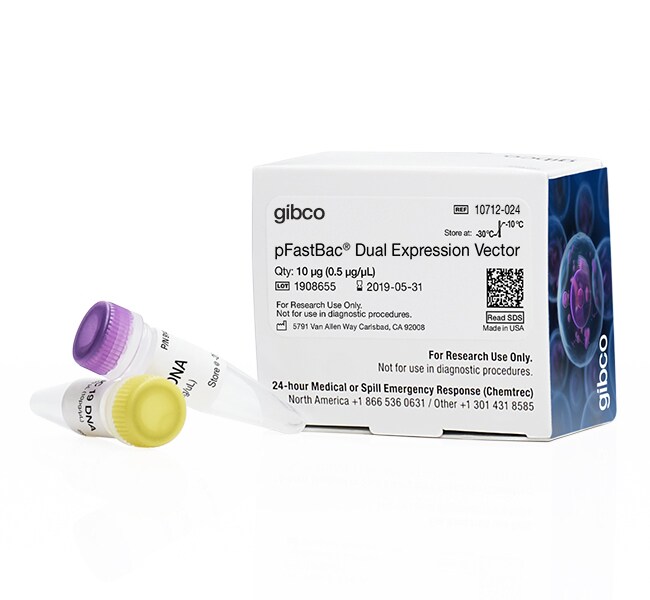
pFastBac™ Dual 表达载体
pFastBac™ Dual 载体在一个载体中具有两个启动子,当使用 Bac-to-Bac® 杆状病毒表达系统时,可在昆虫细胞中同时表达两种蛋白(货号 10359-016)。该载体具有两个强启动子,多角体蛋白启动子和 p10了解更多信息
| 货号 | 数量 |
|---|---|
| 10712024 | 10 μg |
货号 10712024
价格(CNY)
12,962.00
Each
数量:
10 μg
价格(CNY)
12,962.00
Each
pFastBac™ Dual 载体在一个载体中具有两个启动子,当使用 Bac-to-Bac® 杆状病毒表达系统时,可在昆虫细胞中同时表达两种蛋白(货号 10359-016)。该载体具有两个强启动子,多角体蛋白启动子和 p10 启动子,可实现高水平表达。包含表达 CAT 和 β-葡萄糖醛酸酶 (gus) 的表达对照载体。
仅供科研使用。不可用于诊断程序。
规格
产品类型表达载体
数量10 μg
载体pFastBac
克隆方法限制性内切酶/MCS
产品线pFastBac
促进剂p10、多角体蛋白, Polyhedrin
蛋白标记未标记
Unit SizeEach
内容与储存
pFastBac™ Dual (10 μg) 和 pFastBac™ Dual 对照载体 (4 ng) 以冻干形式提供。
在 -20°C 下储存。适当储存时载体可保证稳定 6 个月。
在 -20°C 下储存。适当储存时载体可保证稳定 6 个月。
常见问题解答 (FAQ)
白色菌落不能在液体培养基中生长。我该怎么办?
为什么会出现蓝色菌落?为什么会出现中心为蓝色而边缘为白色的菌落?
我得到的主要是白色/野生型空斑,而不是蓝色/重组型空斑。哪里出错了?
感染细胞后,我在一个细胞中看到较大的多角体,而在相邻细胞中看到较小的多角体(数量更多)。这正常吗?
我担心得不到空斑。出现空斑需要几天?空斑通常为多大?
引用和文献 (8)
引用和文献
Abstract
Molecular characterization of hCTR1, the human copper uptake protein.
Journal:J Biol Chem
PubMed ID:12034741
'We have expressed hCTR1, the human copper transporter, in Sf9 cells using a baculovirus-mediated expression system, and we observed greatly enhanced copper uptake. Western blots showed that the protein is delivered to the plasma membrane, where it mediates saturable copper uptake with a K(m) of approximately 3.5 microm. We also
Structure of the reovirus membrane-penetration protein, Mu1, in a complex with is protector protein, Sigma3.
Journal:Cell
PubMed ID:11832217
Cell entry by nonenveloped animal viruses requires membrane penetration without membrane fusion. The reovirus penetration agent is the outer-capsid protein, Mu1. The structure of Mu1, complexed with its
Molecular characterization of major cat allergen Fel d 1: expression of heterodimer by use of a baculovirus expression system.
Journal:J Biol Chem
PubMed ID:15546862
Fel d 1 is a major cat allergen inducing allergic rhinitis and asthma in sensitized individuals. It has a more complex structure when compared with other allergens and therefore expression of recombinant Fel d 1 has been considered a challenge. The present study shows for the first time that a
A novel 43-kDa protein as a negative regulatory component of phenoloxidase-induced melanin synthesis.
Journal:J Biol Chem
PubMed ID:15857824
The melanization reaction induced by activated phenoloxidase in arthropods is important in the multiple host defense innate immune reactions, leading to the sequestration and killing of invading microorganisms. This reaction ought to be tightly controlled because excessive formation of quinones and systemic hypermelanization are deleterious to the hosts, suggesting that
Human MutY homolog, a DNA glycosylase involved in base excision repair, physically and functionally interacts with mismatch repair proteins human MutS homolog 2/human MutS homolog 6.
Journal:J Biol Chem
PubMed ID:11801590
Adenines mismatched with guanines or 7,8-dihydro-8-oxo-deoxyguanines that arise through DNA replication errors can be repaired by either base excision repair or mismatch repair. The human MutY homolog (hMYH), a DNA glycosylase, removes adenines from these mismatches. Human MutS homologs, hMSH2/hMSH6 (hMutSalpha), bind to the mismatches and initiate the repair on