Search


引用和文献 (27)
Gibco™
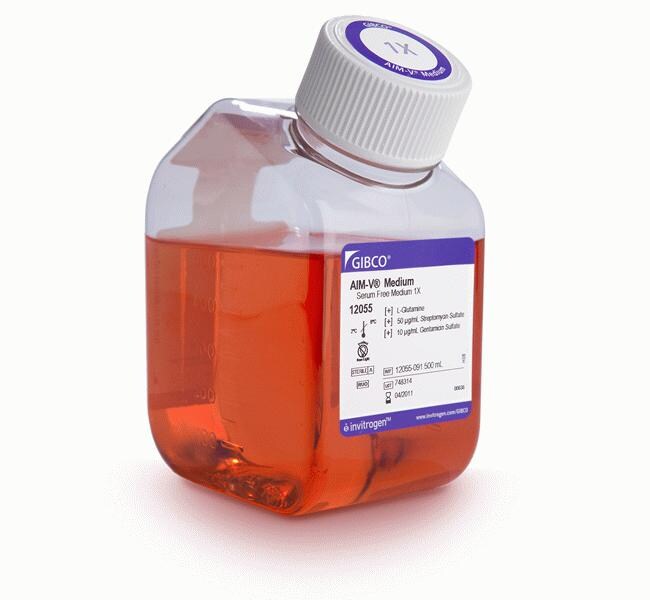
AIM V™ 培养基,液体(研究级)
含 L-谷氨酰胺、50 µg/mL 硫酸链霉素和 10 µg/mL 硫酸庆大霉素。了解更多信息
Have Questions?
更改视图

| 货号 | 数量 |
|---|---|
| 12055091 | 500 mL |
| 12055083 | 1000 mL |
货号 12055091
价格(CNY)
1,603.00
Each
数量:
500 mL
价格(CNY)
1,603.00
Each
含 L-谷氨酰胺、50 µg/mL 硫酸链霉素和 10 µg/mL 硫酸庆大霉素。
仅供科研使用。不可用于诊断程序。
规格
细胞类型单核细胞、树突状细胞、T 细胞、杂交瘤细胞、PBMC、成纤维细胞、巨噬细胞、骨髓瘤细胞、淋巴细胞
所含抗生素硫酸链霉素、庆大霉素
产品线AIM V
产品类型无血清培养基 (SFM)
纯度或质量等级研究级
数量500 mL
运输条件室温
培养类型哺乳动物细胞培养
形式液体
无菌无菌过滤
加有添加剂谷氨酰胺, 酚红, HSA
Unit SizeEach
内容与储存
避光储存在冷藏冰箱 (2-8°C) 中。
常见问题解答 (FAQ)
What is the difference between AIM V Medium (Cat. Nos. 12055083, 12055091) and CTS AIM V SFM (Cat. Nos. 0870112DK, 0870112BK)?
Which serum-free medium would you recommend for culture and expansion of mouse T cells?
引用和文献 (27)
引用和文献
Abstract
Low oxygen tension and autologous plasma enhance T-cell proliferation and CD49d expression density in serum-free media.
Journal:Cytotherapy
PubMed ID:11953028
'Background As cellular immunotherapy with ex vivo expanded cells becomes more widely used to treat a variety of illnesses, optimization of culture parameters, to maximize cell production and function, is essential for continued success. The effects of reduced oxygen tension and autologous plasma on T-cell expansion, receptor expression, apoptosis, and
Effects of interleukin 4 upon human tumoricidal cells obtained from patients bearing solid tumors.
Journal:J Leukoc Biol
PubMed ID:1991997
'The use of human interleukin 4 (IL4) in the generation of tumoricidal effector cells derived from cancer patients undergoing either interleukin 2/lymphokine activated killer cells (IL2/LAK) therapy or tumor derived activated cell (TDAC) therapy was examined in the present study. Human IL4 alone did not generate LAK cells from patients
Dominant negative effectors of heparin affin regulatory peptide (HARP) angiogenic and transforming activities.
Journal:J Biol Chem
PubMed ID:12070152
'Heparin affin regulatory peptide (HARP) is an heparin-binding growth factor, highly expressed in several primary human tumors and considered as a rate-limiting angiogenic factor in tumor growth, invasion, and metastasis. Implication of this protein in carcinogenesis is linked to its mitogenic, angiogenic, and transforming activities. Recently, we have demonstrated that
T(84) epithelial cells respond to 5-hydroxytryptamine when grown in serum-free media.
Journal:Eur J Pharmacol
PubMed ID:10708712
The aim of this study was to establish the cause of insensitivity of T(84) human colonic epithelial cells to 5-hydroxytryptamine (5-HT). Monolayers of T(84) cells were placed in modified Ussing chambers for measurement of short-circuit current, an index of secretion. When grown in serum-supplemented media, T(84) cells gave secretory responses
Generation of human autologous melanoma-specific cytotoxic T cells from tumor-involved lymph nodes.
Journal:Mol Biother
PubMed ID:1910625
Cytotoxic T lymphocytes (CTL) specific for autologous human melanoma have been successfully generated in vitro from tumor bearing lymph nodes without any stimulation by the autologous tumor. Tumor-involved lymph node cells (LNC) were cultured in serum free medium (AIM-V) containing 1,000 U/ml of recombinant interleukin-2. The best expansion and specific