Search


引用和文献 (14)
Invitrogen™
Platinum™ SuperFi II DNA 聚合酶
Invitrogen Platinum SuperFi II DNA 聚合酶是一款校读 DNA 聚合酶,将超高保真度与创新的缓冲液结合在一起,可较大限度提高 PCR 通用引物退火温度了解更多信息
Have Questions?
更改视图

| 货号 | 反应次数 |
|---|---|
| 12361010 | 100 次反应 |
| 12361050 | 500 次反应 |
| 12361250 | 5 x 500 反应 |
货号 12361010
价格(CNY)
582.00
Special offer
Online exclusive
Ends: 27-Nov-2026
2,008.00共减 1,426.00 (71%)
Each
反应次数:
100 次反应
价格(CNY)
582.00
Special offer
Online exclusive
Ends: 27-Nov-2026
2,008.00共减 1,426.00 (71%)
Each
Invitrogen Platinum SuperFi II DNA 聚合酶是一款校读 DNA 聚合酶,将超高保真度与创新的缓冲液结合在一起,可较大限度提高 PCR 通用引物退火温度。它是克隆、突变和其它需要极佳序列准确度实验应用的理想选择。
Platinum SuperFi II DNA 聚合酶的特点包括:
•出色的 >300X Taq 保真度
• 通用引物退火温度为 60°C
• 具有出色的特异性、灵敏度和得率
• 可稳健地扩增难以扩增的靶标(例如纯度不佳的靶标、GC 含量 ˃65% 的靶标、需长片段 PCR 的靶标)
Platinum SuperFi II DNA 聚合酶是一种工程酶,具有高持续合成能力,并增强对 PCR 抑制剂的耐受性。它也可以实现快速循环方案和扩增长靶标(长达 20 kb)。Platinum 热启动技术使用专有抗体,可在 PCR 变性步骤之前抑制酶活性,防止非特异性扩增和引物降解。该技术还可在室温下进行反应构建,提高了灵敏度和得率。
由于 SuperFi II PCR 缓冲液的独特成分,按照一般设计规则设计的大多数引物对的退火温度为 60°C。缓冲液中的等稳定化分子可提高退火步骤中引物-模板的双重稳定性,并可增强特异性,而无需优化每个引物对的退火温度。使用 Platinum SuperFi II DNA 聚合酶,可以使用同一方案将不同的 PCR 测定共循环,该方案即使用通用引物退火温度和为待扩增的最长片段选择的延伸步骤。
Platinum SuperFi II DNA 多聚酶的应用:
•高保真 PCR
• 克隆和亚克隆
• 位点定向诱变
• 富含 GC 的模板的扩增
• 产生用于测序的模板
• 高通量 PCR
• 扩增纯度不佳的样品
• 长片段 PCR
• 快速 PCR
为提高便利性,我们提供 Platinum SuperFi II 预混液和 Platinum SuperFi II DNA 聚合酶,并提供即用型混合物和 SuperFi II PCR 缓冲液和 dNTP,因此减少了 PCR 反应构建过程中的移液步骤数量。也可以使用 Platinum SuperFi II Green PCR 预混液,此外,其还包含一种密度试剂和两种示踪染料,用于 PCR 产物直接上样到凝胶上,进一步从设置到最终分析简化了 PCR 的工作流程。
查看有关 Platinum SuperFi II DNA 聚合酶产品的更多信息›
Platinum SuperFi II DNA 聚合酶的特点包括:
•出色的 >300X Taq 保真度
• 通用引物退火温度为 60°C
• 具有出色的特异性、灵敏度和得率
• 可稳健地扩增难以扩增的靶标(例如纯度不佳的靶标、GC 含量 ˃65% 的靶标、需长片段 PCR 的靶标)
Platinum SuperFi II DNA 聚合酶是一种工程酶,具有高持续合成能力,并增强对 PCR 抑制剂的耐受性。它也可以实现快速循环方案和扩增长靶标(长达 20 kb)。Platinum 热启动技术使用专有抗体,可在 PCR 变性步骤之前抑制酶活性,防止非特异性扩增和引物降解。该技术还可在室温下进行反应构建,提高了灵敏度和得率。
由于 SuperFi II PCR 缓冲液的独特成分,按照一般设计规则设计的大多数引物对的退火温度为 60°C。缓冲液中的等稳定化分子可提高退火步骤中引物-模板的双重稳定性,并可增强特异性,而无需优化每个引物对的退火温度。使用 Platinum SuperFi II DNA 聚合酶,可以使用同一方案将不同的 PCR 测定共循环,该方案即使用通用引物退火温度和为待扩增的最长片段选择的延伸步骤。
Platinum SuperFi II DNA 多聚酶的应用:
•高保真 PCR
• 克隆和亚克隆
• 位点定向诱变
• 富含 GC 的模板的扩增
• 产生用于测序的模板
• 高通量 PCR
• 扩增纯度不佳的样品
• 长片段 PCR
• 快速 PCR
为提高便利性,我们提供 Platinum SuperFi II 预混液和 Platinum SuperFi II DNA 聚合酶,并提供即用型混合物和 SuperFi II PCR 缓冲液和 dNTP,因此减少了 PCR 反应构建过程中的移液步骤数量。也可以使用 Platinum SuperFi II Green PCR 预混液,此外,其还包含一种密度试剂和两种示踪染料,用于 PCR 产物直接上样到凝胶上,进一步从设置到最终分析简化了 PCR 的工作流程。
查看有关 Platinum SuperFi II DNA 聚合酶产品的更多信息›
规格
保真度(相对于 Taq)>300 X
热启动内置热启动
反应次数100 次反应
突出端平末端
聚合酶Platinum SuperFi II DNA 聚合酶
数量100 次反应
反应形式独立
运输条件干冰
尺寸(最终产品)20 kb 或更小
适用于(应用)Hot-start PCR, High-fidelity PCR
高 GC PCR 扩增效果高
反应速度快速
Unit SizeEach
内容与储存
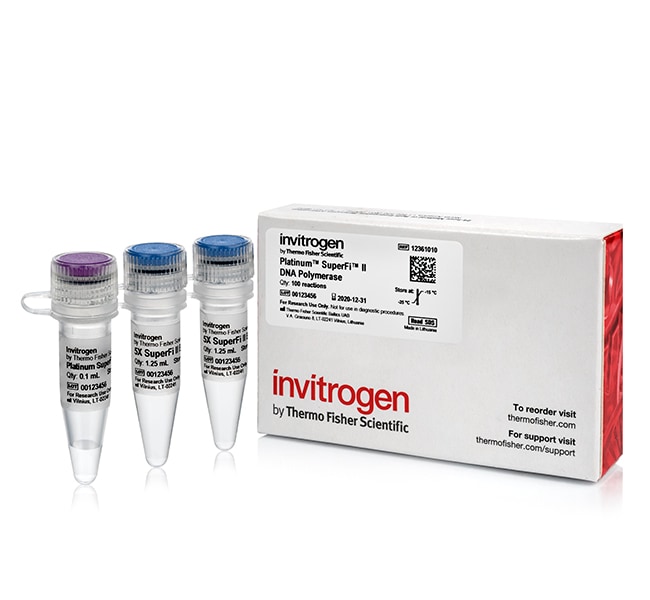
• 100 μL Platinum SuperFi II DNA 聚合酶
• 1.25 mL SuperFi II 缓冲液 (5X)
足以进行100次 50 μL 反应
• 1.25 mL SuperFi II 缓冲液 (5X)
足以进行100次 50 μL 反应
常见问题解答 (FAQ)
What is the longest amplicon I can get using Platinum SuperFi II DNA Polymerase?
I'm having a hard time amplifying/cloning low copy cDNAs via PCR. Do you have any suggestions for me?
What are your recommendations when working with long amplicons using Platinum SuperFi II DNA Polymerase?
Can I use Platinum SuperFi DNA Polymerase cycling protocol and primer annealing temperature with Platinum SuperFi II DNA Polymerase?
Can I perform TA cloning with Platinum SuperFi II DNA Polymerase?
引用和文献 (14)
引用和文献
Abstract
A PCR amplicon-based SARS-CoV-2 replicon for antiviral evaluation.
Journal:Sci Rep
PubMed ID:33500537
'The development of specific antiviral compounds to SARS-CoV-2 is an urgent task. One of the obstacles for the antiviral development is the requirement of biocontainment because infectious SARS-CoV-2 must be handled in a biosafety level-3 laboratory. Replicon, a non-infectious self-replicative viral RNA, could be a safe and effective tool for
Engineering SARS-CoV-2 using a reverse genetic system.
Journal:Nat Protoc
PubMed ID:33514944
'Reverse genetic systems are a critical tool for studying viruses and identifying countermeasures. In response to the ongoing COVID-19 pandemic, we recently developed an infectious complementary DNA (cDNA) clone for severe acute respiratory syndrome coronavirus 2 (SARS-CoV-2). The reverse genetic system can be used to rapidly engineer viruses with desired
The analysis of GSTA1 promoter genetic and functional diversity of human populations.
Journal:Sci Rep
PubMed ID:33658540
'GSTA1 encodes a member of a family of enzymes that function to add glutathione to target electrophilic compounds, including carcinogens, therapeutic drugs, environmental toxins, and products of oxidative stress. GSTA1 has several functional SNPs within its promoter region that are responsible for a change in its expression by altering promoter
Epigallocatechin-3-gallate Alleviates Vanadium-Induced Reduction of Antioxidant Capacity via Keap1-Nrf2-sMaf Pathway in the Liver, Kidney, and Ovary of Laying Hens.
Journal:Biol Trace Elem Res
PubMed ID:33405082
'This study evaluated the effect of epigallocatechin-3-gallate (EGCG) alleviating the reduction of antioxidant capacity induced by dietary vanadium (V) in the liver, kidney, and ovary of laying hens. Furthermore, Kelch-like ECH-associated protein 1(Keap1)-nuclear factor erythroid 2-related factor 2 (Nrf2)-small Maf proteins (sMaf) pathway was explored to reveal the molecular mechanism.
Human Ubiquitin-Specific Peptidase 18 Is Regulated by microRNAs
Journal:Front Genet
PubMed ID:33633774
'Ubiquitin-specific peptidase 18 (USP18) acts as gatekeeper of type I interferon (IFN) responses by binding to the IFN receptor subunit IFNAR2 and preventing activation of the downstream JAK/STAT pathway. In any given cell type, the level of USP18 is a key determinant of the output of IFN-stimulated transcripts. How the