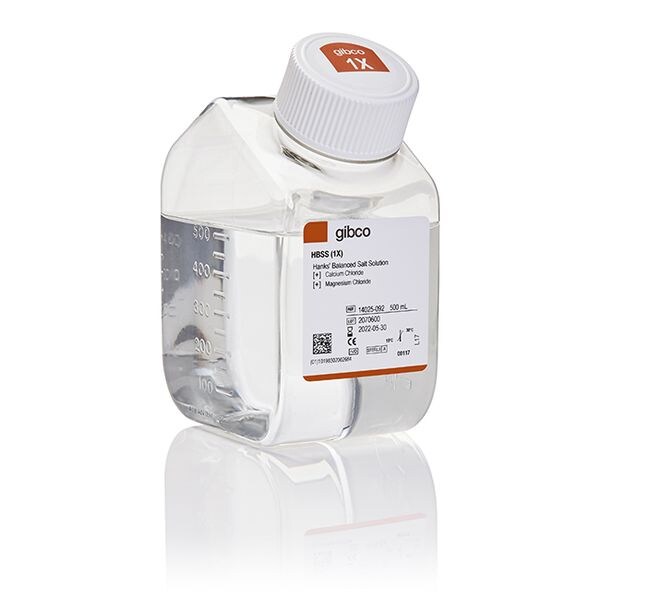
HBSS, calcium, magnesium, no phenol red
Invitrogen17万+抗体限时买二赠一,靶点广,灵活用!
HBSS, calcium, magnesium, no phenol red
Gibco™

HBSS, calcium, magnesium, no phenol red

Hanks' Balanced Salt Solution (HBSS) is used for a variety of cell culture applications, such as washing cells before dissociation,Read more
Have Questions?
Change viewbuttonViewtableView
Catalog NumberQuantity
14025092500 mL
1402513410 x 500 mL
140250761000 mL
140251266 x 1000 mL
Catalog number 14025092
Price (CNY)
369.00
Online Exclusive
Ends: 31-Dec-2025
470.00
Save 101.00 (21%)
Each
Add to cart
Quantity:
500 mL
Customize this product
Price (CNY)
369.00
Online Exclusive
Ends: 31-Dec-2025
470.00
Save 101.00 (21%)
Each
Add to cart

Hanks' Balanced Salt Solution (HBSS) is used for a variety of cell culture applications, such as washing cells before dissociation, transporting cells or tissue samples, diluting cells for counting, and preparing reagents. Formulations with calcium and magnesium are generally used as transport media, or for reagent preparation.

We offer a variety of Gibco™ HBSS formulations for a range of cell culture applications.


This HBSS is modified as follows:
WithWithout
• Calcium• Phenol Red
• Magnesium• Sodium Pyruvate
• Glucose 


The complete formulation is available.

For Research Use or Further Manufacturing. Not for diagnostic use or direct administration into humans or animals.
Specifications
Chemical Name or MaterialHanks' Balanced Salt Solution (HBSS)
ColorClear
IncludesNo Sodium Pyruvate
Manufacturing QualitycGMP-compliant under the ISO 13485 standard
Osmolality270 - 305 mOsm/kg
Recommended StorageStorage conditions: 15–30°C
Shipping conditions: Ambient
Shelf life: 36 months from date of manufacture
SterilitySterile-filtered
Concentration1 X
For Use With (Application)Mammalian Cell Culture
Physical FormLiquid
Product LineGibco™
Quantity500 mL
Solution TypeHank's Balanced Salt
pH6.7 - 7.8
Unit SizeEach

Frequently asked questions (FAQs)

What is the pH of HBSS, calcium, magnesium, no phenol red at room temperature.

At room temperature, HBSS, calcium, magnesium, no phenol red has a pH of 6.7 - 7.8.

Find additional tips, troubleshooting help, and resources within our Cell Culture Support Center.

Can I store Hank's Balanced Salt Solution (HBSS) in the refrigerator?

The recommended storage condition for our HBSS products is at 15-30 degrees C. Generally, storage at 4 degrees C will not impact these products. The only concern would be for the 10x HBSS solutions with calcium and magnesium as these salts might precipitate when stored outside the recommended temperature ranges. As long as you don't see any precipitation upon refrigeration, the product will be fine.

Find additional tips, troubleshooting help, and resources within our Cell Culture Support Center.

Do I need to add additional HEPES to Hank's Balanced Salt Solution (HBSS) (Cat. No. 14025xxx)?

HBSS (Cat. No. 14025xxx) does not contain HEPES and it needs to be externally supplemented. The complete formulation is available here (https://www.thermofisher.com/us/en/home/technical-resources/media-formulation.153.html).

Find additional tips, troubleshooting help, and resources within our Cell Culture Support Center.

I understand that some media are worse than others for fluorescence imaging. How do I choose?

Most media contain phenol red, which can quench fluorescent dyes in the visible wavelengths. Most media also contain autofluorescent components, such as riboflavin, which can reduce signal-to-background. We offer FluoroBrite DMEM and HEPES-based Live Cell Imaging Solution, which have been optimized for fluorescent imaging. We also offer a number of media without phenol red. But if none of these are reasonable options for your experiment, then we also offer BackDrop Background Suppressor ReadyProbes Reagent, which can be added to quench media autofluorescence.

Find additional tips, troubleshooting help, and resources within our Cell Analysis Support Center.

Should I be concerned about phenol red in my media when labeling my live cells with fluorescent dyes?

Some cell types accumulate phenol red, and this can pose a problem in the use of many fluorescent probes. Phenol red can quench visible-wavelength dyes and, although phenol red is non-fluorescent, various impurities may be fluorescent. We have many phenol red-free media to choose from. Our Live Cell Imaging Solution (HEPES-based) and our FluoroBrite DMEM have been optimized to be phenol red-free as well as to be non-autofluorescent.

Find additional tips, troubleshooting help, and resources within our Cell Analysis Support Center.