Search

Thermo Scientific™
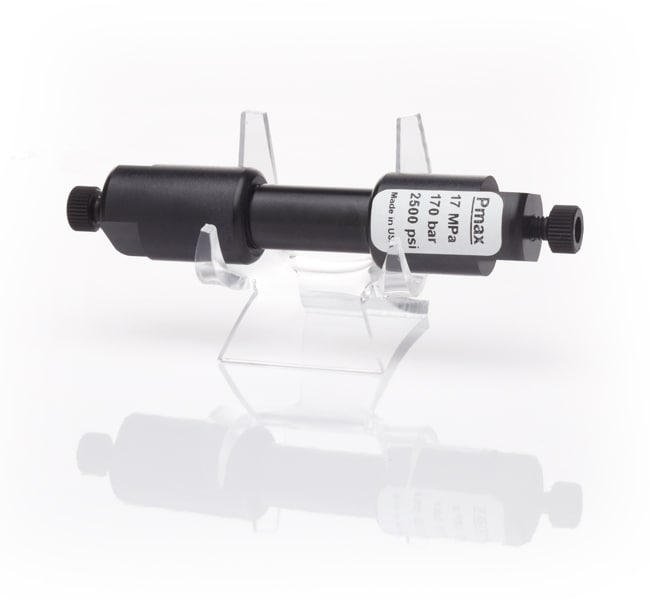
POROS™ A 20 μm Protein A Affinity HPLC Columns
Thermo Scientific™ POROS™ Protein A is based on an immobilized recombinant Protein A functional group designed for high throughput purification of antibodies. The 20 micron particle size is used for high resolution and small scale preparative to semi-preparative separation of biomolecules.
Have Questions?
更改视图

| 货号 | 材质 | 长度(公制) | 直径(公制) | 数量 |
|---|---|---|---|---|
| 1502412 | Stainless Steel | 30 mm | 2.1 mm | 1 Column |
| 1502224 又称 1-5022-24 | PEEK | 50 mm | 4.6 mm | 1 Column |
| 1502226 又称 1-5022-26 | PEEK | 100 mm | 4.6 mm | 1根柱 |
| 2100100 | PEEK | 30 mm | 2.1 mm | 1根柱 |
货号 1502412
价格(CNY)
24,675.31
Each
材质:
Stainless Steel
长度(公制):
30 mm
直径(公制):
2.1 mm
数量:
1 Column
价格(CNY)
24,675.31
Each
POROS Protein A is based on an immobilized recombinant Protein A functional group designed for high throughput purification of antibodies. The 20 micron particle size is used for high resolution and small scale preparative to semi-preparative separation of biomolecules.
POROS High Performance Chromatography™ Media and Pre-Packed Columns
- A high performance chromatography resins for analytical to process scale separations.
- Higher productivity: High throughput and high dynamic capacity associated with High Performance Chromatography™
- Chemical stability: Allows aggressive cleaning and sanitization
- Enhanced biomolecule access: Provided via large pores, ranging between 500-10,000 Å
- Polystyrenedivinylbenzene particles: Yield a robust, easily packable matrix
- Develop better separations methods in a shorter time frame: The speed of High Performance Chromatography technology reduces weeks of experimentation to only a few hours of work, so you have plenty of time to explore all the variables of your separation
Reduce time-consuming sample prep
You can replace many sample preparation steps with high speed High Performance Chromatography technology. For instance, dialysis of large volumes of material can be replaced by high flow rate processing of the dilute sample. Elution in a small volume of new buffer accomplishes both buffer exchange and concentration.
Create novel assays for more efficient analysis
High Performance Chromatography technology is not limited to standard modes of separation. Both enzymes and affinity ligands can be immobilized on POROS media. By combining rapid on-column protein digestions with rapid on-column immunoassays and chromatographic separations, you can create entirely new assays with unlimited potential.
High Capacity, High Resolution, High Speed
In contrast to conventional chromatography media, POROS High Performance Chromatography™ resins particles, are engineered to have two discreet classes of pores. Large 'throughpores' allow convection flow to occur through the particles themselves, quickly carrying sample molecules to short 'diffusive' pores inside. By reducing the distance over which diffusion needs to occur, the time required for sample molecules to interact with interior binding sites is also reduced. Diffusion is no longer limiting and flow rates can be dramatically increased - without compromising resolution or capacity. Separations can be achieved at 1000 to 5000 cm/hr compared to 50 to 360 cm/hr for conventional media.
For Research Use Only. Not for use in diagnostic procedures.
规格
结合功能19 mg/mL
色谱柱格式预填充色谱柱
色谱柱类型亲和柱、分析柱
最大压力2400 psi (170 bar)
包装材料Highly Crosslinked Styrene-Divinylbenzene polymer (ST-DVB)
数量1 Column
固定相蛋白 A
温度2-40°C
容积(公制)0.1 mL
直径(公制)2.1 mm
长度(公制)30 mm
材质Stainless Steel
粒径20 微米
相Affinity Separation
孔径2000 Å
产品线POROS™
技术Bio-LC
pH2-10
Unit SizeEach