Search


引用和文献 (2)
Gibco™
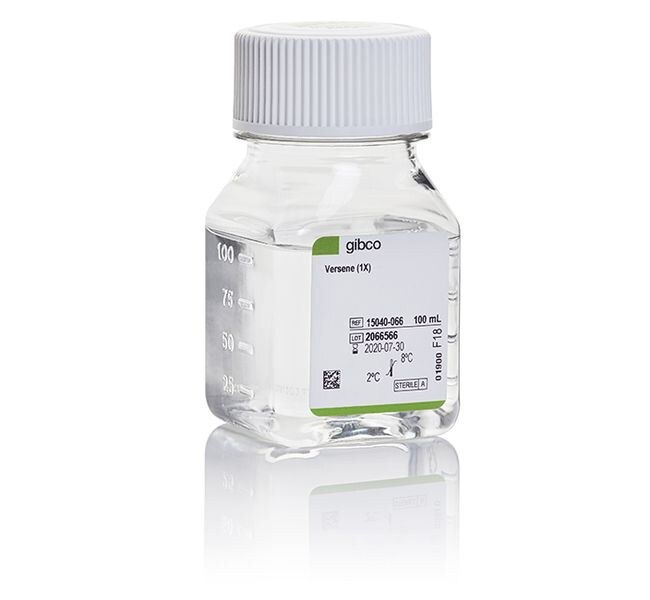
Versene 溶液
乙二胺四乙酸溶液是一种 EDTA 溶液,用作温和的非酶细胞解离试剂。Gibco™ Versene 溶液 (0.48 mM) 配制为每升磷酸盐缓冲盐水 (PBS)了解更多信息
| 货号 | 数量 |
|---|---|
| 15040066 | 100 mL |
货号 15040066
价格(CNY)
257.00
Each
数量:
100 mL
价格(CNY)
257.00
Each
乙二胺四乙酸溶液是一种 EDTA 溶液,用作温和的非酶细胞解离试剂。Gibco™ Versene 溶液 (0.48 mM) 配制为每升磷酸盐缓冲盐水 (PBS) 含 0.2 g EDTA(Na4)。
产品用途
仅供研究使用。不可用于诊断程序。
双现场机制 cGMP 生产和质量体系
Gibco™ 乙二胺四乙酸溶液在位于纽约格兰德岛上符合 cGMP 要求的工厂内生产。该工厂是在FDA登记的医疗器械生产商,且通过ISO 13485标准认证。为确保供应链的稳定,我们同时提供由我们的苏格兰工厂生产的相同 Gibco™ Versene 溶液产品 (15040-033)。后者亦是在FDA登记的医疗仪器生产商,且符合ISO 13485标准。
产品用途
仅供研究使用。不可用于诊断程序。
双现场机制 cGMP 生产和质量体系
Gibco™ 乙二胺四乙酸溶液在位于纽约格兰德岛上符合 cGMP 要求的工厂内生产。该工厂是在FDA登记的医疗器械生产商,且通过ISO 13485标准认证。为确保供应链的稳定,我们同时提供由我们的苏格兰工厂生产的相同 Gibco™ Versene 溶液产品 (15040-033)。后者亦是在FDA登记的医疗仪器生产商,且符合ISO 13485标准。
仅供科研使用。不可用于诊断程序。
规格
螯合剂EDTA
生产质量符合医疗器械 cGMP、21 CFR 第 820 部分和 ISO 13485
数量100 mL
有效期18 个月
运输条件室温
分类无动物来源
产品类型细胞培养解离试剂
无菌无菌过滤
加有添加剂EDTA
Unit SizeEach
内容与储存
储存条件:2 至 8°C
运输条件:环境条件
有效期:自生产之日起 18 个月
运输条件:环境条件
有效期:自生产之日起 18 个月
常见问题解答 (FAQ)
你们提供哪些用于解离细胞的试剂?这些产品之间的主要区别是什么?
在Gibco Essential 8 Flex培养基中培养细胞时,我是否需要在传代过程中加入ROCK抑制剂?
Gibco 乙二胺四乙酸溶液是有效兼容Gibco Essential 8 Flex培养基的推荐解离试剂么?
I currently use mTeSR1. How difficult would it be to adapt my cells to the StemFlex Medium system?
What reagents do you offer for cell dissociation, and what are the main differences between them?
引用和文献 (2)
引用和文献
Abstract
Decreased metallation and activity in subsets of mutant superoxide dismutases associated with familial amyotrophic lateral sclerosis.
Journal:J Biol Chem
PubMed ID:11854284
Over 90 different mutations in the gene encoding copper/zinc superoxide dismutase (SOD1) cause approximately 2% of amyotrophic lateral sclerosis (ALS) cases by an unknown mechanism. We engineered 14 different human ALS-related SOD1 mutants and obtained high yields of biologically metallated proteins from an Sf21 insect cell expression system. Both the
Molecular determinants of receptor binding and signaling by the CX3C chemokine fractalkine.
Journal:J Biol Chem
PubMed ID:11432858
Fractalkine/CX3CL1 is a membrane-tethered chemokine that functions as a chemoattractant and adhesion protein by interacting with the receptor CX3CR1. To understand the molecular basis for the interaction, an extensive mutagenesis study of fractalkine's chemokine domain was undertaken. The results reveal a cluster of basic residues (Lys-8, Lys-15, Lys-37, Arg-45, and