Search


引用和文献 (7)
Invitrogen™
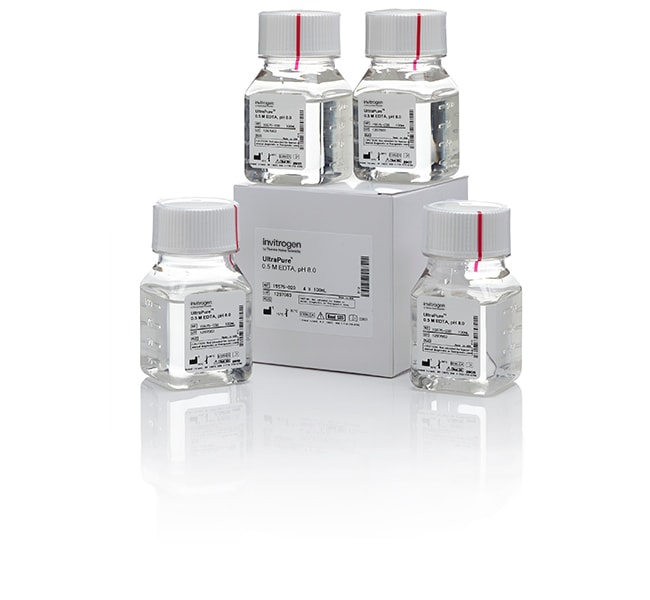
UltraPure™ 0.5M EDTA,pH 值 8.0
UltraPure™ 0.5 M EDTA(pH 值 8.0)是一种水溶液,制备方法为:将 Na2EDTA•2H2O 溶解在蒸馏去离子水中,并使用氢氧化钠将了解更多信息
| 货号 | 数量 |
|---|---|
| 15575020 | 4 x 100 mL |
货号 15575020
价格(CNY)
725.00
飞享价
Ends: 31-Dec-2026
1,417.00共减 692.00 (49%)
Each
数量:
4 x 100 mL
价格(CNY)
725.00
飞享价
Ends: 31-Dec-2026
1,417.00共减 692.00 (49%)
Each
UltraPure™ 0.5 M EDTA(pH 值 8.0)是一种水溶液,制备方法为:将 Na2EDTA•2H2O 溶解在蒸馏去离子水中,并使用氢氧化钠将 pH 值调整至 8.0。这种无菌过滤溶液适用于需要二价金属离子螯合剂的生物化学或分子生物学应用。
仅供科研使用。不可用于诊断程序。
规格
化学名称或材料EDTA
最大浓度0.5 M
适用于(应用)染色质生物学、核酸凝胶电泳、印迹
形式液体
产品线UltraPure
产品类型EDTA
纯度分子生物学级
数量4 x 100 mL
运输条件室温
pHpH 8.0
Unit SizeEach
内容与储存
目录:4 瓶(各 100 mL)UltraPure™ 0.5M EDTA,pH 值 8.0。在室温下储存。
常见问题解答 (FAQ)
I received a shipment of UltraPure 0.5M EDTA, pH 8.0 (Cat. No. 15575020), but it was stored below 15-30 degrees C over the weekend. Can you confirm this product will still be stable?
What is the difference between EDTA and EGTA?
How does EDTA work?
引用和文献 (7)
引用和文献
Abstract
A comprehensive protocol for efficient differentiation of human NPCs into electrically competent neurons.
Journal:Journal of neuroscience methods
PubMed ID:39053772
Nondestructive sampling of human skeletal remains yields ancient nuclear and mitochondrial DNA.
Journal:Am J Phys Anthropol
PubMed ID:22183740
'Museum curators and living communities are sometimes reluctant to permit ancient DNA (aDNA) studies of human skeletal remains because the extraction of aDNA usually requires the destruction of at least some skeletal material. Whether these views stem from a desire to conserve precious materials or an objection to destroying ancestral
Digital gene expression by tag sequencing on the illumina genome analyzer.
Journal:Curr Protoc Hum Genet
PubMed ID:20373513
'This unit provides a protocol for performing digital gene expression profiling on the Illumina Genome Analyzer sequencing platform. Tag sequencing (Tag-seq) is an implementation of the LongSAGE protocol on the Illumina sequencing platform that increases utility while reducing both the cost and time required to generate gene expression profiles. The
DNA extraction from aged skeletal samples for STR typing by capillary electrophoresis.
Journal:Methods Mol Biol
PubMed ID:22139661
STR analysis of DNA extracted from skeletal samples can play an important role in the identification of missing persons. Here we present a method for the extraction of DNA from skeletal samples involving complete demineralization and digestion of the sample, followed by purification by silica binding. This method, together with
Lentiviral transduction and clonal selection of hESCs with endothelial-specific transgenic reporters.
Journal:Curr Protoc Stem Cell Biol
PubMed ID:21509935
Generation of vascular endothelial cells (EC) from human embryonic stem cells (hESC) is a vital component of cell-based strategies for treatment of cardiovascular disease. Before hESC-derived ECs can be administered in therapeutic modalities, however, chemically defined culture conditions must be developed that reproducibly and robustly induce vascular differentiation. One approach