Search


引用和文献 (8)
Invitrogen™
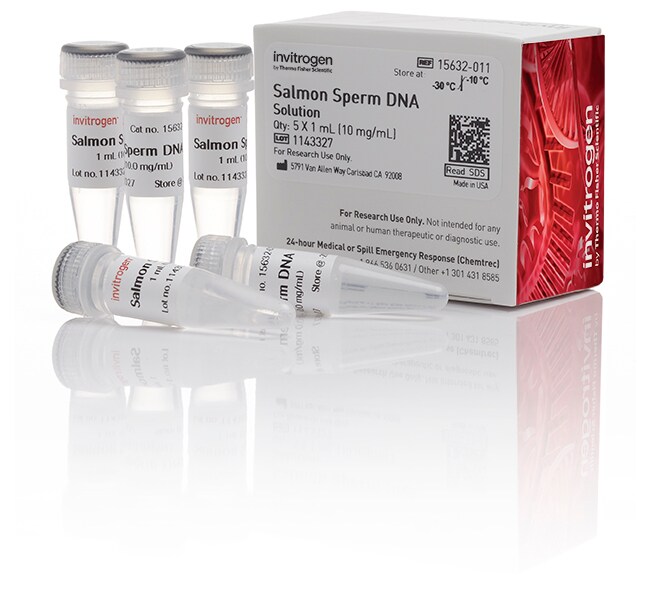
UltraPure™ 鲑鱼精子 DNA 溶液
UltraPure™ 鲑鱼精子 DNA 溶液是一种已剪切的即用型 DNA 溶液,可直接用于制备预杂交和杂交溶液。该 DNA 溶液制备自使用苯酚/氯仿提取的高纯 DNA了解更多信息
| 货号 | 数量 |
|---|---|
| 15632011 | 5 x 1 mL |
货号 15632011
价格(CNY)
1,540.00
飞享价
Ends: 31-Dec-2026
2,962.00共减 1,422.00 (48%)
Each
数量:
5 x 1 mL
价格(CNY)
1,540.00
飞享价
Ends: 31-Dec-2026
2,962.00共减 1,422.00 (48%)
Each
UltraPure™ 鲑鱼精子 DNA 溶液是一种已剪切的即用型 DNA 溶液,可直接用于制备预杂交和杂交溶液。该 DNA 溶液制备自使用苯酚/氯仿提取的高纯 DNA 和不含 DNase 与 RNase(经 DEPC 处理)的去离子蒸馏水。DNA 经过剪切,平均大小 ≤ 2,000 bp。将浓度调整为 10 mg/mL。
应用
这类溶液用于阻断探针与膜表面的非特异性吸附。
性能和质量检测
对浓度、大小确认、黏度和紫外吸收 (A260/A280) 进行分析检测。
应用
这类溶液用于阻断探针与膜表面的非特异性吸附。
性能和质量检测
对浓度、大小确认、黏度和紫外吸收 (A260/A280) 进行分析检测。
仅供科研使用。不可用于诊断程序。
规格
适用于(应用)染色质生物学、核酸凝胶电泳、印迹
关键功能阻断非特异性杂交
产品线UltraPure
产品类型鲑鱼精子 DNA 溶液
数量5 x 1 mL
试剂类型鲑鱼精子 DNA
运输条件干冰
Unit SizeEach
内容与储存
内容物:5 管鲑鱼精子 DNA 溶液(各 1 mL,10 mg/mL)
UltraPure™ 鲑鱼精子 DNA 在 -20°C 下可保持稳定 1 年。除非产品文件中另有说明,否则产品可保证自购买日期起 6 个月内质量合格。
UltraPure™ 鲑鱼精子 DNA 在 -20°C 下可保持稳定 1 年。除非产品文件中另有说明,否则产品可保证自购买日期起 6 个月内质量合格。
常见问题解答 (FAQ)
What species of salmon is Ultrapure Salmon Sperm DNA derived from?
Is Ultrapure Salmon Sperm DNA double stranded? How can I make it single stranded?
What concentration should the UltraPure Salmon Sperm DNA Solution (Cat. No. 15632011) be used at?
引用和文献 (8)
引用和文献
Abstract
The human organic cation transporter (hOCT2) recognizes the degree of substrate ionization.
Journal:J Biol Chem
PubMed ID:11953440
'The organic cation transporter, OCT2, plays a role in renal secretion of a broad array of weak bases. To determine whether the degree of ionization of these compounds plays a role in their interaction with OCT2, we examined the influence of external pH values on the activity of the human
The role of polymer nanolayer architecture on the separation performance of anion-exchange membrane adsorbers: part II. DNA and virus separations.
Journal:Biotechnol Bioeng
PubMed ID:21618476
'The surface-initiated polymerization protocol developed in part I was used to prepare strong anion-exchange membranes with variable polymer chain graft densities and degrees of polymerization for DNA and virus particle separations. A focus of part II was to evaluate the role of polymer nanolayer architecture on DNA and virus binding.
Spectrophotometric analysis of nucleic acids: oxygenation-dependent hyperchromism of DNA.
Journal:Anal Bioanal Chem
PubMed ID:20169336
'The absorbance at 260 nm (A(260)) is ubiquitously used for nucleic acid quantification. We show that following oxygenation, DNA solutions experience alterations in both spectral properties (hyperchromism in the UV region, lambda(max) 260 nm) and DNA conformation. The spectral changes caused by oxygen-DNA complexation are stable for at least several
A quantitative real-time polymerase chain reaction assay for the seagrass pathogen Labyrinthula zosterae.
Journal:Mol Ecol Resour
PubMed ID:21777400
'The protist Labyrinthula zosterae (Phylum Bigyra, sensu Tsui et al. 2009) has been identified as a causative agent of wasting disease in eelgrass (Zostera marina), of which the most intense outbreak led to the destruction of 90% of eelgrass beds in eastern North America and western Europe in the 1930s.
Noncoding DNA in lipofection of HeLa cells-a few insights.
Journal:Mol Pharm
PubMed ID:23421924
'In cationic carrier-mediated gene delivery, the disproportional relationship between the quantity of delivered DNA and the amount of encoded protein produced is a well-known phenomenon. The numerous intracellular barriers which need to be overcome by pDNA to reach the nucleoplasm play a major role in it. In contrast to what