Search


引用和文献 (6)
Invitrogen™
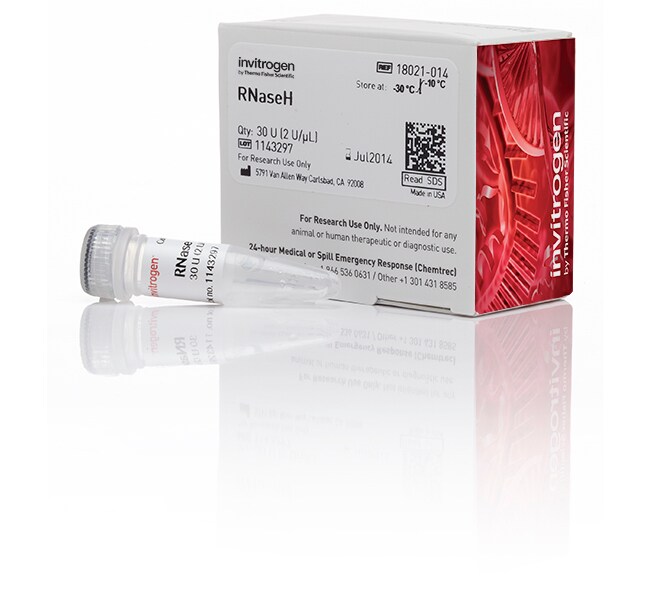
核糖核酸酶 H
核糖核酸酶 H (RNase H) 是一种核糖核酸内切酶,可特异性降解 RNA-DNA 杂交体中的 RNA 链,生成 5´了解更多信息
Have Questions?
更改视图

| 货号 | 数量 |
|---|---|
| 18021014 | 30 U |
| 18021071 | 120 U |
货号 18021014
价格(CNY)
2,025.00
飞享价
Ends: 31-Dec-2026
3,116.00共减 1,091.00 (35%)
Each
数量:
30 U
价格(CNY)
2,025.00
飞享价
Ends: 31-Dec-2026
3,116.00共减 1,091.00 (35%)
Each
核糖核酸酶 H (RNase H) 是一种核糖核酸内切酶,可特异性降解 RNA-DNA 杂交体中的 RNA 链,生成 5´ 磷酸封端的寡核糖核苷酸和单链 DNA。
应用
在第二链 cDNA 合成过程中去除 mRNA。在 Oligo(dT) 存在的情况下从 mRNA 去除 poly(A) 序列。寡脱氧核苷酸介导的 RNA 切割。
来源
从在质粒上表达大肠杆菌 RNase H 基因的大肠杆菌中纯化获得。
性能和质量检测
核糖核酸酶、非特异性脱氧核糖核酸内切酶、3´ 和 5´ 脱氧核糖核酸外切酶。
单位定义
一个单位的酶量可于 37°C 下在 20 min 内将 3H 标记 poly(A)poly(dT) 中的 1 nmol RNA 水解为酸溶性物质。
单位反应条件
20 mM Tris-HCl(pH 值 7.5)、0.1M KCl、10 mM MgCl2、0.1 mM DTT、5% (w/v) 蔗糖、0.5 nmol 3H 标记 poly(A)poly(dT) 和 50 µL 酶,37°C 下 20 min。
应用
在第二链 cDNA 合成过程中去除 mRNA。在 Oligo(dT) 存在的情况下从 mRNA 去除 poly(A) 序列。寡脱氧核苷酸介导的 RNA 切割。
来源
从在质粒上表达大肠杆菌 RNase H 基因的大肠杆菌中纯化获得。
性能和质量检测
核糖核酸酶、非特异性脱氧核糖核酸内切酶、3´ 和 5´ 脱氧核糖核酸外切酶。
单位定义
一个单位的酶量可于 37°C 下在 20 min 内将 3H 标记 poly(A)poly(dT) 中的 1 nmol RNA 水解为酸溶性物质。
单位反应条件
20 mM Tris-HCl(pH 值 7.5)、0.1M KCl、10 mM MgCl2、0.1 mM DTT、5% (w/v) 蔗糖、0.5 nmol 3H 标记 poly(A)poly(dT) 和 50 µL 酶,37°C 下 20 min。
仅供科研使用。不可用于诊断程序。
规格
产品类型核糖核酸酶 H
数量30 U
运输条件经批准可置于湿冰或干冰上运输
最大浓度2 U/μL
酶RNase
Unit SizeEach
内容与储存
1 样品瓶核糖核酸酶 H 含 30 个单位,浓度为 2 U/µL
储存在 -20°C 非自动除霜冷冻冰箱中。
储存在 -20°C 非自动除霜冷冻冰箱中。
常见问题解答 (FAQ)
Do you offer RNAse H from the SuperScript III First Strand Synthesis System as a stand-alone item?
Which components of the SuperScript III First Strand Synthesis System for RT-PCR are available for purchase separately?
引用和文献 (6)
引用和文献
Abstract
Functions of Transforming Growth Factor-beta Family Type I Receptors and Smad Proteins in the Hypertrophic Maturation and Osteoblastic Differentiation of Chondrocytes.
Journal:J Biol Chem
PubMed ID:12082094
'We investigated the effects of bone morphogenetic protein (BMP)-2, a member of the transforming growth factor-beta superfamily, on the regulation of the chondrocyte phenotype, and we identified signaling molecules involved in this regulation. BMP-2 triggers three concomitant responses in mouse primary chondrocytes and chondrocytic MC615 cells. First, BMP-2 stimulates expression
De novo ceramide regulates the alternative splicing of caspase 9 and Bcl-x in A549 lung adenocarcinoma cells. Dependence on protein phosphatase-1.
Journal:J Biol Chem
PubMed ID:11801602
'In a recent study, we showed that ceramide induces the dephosphorylation of SR proteins, a family of protein factors that regulate alternative splicing. In this study, the regulation of the alternative processing of pre-mRNA of both caspase 9 and Bcl-x(L) was examined in response to ceramide. Treatment of A549 lung
The novel WD-repeat protein MORG1 acts as a molecular scaffold for HIF prolyl-hydroxylase 3 (PHD3).
Journal:J Biol Chem
PubMed ID:16407229
'Hypoxia-inducible factor-1 (HIF-1), a transcriptional complex composed of an oxygen-sensitive alpha- and a beta-subunit, plays a pivotal role in cellular adaptation to low oxygen availability. Under normoxia, the alpha-subunit of HIF-1 is hydroxylated by a family of prolyl hydroxylases (PHDs) and consequently targeted for proteasomal degradation. Three different prolyl hydroxylases
High-sensitivity detection of DNA hybridization on microarrays using resonance light scattering.
Journal:Anal Chem
PubMed ID:11985309
The application of resonance light scattering (RLS) particles for high-sensitivity detection of DNA hybridization on cDNA microarrays is demonstrated. Arrays composed of approximately 2000 human genes (
mRNA decay is rapidly induced after spore germination of Saccharomyces cerevisiae.
Journal:J Biol Chem
PubMed ID:12181322
Spores from the yeast Saccharomyces cerevisiae can germinate and resume their vegetative growth when placed in favorable conditions. Biochemical studies on germination have been limited by the difficulty of obtaining a pure population of spores germinating synchronously. Here, we report that spores can be purified and sorted according to their