Search


引用和文献 (7)
Invitrogen™
Subcloning Efficiency™ DH5α 感受态细胞
Subcloning Efficiency DH5α 感受态细胞是化学感受态细胞的通用细胞株,可提供 >1 x 10⁶ cfu/μg 质粒 DNA了解更多信息
| 货号 | 数量 |
|---|---|
| 18265017 | 4 x 500μL |
货号 18265017
价格(CNY)
728.00
飞享价
Ends: 31-Dec-2026
910.00共减 182.00 (20%)
Each
数量:
4 x 500μL
价格(CNY)
728.00
飞享价
Ends: 31-Dec-2026
910.00共减 182.00 (20%)
Each
Subcloning Efficiency DH5α 感受态细胞是化学感受态细胞的通用细胞株,可提供 >1 x 10⁶ cfu/μg 质粒 DNA 的转化效率。Subcloning Efficiency DH5α 感受态细胞是常规亚克隆程序或起始 DNA 不受限制的任何应用的经济解决方案。
Subcloning Efficiency DH5α 感受态细胞的特点:
•专为常规、日常使用而设计
•包含可用于常规应用的遗传标记
适用于常规亚克隆程序
推荐使用 Subcloning Efficiency DH5α 感受态细胞将基因常规亚克隆至质粒载体中,但其不适用于 cDNA 文库的生成。这些经济的细胞可产生 >1 x 10⁶ 转化体/μg 对照 DNA/50 μL 反应。
灵活的克隆功能
Subcloning Efficiency DH5α 感受态细胞包含以下基因标志物,因此具有以下优势:
•lacZΔM15 可用于在含 X-gal 或 Bluo-gal 的平板上对菌落进行蓝白斑筛选
• recA1 可确保增加插入片段稳定性并防止不需要的重组
• endA1 可提高小提中制备的质粒 DNA 的得率和质量
• DH5α 感受态细胞支持 M13mp 载体复制但不支持斑块形成
基因型:F- Φ80lacZΔM15 Δ(lacZYA-argF) U169 recA1 endA1 hsdR17(rk-, mk+) phoA supE44 thi-1 gyrA96 relA1 λ-
Subcloning Efficiency DH5α 感受态细胞的特点:
•专为常规、日常使用而设计
•包含可用于常规应用的遗传标记
适用于常规亚克隆程序
推荐使用 Subcloning Efficiency DH5α 感受态细胞将基因常规亚克隆至质粒载体中,但其不适用于 cDNA 文库的生成。这些经济的细胞可产生 >1 x 10⁶ 转化体/μg 对照 DNA/50 μL 反应。
灵活的克隆功能
Subcloning Efficiency DH5α 感受态细胞包含以下基因标志物,因此具有以下优势:
•lacZΔM15 可用于在含 X-gal 或 Bluo-gal 的平板上对菌落进行蓝白斑筛选
• recA1 可确保增加插入片段稳定性并防止不需要的重组
• endA1 可提高小提中制备的质粒 DNA 的得率和质量
• DH5α 感受态细胞支持 M13mp 载体复制但不支持斑块形成
基因型:F- Φ80lacZΔM15 Δ(lacZYA-argF) U169 recA1 endA1 hsdR17(rk-, mk+) phoA supE44 thi-1 gyrA96 relA1 λ-
仅供科研使用。不可用于诊断程序。
规格
耐抗生素细菌No
蓝色/白色筛查是
是否可克隆甲基化 DNA是
克隆不稳定 DNA不适合克隆不稳定DNA
是否含 F' 附加体缺乏 F’附加体
高通量能力不兼容高通量应用(手动)
提高质粒质量是
制备无甲基化 DNA不适合制备未甲基化DNA
产品线DH5a, Subcloning Efficiency
产品类型感受态细胞
数量4 x 500μL
减少克隆重组现象是
运输条件干冰
T1 噬菌体 - 抗性 (tonA)否
转化效率级别亚克隆效率 (10^6-10^7 cfu⁄μg)
产品规格One Shot
种属大肠杆菌
Unit SizeEach
内容与储存
包含:
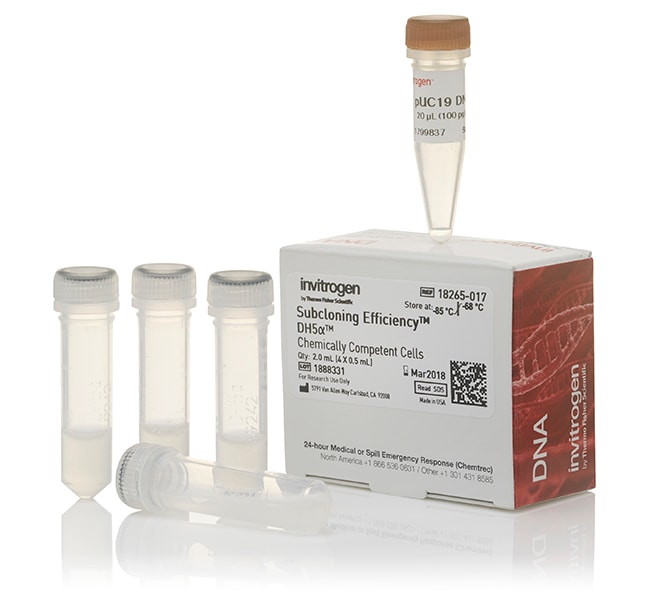
• Subcloning Efficiency DH5α 感受态细胞:4 个小瓶,各 500 μL(总计 2 mL)
• pUC19 DNA (100 pg/uL):1 个小瓶,20 μL
在 -80°C 下储存感受态细胞。在 -20°C 下储存 pUC19 DNA。
• Subcloning Efficiency DH5α 感受态细胞:4 个小瓶,各 500 μL(总计 2 mL)
• pUC19 DNA (100 pg/uL):1 个小瓶,20 μL
在 -80°C 下储存感受态细胞。在 -20°C 下储存 pUC19 DNA。
常见问题解答 (FAQ)
我正在尝试克隆一个毒性可能非常大的插入片段。我使用过DH5α和TOP10细胞进行转化但是没有在平板上得到克隆。你们能为我提供一些建议吗?
你们提供Subcloning Efficiency、Library Efficiency和MAX Efficiency感受态细胞。它们的区别是什么?
I am trying to clone an insert that is supposedly pretty toxic. I used DH5? and TOP10 cells for the transformation and got no colonies on the plate. Do you have any suggestions for me?
How do you recommend that I prepare my DNA for successful electroporation of E. coli?
You offer competent cells in Subcloning Efficiency, Library Efficiency and MAX Efficiency. How do these differ?
引用和文献 (7)
引用和文献
Abstract
Modified gateway system for double shRNA expression and Cre/lox based gene expression.
Journal:BMC Biotechnol
PubMed ID:21418658
'The growing need for functional studies of genes has set the stage for the development of versatile tools for genetic manipulations. Aiming to provide tools for high throughput analysis of gene functions, we have developed a modified short hairpin RNA (shRNA) and gene expression system based on Gateway Technology. The
Multicolor and electron microscopic imaging of connexin trafficking.
Journal:Science
PubMed ID:11964472
'Recombinant proteins containing tetracysteine tags can be successively labeled in living cells with different colors of biarsenical fluorophores so that older and younger protein molecules can be sharply distinguished by both fluorescence and electron microscopy. Here we used this approach to show that newly synthesized connexin43 was transported predominantly in
Studies of the properties of human origin recognition complex and its Walker A motif mutants.
Journal:Proc Natl Acad Sci U S A
PubMed ID:15618391
The eukaryotic six-subunit origin recognition complex (ORC) governs the initiation site of DNA replication and formation of the prereplication complex. In this report we describe the isolation of the wild-type Homo sapiens (Hs)ORC and variants containing a Walker A motif mutation in the Orc1, Orc4, or Orc5 subunit using the
Requirement for either a host- or pectin-induced pectate lyase for infection of pisum sativum by nectriahematococca.
Journal:Proc Natl Acad Sci U S A
PubMed ID:10931947
Fungal pathogens usually have multiple genes that encode extracellular hydrolytic enzymes that may degrade the physical barriers in their hosts during the invasion process. Nectria hematococca, a plant pathogen, has two inducible pectate lyase (PL) genes (pel) encoding PL that can help degrade the carbohydrate barrier in the host. pelA
UDP-glucuronate Decarboxylase, a Key Enzyme in Proteoglycan Synthesis. CLONING, CHARACTERIZATION, AND LOCALIZATION.
Journal:J Biol Chem
PubMed ID:11877387
UDP-glucuronate decarboxylase (UGD) catalyzes the formation of UDP-xylose from UDP-glucuronate. UDP-xylose is then used to initiate glycosaminoglycan biosynthesis on the core protein of proteoglycans. In a yeast two-hybrid screen with the protein kinase Akt (protein kinase B), we detected interactions with a novel sequence, which we cloned and expressed. The