Search


引用和文献 (13)
Thermo Scientific™
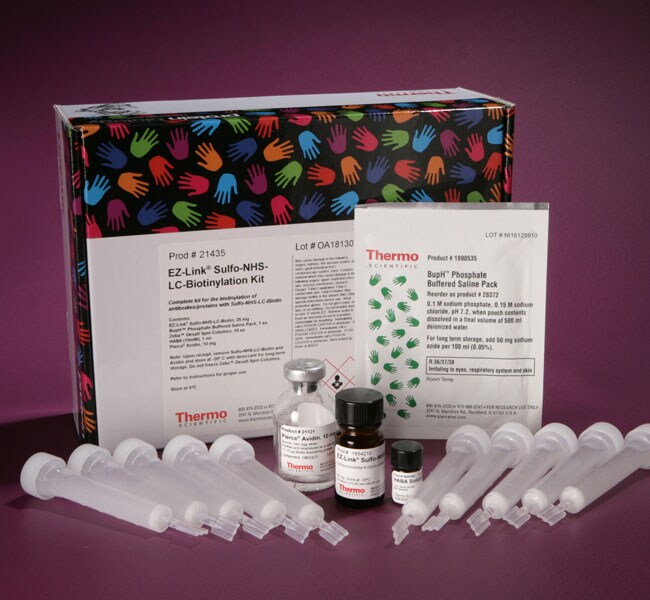
EZ-Link™ Sulfo-NHS-LC-生物素化试剂盒
The Thermo Scientific EZ-Link Sulfo-NHS-LC-Biotinylation Kit contains reagents sufficient for 10 biotinylation reactions (e.g., 1–10 mg antibody per reaction). The了解更多信息
| 货号 | 数量 |
|---|---|
| 21435 | 10 reactions |
货号 21435
价格(CNY)
8,162.00
Each
数量:
10 reactions
价格(CNY)
8,162.00
Each
The Thermo Scientific EZ-Link Sulfo-NHS-LC-Biotinylation Kit contains reagents sufficient for 10 biotinylation reactions (e.g., 1–10 mg antibody per reaction). The EZ-Link Sulfo-NHS-LC-Biotin reagent included in the kit is an intermediate-length, water-soluble biotinylation reagent for labeling antibodies, proteins, and other molecules that have primary amines.
Features of EZ-Link Sulfo-NHS-LC-Biotin:
• Protein labeling—biotinylate antibodies to facilitate immobilization, purification or detection using streptavidin resins or probes
• Cell surface labeling—biotinylates only surface proteins of whole cells because the negatively charged reagent does not permeate cell membranes
• Amine-reactive—reacts with primary amines (-NH2), such as lysine side-chains, or the amino-termini of polypeptides
• Soluble—charged sulfo-NHS group increases reagent water solubility compared to ordinary NHS-ester compounds
• Irreversible—forms permanent amide bonds; spacer arm cannot be cleaved
• Medium length—spacer arm (total length added to target) is 22.4 angstroms; provides excellent balance between adequate length (minimal steric hindrance for biotin binding) and modest mass
Sulfo-NHS-LC-Biotin is one of three very similar EZ-Link Reagents that are water-soluble, non-cleavable, and enable simple and efficient biotinylation of antibodies, proteins and any other primary amine-containing macromolecules in solution. Specific labeling of cell surface proteins is another common application for these uniquely water-soluble and membrane impermeable reagents. Differing only in their spacer arm lengths, the three Sulfo-NHS-ester reagents offer the possibility of optimizing labeling and detection experiments where steric hindrance of biotin binding is an important factor. Sulfo-NHS-LC-Biotin is offered in several package sizes and as complete protein labeling kits.
We manufacture biotin reagents to ensure the highest possible overall product integrity, consistency, and performance for the intended research applications.
N-Hydroxysulfosuccinimide (NHS) esters of biotin are the most popular type of biotinylation reagent. NHS-activated biotins react efficiently with primary amino groups (-NH2) in alkaline buffers to form stable amide bonds. Proteins (e.g., antibodies) typically have several primary amines that are available as targets for labeling, including the side chain of lysine (K) residues and the N-terminus of each polypeptide.
Varieties of biotin NHS-ester reagents differ in length, solubility, cell permeability and cleavability. Non-sulfonated NHS-biotins are cell permeable but must be dissolved in organic solvent such as DMSO or DMF. Sulfo-NHS biotins (and those with pegylated spacers) are directly water soluble but not membrane permeable. Varieties containing disulfide bonds can be cleaved using reducing agents, enabling the biotin group to be disconnected from the labeled protein.
Related Products
EZ-Link™ Sulfo-NHS-LC-Biotin
EZ-Link™ Micro Sulfo-NHS-LC-Biotinylation Kit
Features of EZ-Link Sulfo-NHS-LC-Biotin:
• Protein labeling—biotinylate antibodies to facilitate immobilization, purification or detection using streptavidin resins or probes
• Cell surface labeling—biotinylates only surface proteins of whole cells because the negatively charged reagent does not permeate cell membranes
• Amine-reactive—reacts with primary amines (-NH2), such as lysine side-chains, or the amino-termini of polypeptides
• Soluble—charged sulfo-NHS group increases reagent water solubility compared to ordinary NHS-ester compounds
• Irreversible—forms permanent amide bonds; spacer arm cannot be cleaved
• Medium length—spacer arm (total length added to target) is 22.4 angstroms; provides excellent balance between adequate length (minimal steric hindrance for biotin binding) and modest mass
Sulfo-NHS-LC-Biotin is one of three very similar EZ-Link Reagents that are water-soluble, non-cleavable, and enable simple and efficient biotinylation of antibodies, proteins and any other primary amine-containing macromolecules in solution. Specific labeling of cell surface proteins is another common application for these uniquely water-soluble and membrane impermeable reagents. Differing only in their spacer arm lengths, the three Sulfo-NHS-ester reagents offer the possibility of optimizing labeling and detection experiments where steric hindrance of biotin binding is an important factor. Sulfo-NHS-LC-Biotin is offered in several package sizes and as complete protein labeling kits.
We manufacture biotin reagents to ensure the highest possible overall product integrity, consistency, and performance for the intended research applications.
N-Hydroxysulfosuccinimide (NHS) esters of biotin are the most popular type of biotinylation reagent. NHS-activated biotins react efficiently with primary amino groups (-NH2) in alkaline buffers to form stable amide bonds. Proteins (e.g., antibodies) typically have several primary amines that are available as targets for labeling, including the side chain of lysine (K) residues and the N-terminus of each polypeptide.
Varieties of biotin NHS-ester reagents differ in length, solubility, cell permeability and cleavability. Non-sulfonated NHS-biotins are cell permeable but must be dissolved in organic solvent such as DMSO or DMF. Sulfo-NHS biotins (and those with pegylated spacers) are directly water soluble but not membrane permeable. Varieties containing disulfide bonds can be cleaved using reducing agents, enabling the biotin group to be disconnected from the labeled protein.
Related Products
EZ-Link™ Sulfo-NHS-LC-Biotin
EZ-Link™ Micro Sulfo-NHS-LC-Biotinylation Kit
仅供科研使用。不可用于诊断程序。
规格
描述EZ-Link Sulfo-NHS-LC-生物素化试剂盒
标记规模1 至 10 mg
产品线EZ-Link
产品类型Sulfo-NHS-LC-生物素化试剂盒
数量10 reactions
标记目标抗体, 蛋白
标签或染料生物素
溶解度水
Unit SizeEach
内容与储存
足够用于:10 次标记反应,每次 1 至 10 mg 抗体
•EZ-Link Sulfo-NHS-LC-生物素,25 mg
•PBS 包(制成 500 mL),1 包
•Zeba 脱盐离心柱 (7K MWCO),5 mL,10 个柱
•HABA 溶液,1 mL
•亲和素,10 mg
在 -20°C 下储存生物素和亲和素试剂。在 4°C 下储存剩余的试剂盒组分。
•EZ-Link Sulfo-NHS-LC-生物素,25 mg
•PBS 包(制成 500 mL),1 包
•Zeba 脱盐离心柱 (7K MWCO),5 mL,10 个柱
•HABA 溶液,1 mL
•亲和素,10 mg
在 -20°C 下储存生物素和亲和素试剂。在 4°C 下储存剩余的试剂盒组分。
常见问题解答 (FAQ)
In the EZ-Link Sulfo-NHS-LC-Biotinylation kit, what groups does Sulfo-NHS-LC-Biotin react with for biotinylation?
How do the EZ-Link Micro Biotinylation Kits differ from the standard biotinylation kits?
Can you provide the shelf-life for EZ-Link Sulfo-NHS-LC-Biotinylation Kit?
Is there any advantage of choosing a Sulfo-NHS biotin with a longer spacer arm than EZ-Link Sulfo NHS Biotin?
Why would I chose a Sulfo-NHS Biotin over its non-sulfonated counterpart?
引用和文献 (13)
引用和文献
Abstract
Capture and display of antibodies secreted by hybridoma cells enables fluorescent on-cell screening.
Journal:MAbs
PubMed ID:30794061
'Hybridoma methods for monoclonal antibody (mAb) cloning are a mainstay of biomedical research, but they are hindered by the need to maintain hybridomas in oligoclonal pools during antibody screening. Here, we describe a system in which hybridomas specifically capture and display the mAbs they secrete: On-Cell mAb Screening (OCMS™). In
HIV-1 Envelope Recognition by Polyreactive and Cross-Reactive Intestinal B Cells.
Journal:Cell Rep
PubMed ID:30970259
'Mucosal immune responses to HIV-1 involve the recognition of the viral envelope glycoprotein (gp)160 by tissue-resident B cells and subsequent secretion of antibodies. To characterize the B cells "sensing" HIV-1 in the gut of infected individuals, we probed monoclonal antibodies produced from single intestinal B cells binding to recombinant gp140
Optimizing ultrasound molecular imaging of secreted frizzled related protein 2 expression in angiosarcoma.
Journal:PLoS One
PubMed ID:28333964
Secreted frizzled related protein 2 (SFRP2) is a tumor endothelial marker expressed in angiosarcoma. Previously, we showed ultrasound molecular imaging with SFRP2-targeted contrast increased average video pixel intensity (VI) of angiosarcoma vessels by 2.2 ± 0.6 VI versus streptavidin contrast. We hypothesized that redesigning our contrast agents would increase imaging
BDNF inhibits neurodegenerative disease-associated asparaginyl endopeptidase activity via phosphorylation by AKT.
Journal:JCI Insight
PubMed ID:30135302
AEP is an age-dependent lysosomal asparaginyl endopeptidase that cleaves numerous substrates including tau and a-synuclein and mediates their pathological roles in neurodegenerative diseases. However, the molecular mechanism regulating this critical protease remains incompletely understood. Here, we show that Akt phosphorylates AEP on residue T322 upon brain-derived neurotrophic factor (BDNF) treatment
Targeting CD46 for both adenocarcinoma and neuroendocrine prostate cancer.
Journal:JCI Insight
PubMed ID:30185663
Although initially responsive to androgen signaling inhibitors (ASIs), metastatic castration-resistant prostate cancer (mCRPC) inevitably develops and is incurable. In addition to adenocarcinoma (adeno), neuroendocrine prostate cancer (NEPC) emerges to confer ASI resistance. We have previously combined laser capture microdissection and phage antibody display library selection on human cancer specimens and