Search


引用和文献 (8)
Thermo Scientific™
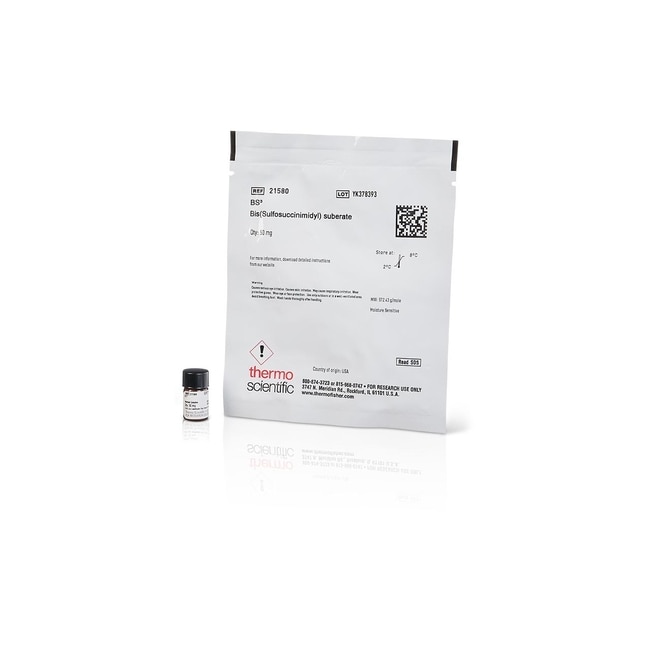
BS3 (二(磺基琥珀酰亚胺)辛二酸酯)
Thermo Scientific Pierce BS3(磺基-DSS)是二(磺基琥珀酰亚胺)辛二酸酯,一种同型双功能、水溶性、不可裂解和膜不通透性的胺-胺交联剂。BS3 在8个碳原子间隔臂的每个末端有一个胺反应性了解更多信息
Have Questions?
更改视图

| 货号 | 数量 |
|---|---|
| 21580 | 50 mg |
| A39266 | 10 x 2 mg |
| 21586 | 1 g |
货号 21580
价格(CNY)
2,452.00
Each
数量:
50 mg
价格(CNY)
2,452.00
Each
Thermo Scientific Pierce BS3(磺基-DSS)是二(磺基琥珀酰亚胺)辛二酸酯,一种同型双功能、水溶性、不可裂解和膜不通透性的胺-胺交联剂。
BS3 在8个碳原子间隔臂的每个末端有一个胺反应性 N-羟基磺基琥珀酰亚胺 (NHS) 酯。NHS 酯在 pH 7-9 条件下与伯胺反应可形成稳定的酰胺键,同时释放 N-羟基磺基琥珀酰亚胺离去基团。蛋白(包括抗体)通常在赖氨酸 (K) 残基的侧链和每个多肽的 N 端有若干伯胺,这些伯胺可用作 NHS 酯交联试剂的靶标。
No-Weigh 微量管处理:
八个微量管各含 2 mg 交联剂。用移液器吸头刺穿铝箔,并在 DSS 中加入 DMSO 或 DMF,或者在 BS3 中加入水缓冲液。将微量管排塞储存于提供的铝箔袋中。使用过的微量管可从未使用的微量管上切断并丢弃。
BS3 的特点:
•反应基团:磺基-NHS 酯(两端)
• 可与以下基团发生反应:氨基基团(伯胺)
• 胺反应性磺基-NHS 酯与任何含伯胺分子迅速反应
•水溶性;与 DSS 具有可比性
• 具有膜不通透性以便进行细胞表面标记
• 高纯度结晶试剂可用于生成高纯度交联偶联物
因为它包含亲水磺酰基团,BS3 交联剂可溶于水和许多常用缓冲液中达到 ∼∼100 mM,因此避免了使用可能会破坏蛋白结构的有机溶剂。BS3 的水溶性类似物 DSS 也适用于需要不太亲水性的交联剂(例如为了产生细胞内交联)的应用。DSS 和 BS3 对于伯胺的交联活性基本相同。
BS3 的特点:
• 其他名称:磺基-DSS
• 分子式:C16H18N2O14S2Na2
• 分子量:572.43
•间隔臂长度:11.4Å(8个原子)
• CAS 编号:82436-77-9
• 反应基团:NHS 酯,在 pH 7.0–9.0 条件下与伯胺发生反应
应用:
• 在细胞裂解和免疫沉淀前进行细胞表面蛋白的交联
• 通过化学交联识别受体-配体相互作用
• “固定”蛋白相互作用,以便识别较弱或瞬时蛋白相互作用
• 识别邻近的蛋白相互作用
• 进行蛋白交联,以通过单步反应产生生物偶联物
• 将蛋白固定到胺包被的表面上
BS3 规格:
我们按照较高规格生产 BS3,以生产高特异性生物偶联物,确保您数据的完整性,并为您提供较高程度的一致性。BS3 的每个批次都经过检测,符合以下最低规格:
•纯度:>93%(通过 NMR 法定量,交联剂纯度的较高标准)
• 溶解度:> 5.8 mg/mL(溶于 DI 水),无不溶性材料的透明溶液
产品参考文献
交联剂应用指南 -- 检索本产品的较新参考文献
相关产品
Pierce™ 优级 BS3
DSS(辛二酸二琥珀酰亚胺)
BS(PEG)5(聚乙二醇化二(磺基琥珀酰亚胺基)辛二酸)
BS(PEG)9(聚乙二醇化二(磺基琥珀酰亚胺基)辛二酸)
BS3 在8个碳原子间隔臂的每个末端有一个胺反应性 N-羟基磺基琥珀酰亚胺 (NHS) 酯。NHS 酯在 pH 7-9 条件下与伯胺反应可形成稳定的酰胺键,同时释放 N-羟基磺基琥珀酰亚胺离去基团。蛋白(包括抗体)通常在赖氨酸 (K) 残基的侧链和每个多肽的 N 端有若干伯胺,这些伯胺可用作 NHS 酯交联试剂的靶标。
No-Weigh 微量管处理:
八个微量管各含 2 mg 交联剂。用移液器吸头刺穿铝箔,并在 DSS 中加入 DMSO 或 DMF,或者在 BS3 中加入水缓冲液。将微量管排塞储存于提供的铝箔袋中。使用过的微量管可从未使用的微量管上切断并丢弃。
BS3 的特点:
•反应基团:磺基-NHS 酯(两端)
• 可与以下基团发生反应:氨基基团(伯胺)
• 胺反应性磺基-NHS 酯与任何含伯胺分子迅速反应
•水溶性;与 DSS 具有可比性
• 具有膜不通透性以便进行细胞表面标记
• 高纯度结晶试剂可用于生成高纯度交联偶联物
因为它包含亲水磺酰基团,BS3 交联剂可溶于水和许多常用缓冲液中达到 ∼∼100 mM,因此避免了使用可能会破坏蛋白结构的有机溶剂。BS3 的水溶性类似物 DSS 也适用于需要不太亲水性的交联剂(例如为了产生细胞内交联)的应用。DSS 和 BS3 对于伯胺的交联活性基本相同。
BS3 的特点:
• 其他名称:磺基-DSS
• 分子式:C16H18N2O14S2Na2
• 分子量:572.43
•间隔臂长度:11.4Å(8个原子)
• CAS 编号:82436-77-9
• 反应基团:NHS 酯,在 pH 7.0–9.0 条件下与伯胺发生反应
应用:
• 在细胞裂解和免疫沉淀前进行细胞表面蛋白的交联
• 通过化学交联识别受体-配体相互作用
• “固定”蛋白相互作用,以便识别较弱或瞬时蛋白相互作用
• 识别邻近的蛋白相互作用
• 进行蛋白交联,以通过单步反应产生生物偶联物
• 将蛋白固定到胺包被的表面上
BS3 规格:
我们按照较高规格生产 BS3,以生产高特异性生物偶联物,确保您数据的完整性,并为您提供较高程度的一致性。BS3 的每个批次都经过检测,符合以下最低规格:
•纯度:>93%(通过 NMR 法定量,交联剂纯度的较高标准)
• 溶解度:> 5.8 mg/mL(溶于 DI 水),无不溶性材料的透明溶液
产品参考文献
交联剂应用指南 -- 检索本产品的较新参考文献
相关产品
Pierce™ 优级 BS3
DSS(辛二酸二琥珀酰亚胺)
BS(PEG)5(聚乙二醇化二(磺基琥珀酰亚胺基)辛二酸)
BS(PEG)9(聚乙二醇化二(磺基琥珀酰亚胺基)辛二酸)
仅供科研使用。不可用于诊断程序。
规格
细胞渗透性否
形式粉末
标记方法化学标记
分子量572.43
聚乙二醇化否
产品线Pierce
数量50 mg
反应一部分Sulfo-NHS 酯
运输条件环境
溶解度水
间隔臂长11.4 Å
水溶性是
化学反应性胺-胺
可裂解否
交联剂类型同型双功能团试剂
产品规格标准品,一次性使用,优级
产品类型交联剂
间隔子中等(10 至 30 Å)
Unit SizeEach
内容与储存
接收后,请在 4°C 下干燥储存。
常见问题解答 (FAQ)
What is the difference between DSS and BS3 crosslinkers?
What is the protocol for crosslinking IgG to Dynabeads from the Dynabeads Protein G Immunoprecipitation Kit (Cat. No. 10007D) using DSS (disuccinimidyl suberate)?
Can you provide the shelf-life for BS3 (bis(sulfosuccinimidyl)suberate)?
引用和文献 (8)
引用和文献
Abstract
Identification of mannose receptor as receptor for hepatocyte growth factor ß-chain: novel ligand-receptor pathway for enhancing macrophage phagocytosis.
Journal:J Biol Chem
PubMed ID:22354962
'Hepatocyte growth factor (HGF), a heterodimer composed of the a-chain and ß-chain, exerts multifunctional actions for tissue repair and homeostasis via its receptor, MET. HGF is cleaved by proteases secreted from inflammatory cells, and NK4 and ß-chain remnant (HGF-ß) are generated. Here, we provide evidence that HGF-ß binds to a
Anti-human activin receptor-like kinase 1 (ALK1) antibody attenuates bone morphogenetic protein 9 (BMP9)-induced ALK1 signaling and interferes with endothelial cell sprouting.
Journal:J Biol Chem
PubMed ID:22493445
'Genetic and molecular studies suggest that activin receptor-like kinase 1 (ALK1), a transforming growth factor ß (TGF-ß) type I receptor, and endoglin, a TGF-ß co-receptor, play an essential role in vascular development and pathological angiogenesis. Several agents that interfere with ALK1 and endoglin function are currently in clinical trials for
Tight complex formation between Cosmc chaperone and its specific client non-native T-synthase leads to enzyme activity and client-driven dissociation.
Journal:J Biol Chem
PubMed ID:22416136
'The interaction of the endoplasmic reticulum molecular chaperone Cosmc with its specific client T-synthase (Core 1 ß1-3-galactosyltransferase) is required for folding of the enzyme and eventual movement of the T-synthase to the Golgi, but the mechanism of interaction is unclear. Here we show that the lumenal domain of recombinant Cosmc
Resolving nitrogen-15 and proton chemical shifts for mobile segments of elastin with two-dimensional NMR spectroscopy.
Journal:J Biol Chem
PubMed ID:22474297
In this study, one- and two-dimensional NMR experiments are applied to uniformly (15)N-enriched synthetic elastin, a recombinant human tropoelastin that has been cross-linked to form an elastic hydrogel. Hydrated elastin is characterized by large segments that undergo "liquid-like" motions that limit the efficiency of cross-polarization. The refocused insensitive nuclei enhanced
The tumor necrosis factor receptor stalk regions define responsiveness to soluble versus membrane-bound ligand.
Journal:Mol Cell Biol
PubMed ID:22547679
The family of tumor necrosis factor receptors (TNFRs) and their ligands form a regulatory signaling network that controls immune responses. Various members of this receptor family respond differently to the soluble and membrane-bound forms of their respective ligands. However, the determining factors and underlying molecular mechanisms of this diversity are