Search


引用和文献 (13)
Thermo Scientific™
Pierce™ 660 nm 蛋白检测试剂盒
The Pierce 660-nm Protein Assay is a ready-to-use, detergent- and reducing agent-compatible assay reagent to quickly measure total protein concentration了解更多信息
| 货号 | 数量 |
|---|---|
| 22662 | 450 mL |
货号 22662
价格(CNY)
3,728.00
Each
数量:
450 mL
价格(CNY)
3,728.00
Each
The Pierce 660-nm Protein Assay is a ready-to-use, detergent- and reducing agent-compatible assay reagent to quickly measure total protein concentration compared to a protein standard. The assay is more linear than Coomassie-based Bradford assays and compatible with higher concentrations of most detergents, reducing agents, and other commonly used reagents.
See all available protein assays ›
Features of the 660-nm Protein Assay Kit:
• Compatibility—works with a greater range of detergents and reducing agents than other dye-based assays
• Ready-to-use—single reagent with a simple mix-and-read protocol; no working reagent to prepare
• Linearity—produces standard curves that are more linear than with the Bradford assay method
• Assay format—assay may be performed in test tubes or microplates
• Sample volume—requires only 10 μL for microplate or 100 μL for the test tube procedures
• Storage—room temperature storage
The accessory Ionic Detergent Compatibility Reagent (IDCR) provides for even broader detergent compatibility, making this one of the only protein assays that is suitable for samples containing Laemmli SDS sample buffer with bromophenol blue. Although the Pierce 660-nm Protein Assay produces a higher level of protein-to-protein variation (37%) than other assays, such as the BCA Protein Assay, the simpler single-reagent format and broader substance compatibility make the Pierce 660-nm assay more convenient for many routine applications. The Pierce 660-nm Protein Assay can be performed in either a test tube or microplate format.
How the Pierce 660-nm Assay detects protein
The Pierce 660-nm Protein Assay is based on the binding of a proprietary dye-metal complex to protein in acidic conditions that causes a shift in the dye's absorption maximum, which is measured at 660 nm. The dye-metal complex is reddish-brown and changes to green upon protein binding. The color change is produced by deprotonation of the dye at low pH facilitated by interactions with positively charged amino acid groups in proteins. Therefore, the dye interacts mainly with basic residues in proteins, such as histidine, arginine, and lysine and to a lesser extent tyrosine, tryptophan, and phenylalanine.
The color produced in the assay is stable and increases in proportion to a broad range of increasing protein concentrations, even in the presence of detergents and reducing agents that would be incompatible with Bradford and BCA protein assays.
Related products
Pierce 660-nm Protein Assay Reagent
Ionic Detergent Compatibility Reagent for Pierce 660-nm Protein Assay Reagent
See all available protein assays ›
Features of the 660-nm Protein Assay Kit:
• Compatibility—works with a greater range of detergents and reducing agents than other dye-based assays
• Ready-to-use—single reagent with a simple mix-and-read protocol; no working reagent to prepare
• Linearity—produces standard curves that are more linear than with the Bradford assay method
• Assay format—assay may be performed in test tubes or microplates
• Sample volume—requires only 10 μL for microplate or 100 μL for the test tube procedures
• Storage—room temperature storage
The accessory Ionic Detergent Compatibility Reagent (IDCR) provides for even broader detergent compatibility, making this one of the only protein assays that is suitable for samples containing Laemmli SDS sample buffer with bromophenol blue. Although the Pierce 660-nm Protein Assay produces a higher level of protein-to-protein variation (37%) than other assays, such as the BCA Protein Assay, the simpler single-reagent format and broader substance compatibility make the Pierce 660-nm assay more convenient for many routine applications. The Pierce 660-nm Protein Assay can be performed in either a test tube or microplate format.
How the Pierce 660-nm Assay detects protein
The Pierce 660-nm Protein Assay is based on the binding of a proprietary dye-metal complex to protein in acidic conditions that causes a shift in the dye's absorption maximum, which is measured at 660 nm. The dye-metal complex is reddish-brown and changes to green upon protein binding. The color change is produced by deprotonation of the dye at low pH facilitated by interactions with positively charged amino acid groups in proteins. Therefore, the dye interacts mainly with basic residues in proteins, such as histidine, arginine, and lysine and to a lesser extent tyrosine, tryptophan, and phenylalanine.
The color produced in the assay is stable and increases in proportion to a broad range of increasing protein concentrations, even in the presence of detergents and reducing agents that would be incompatible with Bradford and BCA protein assays.
Related products
Pierce 660-nm Protein Assay Reagent
Ionic Detergent Compatibility Reagent for Pierce 660-nm Protein Assay Reagent
仅供科研使用。不可用于诊断程序。
规格
检测蛋白检测试剂盒
描述Pierce 660 nm 蛋白检测试剂盒
适用于(应用)基于溶液的检测、吸光度
适用于(设备)分光光度计、酶标仪
产品线Pierce
产品类型蛋白定量检测
数量450 mL
特异性无靶标特异性
足够用于300 次试管检测或 3000 次微孔板检测
检测方法比色法
Unit SizeEach
内容与储存
足够用于:300 次管检测或 3000 次微孔板检测
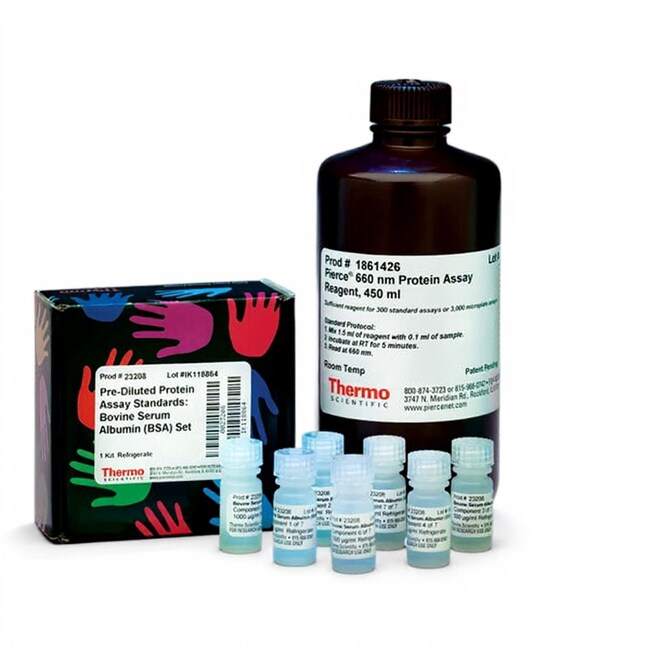
• Pierce 660 nm 蛋白检测试剂,450 mL
• 白蛋白标准品预稀释套件,7 x 3.5 mL
检测试剂在室温下储存,预稀释 BSA 标准品在 4°C 下储存。
• Pierce 660 nm 蛋白检测试剂,450 mL
• 白蛋白标准品预稀释套件,7 x 3.5 mL
检测试剂在室温下储存,预稀释 BSA 标准品在 4°C 下储存。
常见问题解答 (FAQ)
Which Thermo Scientific protein assay is the best or the most reliable?
Can I use the Thermo Scientific 660 nm Protein Assay to quantify peptides?
What is the linear range of the Thermo Scientific 660 nm Protein Assay?
Can I measure the absorbance at a wavelength other than 660 nm when using the Thermo Scientific 660nm Protein Assay Kit?
What advantages does the Thermo Scientific 660nm Protein Assay have over other protein assays?
引用和文献 (13)
引用和文献
Abstract
A rapid and versatile method for the isolation, purification and cryogenic storage of Schwann cells from adult rodent nerves.
Journal:Sci Rep
PubMed ID:27549422
'We herein developed a protocol for the rapid procurement of adult nerve-derived Schwann cells (SCs) that was optimized to implement an immediate enzymatic dissociation of fresh nerve tissue while maintaining high cell viability, improving yields and minimizing fibroblast and myelin contamination. This protocol introduces: (1) an efficient method for enzymatic
Overexpression of the Sorghum bicolor SbCCoAOMT alters cell wall associated hydroxycinnamoyl groups.
Journal:PLoS One
PubMed ID:30289910
'Sorghum (Sorghum bicolor) is a drought tolerant crop, which is being developed as a bioenergy feedstock. The monolignol biosynthesis pathway is a major focus for altering the abundance and composition of lignin. Caffeoyl coenzyme-A O-methyltransferase (CCoAOMT) is an S-adenosyl methionine (SAM)-dependent O-methyltransferase that methylates caffeoyl-CoA to generate feruloyl-CoA, an intermediate
Exosomes facilitate therapeutic targeting of oncogenic KRAS in pancreatic cancer.
Journal:Nature
PubMed ID:28607485
'The mutant form of the GTPase KRAS is a key driver of pancreatic cancer but remains a challenging therapeutic target. Exosomes are extracellular vesicles generated by all cells, and are naturally present in the blood. Here we show that enhanced retention of exosomes, compared to liposomes, in the circulation of
Mechanisms of PKC-Mediated Enhancement of HIF-1a Activity and its Inhibition by Vitamin K2 in Hepatocellular Carcinoma Cells.
Journal:Int J Mol Sci
PubMed ID:30813635
'Hypoxia-inducible factor 1 (HIF-1) plays important roles in cancer cell biology. HIF-1a is reportedly activated by several factors, including protein kinase C (PKC), in addition to hypoxia. We investigated the role of PKC isoforms and the effects of vitamin K2 (VK2) in the activation process of HIF-1a. Human hepatocellular carcinoma
Genetic resistance to DEHP-induced transgenerational endocrine disruption.
Journal:PLoS One
PubMed ID:31181066
'Di(2-ethylhexyl)phthalate (DEHP) interferes with sex hormones signaling pathways (SHP). C57BL/6J mice prenatally exposed to 300 mg/kg/day DEHP develop a testicular dysgenesis syndrome (TDS) at adulthood, but similarly-exposed FVB/N mice are not affected. Here we aim to understand the reasons behind this drastic difference that should depend on the genome of