Search


引用和文献 (10)
Thermo Scientific™
Pierce™ Bradford Plus Protein Assay Kits
棕色至紫色 (A595 nm)、即用型、快速还原剂兼容性检测试剂,用于测定总蛋白浓度(相对于蛋白标准品)。
Have Questions?
更改视图

| 货号 | 最大浓度 |
|---|---|
| 23236 | BSA: 2 mg/mL |
| A55866 | BSA: 0.125, 0.25, 0.5, 0.75, 1, 1.5, and 2 mg/mL |
货号 23236
价格(CNY)
2,330.00
飞享价
Ends: 31-Dec-2026
3,272.00共减 942.00 (29%)
Each
最大浓度:
BSA: 2 mg/mL
价格(CNY)
2,330.00
飞享价
Ends: 31-Dec-2026
3,272.00共减 942.00 (29%)
Each
The Pierce Bradford Plus Protein Assay Kit is a ready-to-use, reducing agent-compatible, improved Bradford assay reagent used to quickly measure total protein concentration compared to a protein standard. It provides increased linearity and half the protein-to-protein variability of other commercial Bradford assay formulations.
Kits are available with or without Pierce Dilution-Free BSA Protein Standards, which are a set of seven pre-diluted BSA standards, packaged in a multichannel pipette-friendly tubestrip. The tubestrip includes a single empty tube that enables users to add their own sample buffer for the purpose of blank subtraction.
The Pierce Bradford Plus Protein Assay Kit is a ready-to-use, reducing agent-compatible, improved Bradford assay reagent used to quickly measure total protein concentration compared to a protein standard. It provides increased linearity and half the protein-to-protein variability of other commercial Bradford assay formulations.
Kit options include Pierce Dilution-Free BSA Protein Standards, which are a set of seven pre-diluted BSA standards, packaged in a multichannel pipette-friendly tubestrip. The tubestrip includes a single empty tube that enables users to add their own sample buffer for the purpose of blank subtraction.
Features of the Pierce Bradford Plus Protein Assay Kit include:
- Colorimetric—measure with a standard spectrophotometer or plate reader at 595 nm
- Easy to use—single reagent; no working reagent preparation required
- Fast—almost immediate color development; add, mix, and read results
- Wide assay range—detects protein concentration in the range 1 to 1500 μg/mL
- Linear—improved linearity and response uniformity compared to traditional Bradford formulations
- Flexible—microplate and cuvette protocols provided and adaptable to several target working ranges
- Serial dilution–free—select kit options include Dilution-Free BSA Protein Standards that eliminate the need to perform serial dilutions when generating a standard curve
The assay is performed at room temperature. Simply add the sample to the tube or well containing reagent, and the resultant blue color is measured at 595 nm following a short room-temperature incubation. The protein assay is compatible with most salts, solvents, buffers, thiols, reducing substances, and metal-chelating agents encountered in protein samples. The assay can be performed in either test tube or microplate format.
How the Bradford Plus Assay detects protein
Use of Coomassie G-250 dye in a colorimetric reagent for the detection and quantitation of total protein was first described by Dr. Marion Bradford in 1976. In the acidic environment of the reagent, protein binds to the Coomassie dye. This results in a spectral shift from the reddish/brown form of the dye (absorbance maximum at 465 nm) to the blue form of the dye (absorbance maximum at 610 nm). The difference between the two forms of the dye is greatest at 595 nm, so that is the optimal wavelength to measure the blue color from the Coomassie dye-protein complex. If desired, the blue color can be measured at any wavelength between 575 nm and 615 nm. At the two extremes (575 nm and 615 nm) there is a loss of about 10% in the measured amount of color (absorbance) compared to that obtained at 595 nm.
Development of color in Coomassie dye-based (Bradford) protein assays has been associated with the presence of certain basic amino acids (primarily arginine, lysine, and histidine) in the protein. Van der Waals forces and hydrophobic interactions also participate in the binding of the dye by protein. The number of Coomassie dye ligands bound to each protein molecule is approximately proportional to the number of positive charges found on the protein. Free amino acids, peptides, and low molecular weight proteins do not produce color with Coomassie dye reagents. In general, the mass of a peptide or protein must be at least 3000 Daltons to be assayed with this reagent.
仅供研究使用。
规格
检测Bradford 检测
最大浓度BSA: 2 mg/mL
适用于(应用)基于溶液的检测、吸光度
适用于(设备)分光光度计、酶标仪
套装内容10 x 1 mL glass ampules
产品线Pierce
产品类型蛋白定量检测
数量950 mL
特异性无靶标特异性
足够用于630 次试管检测或 3160 次微孔板检测
检测方法比色法
Unit SizeEach
内容与储存
足够用于:630 管检测或 3160 微孔板检测
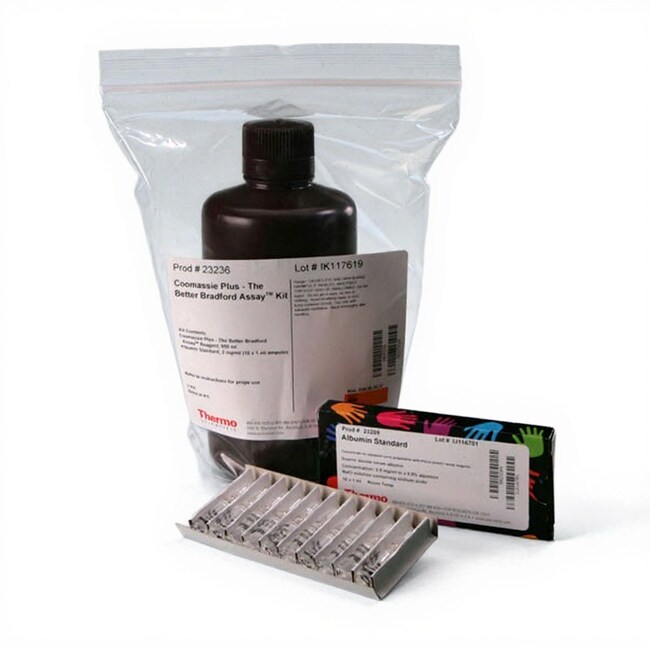
•Pierce 考马斯 Plus 检测试剂,950 mL
•白蛋白标准品安瓿,2 mg/mL,10 x 1 mL
将考马斯 Plus 检测试剂储存于 4°C 下。将未开封白蛋白标准品安瓿于室温下储存。
•Pierce 考马斯 Plus 检测试剂,950 mL
•白蛋白标准品安瓿,2 mg/mL,10 x 1 mL
将考马斯 Plus 检测试剂储存于 4°C 下。将未开封白蛋白标准品安瓿于室温下储存。
常见问题解答 (FAQ)
Which Thermo Scientific protein assay is the best or the most reliable?
What is the effect of temperature on the Pierce Bradford Plus Protein Assay Kit?
What is the detection range of Pierce Bradford Plus Protein Assay Kit?
What are the advantages of the Pierce Bradford Plus Protein Assay Kit over the Bradford Method?
What agents are compatible with Pierce Bradford Plus Protein Assay Kit?
引用和文献 (10)
引用和文献
Abstract
Co-association of methotrexate and SPIONs into anti-CD64 antibody-conjugated PLGA nanoparticles for theranostic application.
Journal:
PubMed ID:25364249
Rheumatoid arthritis (RA) is an autoimmune disease with severe consequences for the quality of life of sufferers. Regrettably, the inflammatory process involved remains unclear, and finding successful therapies as well as new means for its early diagnosis have proved to be daunting tasks. As macrophages are strongly associated with RA
Differences in sperm protein abundance and carbonylation level in bull ejaculates of low and high quality.
Journal:PLoS One
PubMed ID:30427859
'In breeding and insemination centres, significant variation in bull ejaculate quality is often observed between individuals and also within the same individual. Low-quality semen does not qualify for cryopreservation and is rejected, generating economic loss. The mechanisms underlying the formation of low-quality ejaculates are poorly understood; therefore, the aim of
Mitogen-Activated Protein Kinase Cross-Talk Interaction Modulates the Production of Melanins in Aspergillus fumigatus.
Journal:MBio
PubMed ID:30914505
'The pathogenic fungus'
ICAM3-Fc Outperforms Receptor-Specific Antibodies Targeted Nanoparticles to Dendritic Cells for Cross-Presentation.
Journal:Molecules
PubMed ID:31083610
'Optimal targeting of nanoparticles (NP) to dendritic cells (DCs) receptors to deliver cancer-specific antigens is key to the efficient induction of anti-tumour immune responses. Poly (lactic-co-glycolic acid) (PLGA) nanoparticles containing tètanus toxoid and gp100 melanoma-associated antigen, toll-like receptor adjuvants were targeted to the DC-SIGN receptor in DCs by specific humanized
Per-Arnt-Sim Kinase (PASK) Deficiency Increases Cellular Respiration on a Standard Diet and Decreases Liver Triglyceride Accumulation on a Western High-Fat High-Sugar Diet.
Journal:Nutrients
PubMed ID:30558306
Diabetes and the related disease metabolic syndrome are epidemic in the United States, in part due to a shift in diet and decrease in physical exercise. PAS kinase is a sensory protein kinase associated with many of the phenotypes of these diseases, including hepatic triglyceride accumulation and metabolic dysregulation in