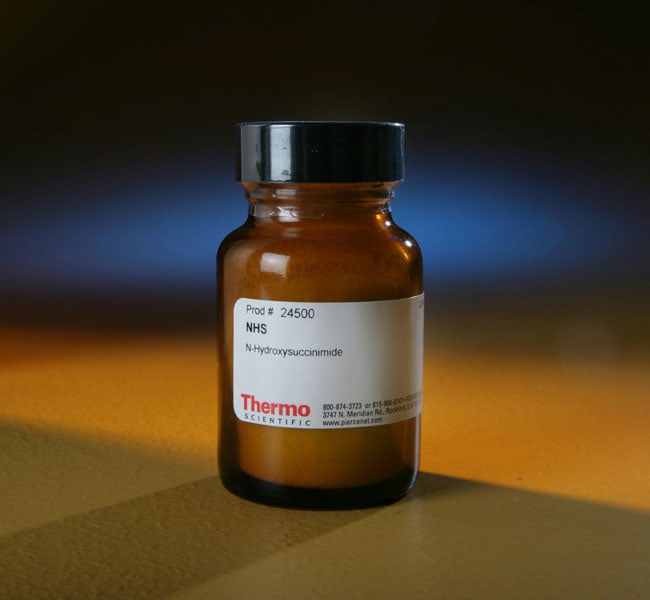
Can NHS and EDC stock solutions be made for long-term storage before use?
No. EDC is very unstable in aqueous environments and must be dissolved immediately before use. NHS and Sulfo-NHS are relatively stable in solution but best results are obtained when they are dissolved immediately before use. Store these compounds desiccated at 4°C.
Find additional tips, troubleshooting help, and resources within our Protein Assays and Analysis Support Center.
Are there any substances that interfere with NHS reactions?
Yes. Except for the intended targets, reactions must not contain carboxyl or amine compounds. Thus, Tris, glycine, lysine, ethanolamine or other amine- containing buffers must be avoided.
Find additional tips, troubleshooting help, and resources within our Protein Assays and Analysis Support Center.
What is the difference between NHS and Sulfo-NHS?
Sulfo-NHS is the sulfonate sodium salt of NHS; it is water-soluble, but not membrane-permeable. NHS is membrane-permeable and water-soluble. NHS is soluble in organic solvents, as is Sulfo-NHS to a lesser extent. Because NHS is a leaving group in reactions with primary amines, the final conjugation product resulting from NHS and Sulfo-NHS reactions is identical. Sulfo-NHS is chosen for its ability to confer better solubility to the activated compound and/or to control its membrane permeability.
Find additional tips, troubleshooting help, and resources within our Protein Assays and Analysis Support Center.
How are NHS and Sulfo-NHS used?
These compounds are used to modify a carboxyl group to form an amine-reactive ester. This is accomplished by mixing NHS with a carboxyl-containing molecule and the carbodiimide EDC (Cat. No. 22980, 22981, 77149, A35391). EDC causes a dehydration reaction between the carboxyl and the NHS hydroxyl group, giving rise to an NHS-ester-activated molecule. The activated molecule can then be reacted spontaneously with a primary amine-containing molecule. Although the carboxyl-molecules can be made to react directly with amines using EDC, the reaction is much more efficient with NHS because a stable intermediate is created. In fact, molecules that are activated as NHS esters can be dried and stored for later reaction to amine-containing targets.
Find additional tips, troubleshooting help, and resources within our Protein Assays and Analysis Support Center.
What are NHS and Sulfo-NHS used for?
These compounds are used in conjunction with the crosslinker EDC (Cat. No. 22980, 22981, 77149, A35391) to synthesize amine-reactive labeling reagents, crosslinkers and conjugation compounds. Any compound containing a carboxylic acid (-COOH), such as a protein, or biotin or peptide, can be activated with NHS or Sulfo-NHS to form an NHS ester that will spontaneously react to form covalent amide linkages with proteins and other molecules that contain primary amines (-NH2).
Find additional tips, troubleshooting help, and resources within our Protein Assays and Analysis Support Center.