Search

Thermo Scientific™
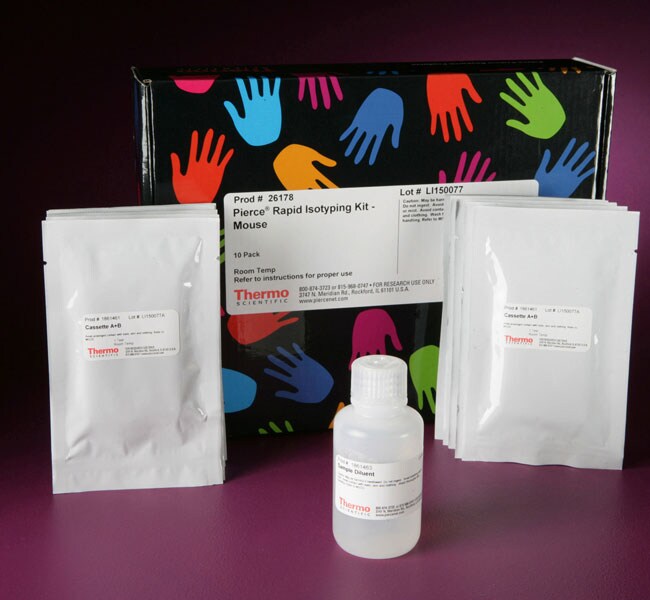
Pierce™ 快速抗体分型试剂盒 - 小鼠
The Thermo Scientific Pierce Rapid Mouse Antibody Isotyping Kit is a single-use, cassette-based kit for 5-minute lateral-flow assay determination of了解更多信息
| 货号 | 数量 |
|---|---|
| 26178 | 10 次测试 |
货号 26178
价格(CNY)
6,012.00
Each
数量:
10 次测试
价格(CNY)
6,012.00
Each
The Thermo Scientific Pierce Rapid Mouse Antibody Isotyping Kit is a single-use, cassette-based kit for 5-minute lateral-flow assay determination of mouse monoclonal antibody class and subclass identity.
This antibody isotyping kit uses cartridges that provide a color-readout of the monoclonal antibody isotype within five minutes after pipetting a small amount of diluted culture supernatant or ascites fluid sample into the sample well. The kit determines mouse IgG1, IgG2a, IgG2b, IgG3, IgA, IgM.
Features of the Pierce Rapid Mouse Antibody Isotyping Kit:
• Long shelf life—stable for at least one year at room temperature
• Single-step—add diluted antibody sample to the loading-well of cassette
• Fast—within 5 minutes a band appears that indicates the antibody isotype
• Sensitive—detect antibodies in tissue culture media or ascites fluid samples at any concentration greater than 10 ng/mL
• Specific—assay does not cross-react with fetal bovine serum (FBS)
• Reliable—results are similar to the standard ELISA-based isotyping assays
Each Pierce Rapid Isotyping Kit assay is performed by simply adding a properly diluted tissue culture supernatant or mouse ascites sample to the well of the small cassette. Gold conjugates embedded in the cassette form specific class- and subclass-soluble complexes with the antibodies in the sample. These complexes travel the length of the membrane and are resolved on the anti-isotype and class-specific antibody-impregnated membrane. Results are displayed as a red band indicating the antibody isotype or subclass.
Determining the class and subclass of a monoclonal antibody is useful in planning the best immunoglobulin purification method. For example, mouse IgA and IgM are best purified by size (i.e., gel exclusion) or using immunoaffinity separation columns. Mouse IgG2a and IgG2b are purified with immobilized Protein A at pH 7-8, while Mouse IgG1 binds best to Protein A at pH 8-9. Immunoglobulin that contains kappa light chains can be purified using immobilized Protein L.
The Pierce Rapid Isotyping Kit is compatible with both tissue culture supernatant and mouse ascites fluid, and is more sensitive than conventional latex-bead based dipstick assays and much faster than ELISA-based isotyping assays. The kit requires only 0.5μL ascites fluid, 5 to 55μL of cell culture supernatant or 1.5ng of purified antibody.
Related Products
Rapid ELISA Mouse mAb Isotyping Kit
Pierce™ Rapid Antibody Isotyping Kit plus Kappa and Lambda - Mouse
This antibody isotyping kit uses cartridges that provide a color-readout of the monoclonal antibody isotype within five minutes after pipetting a small amount of diluted culture supernatant or ascites fluid sample into the sample well. The kit determines mouse IgG1, IgG2a, IgG2b, IgG3, IgA, IgM.
Features of the Pierce Rapid Mouse Antibody Isotyping Kit:
• Long shelf life—stable for at least one year at room temperature
• Single-step—add diluted antibody sample to the loading-well of cassette
• Fast—within 5 minutes a band appears that indicates the antibody isotype
• Sensitive—detect antibodies in tissue culture media or ascites fluid samples at any concentration greater than 10 ng/mL
• Specific—assay does not cross-react with fetal bovine serum (FBS)
• Reliable—results are similar to the standard ELISA-based isotyping assays
Each Pierce Rapid Isotyping Kit assay is performed by simply adding a properly diluted tissue culture supernatant or mouse ascites sample to the well of the small cassette. Gold conjugates embedded in the cassette form specific class- and subclass-soluble complexes with the antibodies in the sample. These complexes travel the length of the membrane and are resolved on the anti-isotype and class-specific antibody-impregnated membrane. Results are displayed as a red band indicating the antibody isotype or subclass.
Determining the class and subclass of a monoclonal antibody is useful in planning the best immunoglobulin purification method. For example, mouse IgA and IgM are best purified by size (i.e., gel exclusion) or using immunoaffinity separation columns. Mouse IgG2a and IgG2b are purified with immobilized Protein A at pH 7-8, while Mouse IgG1 binds best to Protein A at pH 8-9. Immunoglobulin that contains kappa light chains can be purified using immobilized Protein L.
The Pierce Rapid Isotyping Kit is compatible with both tissue culture supernatant and mouse ascites fluid, and is more sensitive than conventional latex-bead based dipstick assays and much faster than ELISA-based isotyping assays. The kit requires only 0.5μL ascites fluid, 5 to 55μL of cell culture supernatant or 1.5ng of purified antibody.
Related Products
Rapid ELISA Mouse mAb Isotyping Kit
Pierce™ Rapid Antibody Isotyping Kit plus Kappa and Lambda - Mouse
仅供科研使用。不可用于诊断程序。
规格
描述Pierce 快速分型试剂盒 - 小鼠
适用于(应用)膜印迹
数量10 次测试
检测同种型测定
检测方法发色
产品线Pierce
靶标特异性靶标特异性
Unit SizeEach
内容与储存
足够用于:10 次同种型测定
• 分型组织盒(每袋两个),10 袋
• 样品稀释液,45 mL
将试剂盒储存在 2–8°C 下。
• 分型组织盒(每袋两个),10 袋
• 样品稀释液,45 mL
将试剂盒储存在 2–8°C 下。