Search


引用和文献 (4)
Thermo Scientific™
Pierce™ 三氟乙酸 (TFA),测序级
Thermo Scientific Pierce 三氟乙酸 (TFA)(测序级)按严格规格生产和检测,从而确保具有极佳的性能以用作反相肽分离中的离子配对试剂。三氟乙酸 (TFA)(测序级了解更多信息
Have Questions?
更改视图

货号 28904
价格(CNY)
1,473.00
飞享价
Ends: 31-Dec-2026
1,818.00共减 345.00 (19%)
Each
数量:
10 x 1 mL
价格(CNY)
1,473.00
飞享价
Ends: 31-Dec-2026
1,818.00共减 345.00 (19%)
Each
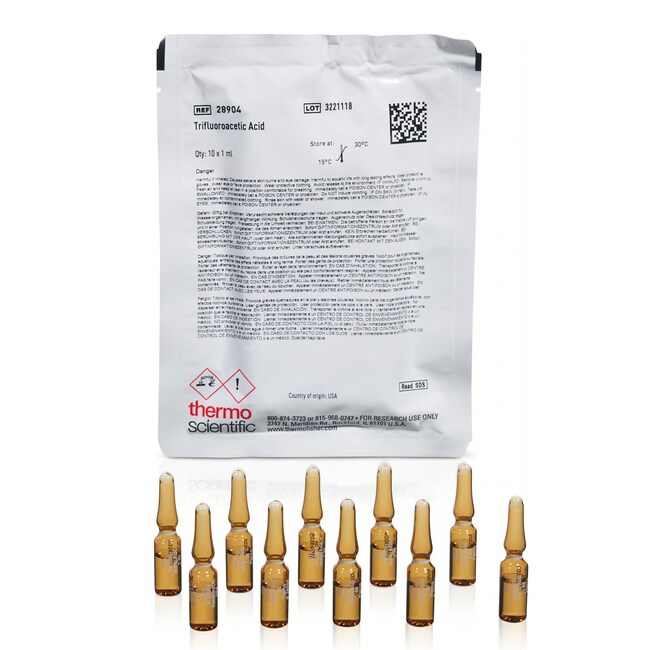
Thermo Scientific Pierce 三氟乙酸 (TFA)(测序级)按严格规格生产和检测,从而确保具有极佳的性能以用作反相肽分离中的离子配对试剂。
三氟乙酸 (TFA)(测序级)的特点:
•高纯度和卓越的清晰度—允许在反相 HPLC 蛋白和肽分离系统中在低紫外波长下进行灵敏的无创性肽检测
•高性能包装—TFA 在氮气条件下包装于琥珀色玻璃安瓿瓶或瓶内,并带有保护性 PTFE 内衬碳氟化合物盖来确保 TFA 完整性
• 经济便利—选择适合您应用的 TFA 规格。在几秒内,1 mL 安瓿便可为反相色谱分析中的流动相制备 1 升新鲜的 0.1% v/v 三氟乙酸溶液
三氟乙酸 (TFA) 的应用,测序级:
• 用于反相高效液相色谱蛋白质/肽测序的离子对试剂
• 蛋白/肽测序
• 蛋白/肽增溶剂
• 固相肽合成
• 氨基酸分析
• 制备 0.1% 三氟乙酸溶液 (w/v vs. v/v)
三氟乙酸 (TFA) 是反相 HPLC 肽分离中极常用的离子对试剂,因为它可锐化峰形并提高分离度,具有挥发性且易于去除,在检测波长范围内的吸收率较低。其按照极高质量标准生产,从而确保数据完整性,极大程度地实现测定灵敏度,同时延长设备使用时间。
制备 0.1% 三氟乙酸溶液:
对于复杂的肽分离应用,成功的关键可能在于是否具有不同的选择性。对同一色谱柱改变流动相组成便足以改变选择性,以分离重叠的肽。三氟乙酸是极常用于反相 HPLC 肽分离的修饰剂。规定的 TFA 浓度通常为 0.1%。为在运行间或实验室间得到可重现的分离,必须使 TFA 浓度相同。
三氟乙酸浓度可以且应该规定为 w/v(重量/体积)或 v/v(体积/体积)。w/v 质量标准规定 TFA 按相对于一体积流动相溶液的重量称重并添加(例如,0.1% TFA w/v 需要 1 克 TFA/升)。v/v 质量标准规定 TFA 按体积测量(例如,0.1% TFA v/v 需要 1 mL TFA/升)。
由于三氟乙酸的密度为 1.53 g/mL,0.1% TFA (w/v) 与 0.1% TFA (v/v) 之间的差异超过 50%。为确保重现性,方法的作者和方法的使用者必须了解给定 TFA 浓度的单位是 w/v 还是 v/v。
相关产品
Pierce™ 三氟乙酸 (TFA),测序级
三氟乙酸 (TFA)(测序级)的特点:
•高纯度和卓越的清晰度—允许在反相 HPLC 蛋白和肽分离系统中在低紫外波长下进行灵敏的无创性肽检测
•高性能包装—TFA 在氮气条件下包装于琥珀色玻璃安瓿瓶或瓶内,并带有保护性 PTFE 内衬碳氟化合物盖来确保 TFA 完整性
• 经济便利—选择适合您应用的 TFA 规格。在几秒内,1 mL 安瓿便可为反相色谱分析中的流动相制备 1 升新鲜的 0.1% v/v 三氟乙酸溶液
三氟乙酸 (TFA) 的应用,测序级:
• 用于反相高效液相色谱蛋白质/肽测序的离子对试剂
• 蛋白/肽测序
• 蛋白/肽增溶剂
• 固相肽合成
• 氨基酸分析
• 制备 0.1% 三氟乙酸溶液 (w/v vs. v/v)
三氟乙酸 (TFA) 是反相 HPLC 肽分离中极常用的离子对试剂,因为它可锐化峰形并提高分离度,具有挥发性且易于去除,在检测波长范围内的吸收率较低。其按照极高质量标准生产,从而确保数据完整性,极大程度地实现测定灵敏度,同时延长设备使用时间。
制备 0.1% 三氟乙酸溶液:
对于复杂的肽分离应用,成功的关键可能在于是否具有不同的选择性。对同一色谱柱改变流动相组成便足以改变选择性,以分离重叠的肽。三氟乙酸是极常用于反相 HPLC 肽分离的修饰剂。规定的 TFA 浓度通常为 0.1%。为在运行间或实验室间得到可重现的分离,必须使 TFA 浓度相同。
三氟乙酸浓度可以且应该规定为 w/v(重量/体积)或 v/v(体积/体积)。w/v 质量标准规定 TFA 按相对于一体积流动相溶液的重量称重并添加(例如,0.1% TFA w/v 需要 1 克 TFA/升)。v/v 质量标准规定 TFA 按体积测量(例如,0.1% TFA v/v 需要 1 mL TFA/升)。
由于三氟乙酸的密度为 1.53 g/mL,0.1% TFA (w/v) 与 0.1% TFA (v/v) 之间的差异超过 50%。为确保重现性,方法的作者和方法的使用者必须了解给定 TFA 浓度的单位是 w/v 还是 v/v。
相关产品
Pierce™ 三氟乙酸 (TFA),测序级
仅供科研使用。不可用于诊断程序。
规格
名称注释Trifluoroacetic Acid (TFA)
物理形态液体
建议的储存条件储存在原容器中,置于干燥、阴凉且通风良好的区域内,避免阳光直照,在以下温度之间:20 至 25°C。
纯度百分比99.5% (TFA)
数量10 x 1 mL
Unit SizeEach
引用和文献 (4)
引用和文献
Abstract
Super-resolution proximity labeling with enhanced direct identification of biotinylation sites.
Journal:Communications biology
PubMed ID:38724559
Promiscuous labeling enzymes, such as APEX2 or TurboID, are commonly used in in situ biotinylation studies of subcellular proteomes or protein-protein interactions. Although the conventional approach of enriching biotinylated proteins is widely implemented, in-depth identification of specific biotinylation sites remains challenging, and current approaches are technically demanding with low yields.
Kinetic reaction modeling for antibody-drug conjugate process development.
Journal:Journal of biotechnology
PubMed ID:31557498
By combining the specificity of monoclonal antibodies (mAbs) and the efficacy of cytotoxic drugs in one molecule, antibody-drug conjugates (ADCs) form a promising class of anti-cancer therapeutics. This is emphasized by around 65 molecules in clinical trials and four marketed products. The conjugation reaction of mAbs with small-molecule drugs is
The impact of glycosylation on monoclonal antibody conformation and stability.
Journal:mAbs
PubMed ID:22123061
Antibody glycosylation is a common post-translational modification and has a critical role in antibody effector function. The use of glycoengineering to produce antibodies with specific glycoforms may be required to achieve the desired therapeutic efficacy. However, the modified molecule could have unusual behavior during development due to the alteration of
Automated multi-attribute method sample preparation using high-throughput buffer exchange tips.
Journal:Rapid communications in mass spectrometry : RCM
PubMed ID:34783086
RATIONALE: The multi-attribute method (MAM) has become a valuable mass spectrometry (MS)-based tool that can identify and quantify the site-specific product attributes and purity information for biotherapeutics such as monoclonal antibodies (mAbs) and fusion molecules in recent years. As we expand the use of the MAM at various stages of