Search


引用和文献 (43)
Applied Biosystems™
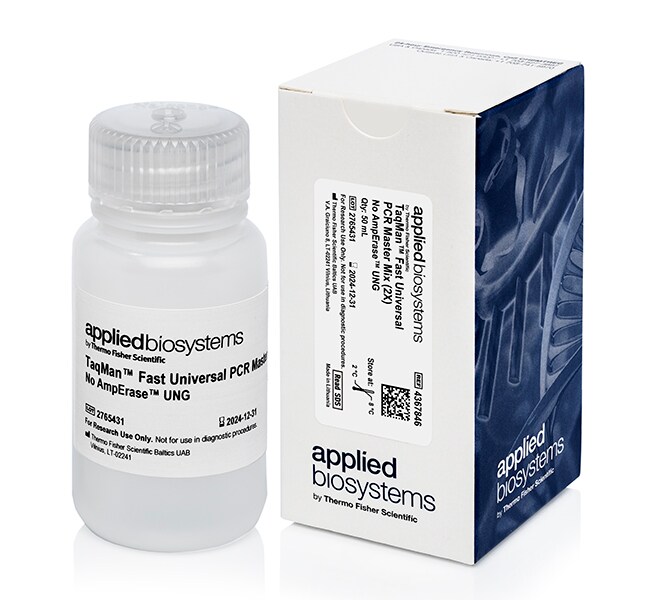
TaqMan™ Fast Universal PCR 预混液 (2X),无 AmpErase™ UNG
使用 Applied Biosystems 7900HT 和 Fast 7500 Fast 实时 PCR了解更多信息
Have Questions?
更改视图

| 货号 | 反应次数 |
|---|---|
| 4364103 | 2500 次反应 |
| 4366072 | 500 次反应 |
| 4367846 | 5000 次反应 |
| 4352042 | 250 次反应 |
| 4366073 | 1250 次反应 |
货号 4364103
价格(CNY)
33,273.00
Each
反应次数:
2500 次反应
价格(CNY)
33,273.00
Each
使用 Applied Biosystems 7900HT 和 Fast 7500 Fast 实时 PCR 系统,在20-μL 的反应体积中,TaqMan Fast Universal 预混液 (2X)(无 AmpErase UNG)在40分钟内提供40个 PCR 循环的结果。优化配方包含 AmpliTaq Fast DNA 聚合酶 UP,一种高度纯化的 DNA 聚合酶,旨在允许快速热启动,尽可能地减少非特异性产物的形成,并实现室温反应构建。此外,一种专有的 ROX 染料可作为一种被动内参,对非 PCR 相关的荧光波动进行标准化,从而在 Applied Biosystems 实时荧光定量 PCR 仪器上实现极高的精度。
便利
以单管形式包含了基于 TaqMan 的 qPCR 扩增和检测所需的一切组分。TaqMan Fast Universal PCR 预混液包含除模板和引物外的全部组分,可用于卓越的实时 qPCR。
兼容性
TaqMan Fast Universal PCR 预混液 (2X)(无 AmpErase UNG)与 TaqMan 基因表达测定兼容。
替代产品:试用 TaqMan Fast Advanced 预混液,这是我们较高性能的探针预混液。借助 TaqMan Fast Advanced 预混液,我们已经能够充分发挥 TaqMan Fast Universal PCR 预混液的优势,并为您的基因表达分析增加了更多功能。
便利
以单管形式包含了基于 TaqMan 的 qPCR 扩增和检测所需的一切组分。TaqMan Fast Universal PCR 预混液包含除模板和引物外的全部组分,可用于卓越的实时 qPCR。
兼容性
TaqMan Fast Universal PCR 预混液 (2X)(无 AmpErase UNG)与 TaqMan 基因表达测定兼容。
替代产品:试用 TaqMan Fast Advanced 预混液,这是我们较高性能的探针预混液。借助 TaqMan Fast Advanced 预混液,我们已经能够充分发挥 TaqMan Fast Universal PCR 预混液的优势,并为您的基因表达分析增加了更多功能。
仅供科研使用。不可用于诊断程序。
规格
保真度(相对于 Taq)2 X
适用于(设备)7500 Fast 系统、7900HT Fast 系统、StepOne™、Fast 模式、StepOnePlus™、Fast 模式
产品规格管装
反应次数2500 次反应
参比荧光染料ROX(预混)
聚合酶AmpliTaq DNA 聚合酶
产品线AmpErase、TaqMan
产品类型Fast 通用型 PCR 预混液
数量2,500 reactions
样品类型DNA(基因组)、cDNA
足够用于2500 次反应
容量20 μL
最大浓度2X
检测方法引物-探针
适用于(应用)基因表达, 基因分型, miRNA 分析
高 GC PCR 扩增效果高
PCR 方法qPCR
反应速度快速
Unit SizeEach
内容与储存
TaqMan™ Fast 通用型 PCR 预混液(不含 AmpErase™ UNG)试剂盒内含10盒,每盒2管(每管 1.25 ml),足以进行2500次 PCR 反应(每次 20 µl)。
在 2°C 至 8°C 下储存。
保证的有效期至少为60天(确切有效期印于产品和检验报告书上)。
在 2°C 至 8°C 下储存。
保证的有效期至少为60天(确切有效期印于产品和检验报告书上)。
常见问题解答 (FAQ)
What is the lowest copy number that can be used with the TaqMan Fast Universal PCR Master Mix (P/N 4352042)?
Which TaqMan assay types can be used when using the with TaqMan Fast Universal PCR Master Mix (P/N 4352042)?
Are there any recommendations for running primer-limited VIC dye-labeled TaqMan Endogenous Controls using the Fast Universal PCR Master Mix such as Cat. No. 4352042?
Are there any recommendations for running multiplex assays using the Fast Universal PCR Master Mix such as Cat. No. 4352042?
Can SNP assays be run using the TaqMan Fast Universal PCR Master Mix (Cat. No. 4352042)?
引用和文献 (43)
引用和文献
Abstract
Genetic analysis of hepatitis C virus with defective genome and its infectivity in vitro.
Journal:J Virol
PubMed ID:19369330
Replication and infectivity of hepatitis C virus (HCV) with a defective genome is ambiguous. We molecularly cloned 38 HCV isolates with defective genomes from 18 patient sera. The structural regions were widely deleted, with the 5' untranslated, core, and NS3-NS5B regions preserved. All of the deletions were in frame,
Down Regulation of Genes Involved in T Cell Polarity and Motility during the Induction of Heart Allograft Tolerance by Allochimeric MHC I
Journal:
PubMed ID:
'Background: The allochimeric MHC class I molecule [α1h1/u]-RT1. Aa that contains donor-type (Wistar Furth, WF; RT1u) epitopes displayed on recipient-type (ACI, RT1a) administered in conjunction with sub-therapeutic dose of cyclosporine (CsA) induces indefinite survival of heterotopic cardiac allografts in rat model. In vascularized transplantation models, the spleen contributes to graft
Activation of Macrophages by Polysaccharide-protein Complex from Lycium barbarum L.
Journal:
PubMed ID:
'Macrophages play crucial roles in innate immunity. This paper reports that a polysaccharide-protein complex isolated from Lycium barbarum (LBP) is able to activate macrophages. LBP was isolated from Lycium barbarum fruit and separated to five homogenous fractions, designated LBPF1, LBPF2, LBPF3, LBPF4 and LBPF5. It was found that LBP (50
Fusion of Epstein-Barr virus nuclear antigen-1-derived glycine-alanine repeat to trans-dominant HIV-1 Gag increases inhibitory activities and survival of transduced cells in vivo
Journal:
PubMed ID:
'Trans-dominant human immunodeficiency virus type 1 (HIV-1) Gag derivatives have been shown to efficiently inhibit late steps of HIV-1 replication in vitro by interfering with Gag precursor assembly, thus ranking among the interesting candidates for gene therapy approaches. However, efficient antiviral activities of corresponding transgenes are likely to be counteracted
Prevalence of Chlamydophila psittaci in wild birds-potential risk for domestic poultry, pet birds, and public health?
Journal:
PubMed ID:
'To determine the prevalence of Chlamydophila psittaci in wild birds, cloacal swabs from 527 songbirds, 442 waterfowl, 84 feral pigeons, and 38 cormorants were examined by Chlamydiaceae-specific real-time polymerase chain reaction (PCR) and ArrayTube microarray assays for chlamydial species determination and genotyping of C. psittaci. Inconclusive cases were further characterized