DAPI and Hoechst Nucleic Acid Stains
Invitrogen17万+抗体限时买二赠一,靶点广,灵活用!
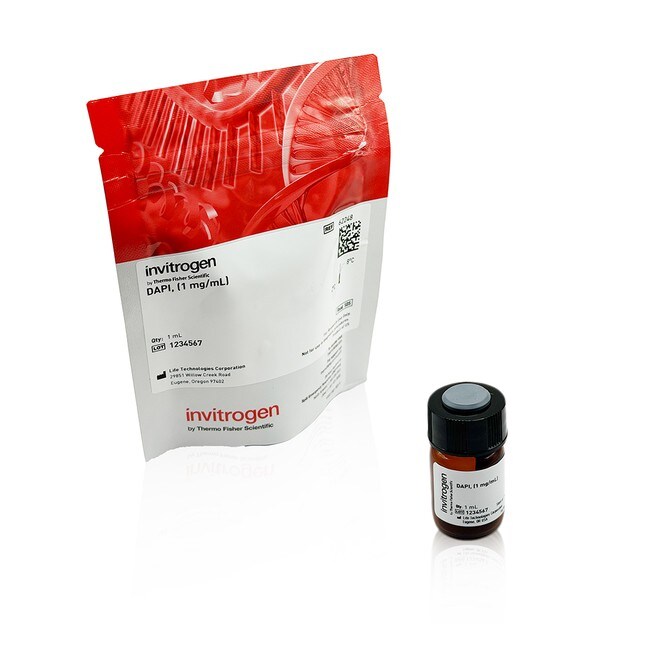
We have modified the packaging to update labeling and improve the protection of our product, #62248. The improvements include thicker glass on the amber vial, and a two component closure that aims to protect from leakage. Additionally our internal verification testing and external customer validation data show that shipping these products at either ambient or freezing temperatures does not impact the functionality, performance, or specificity of staining.
DAPI and Hoechst Nucleic Acid Stains
Thermo Scientific™

DAPI and Hoechst Nucleic Acid Stains

DAPI and Hoechst are classic popular nuclear counterstains for use in all fluorescent cell and tissue techniques. The blue fluorescence is vivid contrast to green, yellow, orange, red, far red and NIR fluorescent probes and labels.
Have Questions?
更改视图buttonViewtableView
货号数量产品类型染料类型
622481 mLDAPI细胞不可透过性
D2149010 mgDAPI细胞不可透过性
D357110 mgDAPI细胞不可透过性
D130610 mgDAPI细胞不可透过性
H356910 mL核酸染色剂Hoechst 33258
H1398100 mg核酸染色剂Hoechst 33258
H21491100 mg核酸染色剂Hoechst 33258
622495 mL核酸染色剂细胞通透性
H357010 mL核酸染色剂Hoechst 33342
H1399100 mg核酸染色剂细胞通透性
H21492100 mg核酸染色剂Hoechst 33342
货号 62248
价格(CNY)
2,013.00
飞享价
Ends: 31-Dec-2025
2,735.00
共减 722.00 (26%)
Each
添加至购物车
数量:
1 mL
产品类型:
DAPI
染料类型:
细胞不可透过性
价格(CNY)
2,013.00
飞享价
Ends: 31-Dec-2025
2,735.00
共减 722.00 (26%)
Each
添加至购物车

DAPI is a fluorescent dye commonly used in molecular biology and cell biology research. DAPI is known for its ability to bind to DNA, specifically to the minor groove of double-stranded DNA. This dye emits blue fluorescence when excited by ultraviolet light, allowing researchers to visualize and stain DNA in various biological samples.

Hoechst dyes are DNA-specific fluorescent stains that bind to the minor groove of double-stranded DNA. They emit blue fluorescence when excited by ultraviolet light. These dyes are widely used for staining DNA in various biological samples.

The FluoroPure™-grade of Hoechst and DAPI powders are manufactured using stringent purification processes to minimize impurities that could interfere with fluorescence imaging. This ensures that the DAPI and Hoechst provides reliable and consistent results with minimal background noise. The >98% purity of FluoroPure grade reagents make them particularly suitable for demanding applications such as super-resolution microscopy and live-cell imaging, where precise and accurate visualization of DNA is essential.

DAPI (4',6-Diamidino-2-Phenylindole):

DAPI 4',6-diamidino-2-phenylindole is a blue fluorescent probe that fluoresces brightly upon selectively binding to the minor groove of double stranded DNA, where its fluorescence is approximately 20-fold greater than in the non-bound state. Its selectivity for DNA and high cell permeability allows efficient staining of nuclei with little background from the cytoplasm and efficient contrasting in IHC staining and spatial transcriptomics and proteomics tissue imaging. DAPI is a classic nuclear counterstain for immunofluorescence microscopy, as well as an important component of high-content screening methods requiring cell-based quantitation of DNA content and segmentation (ex/em 341/452 nm).

DAPI as a dilactate powder is more water soluble than the dihydrochloride salt, and therefore a better choice for preparing stock solutions in water.

To make a 5 mg/mL DAPI stock solution (14.3 mM for the dihydrochloride or 10.9 mM for the dilactate), dissolve the contents of one vial (10 mg) in 2 mL of deionized water (dH2O) or dimethylformamide (DMF). The less water-soluble DAPI dihydrochloride may take some time to completely dissolve in water and sonication may be necessary.

Note: Neither of these DAPI derivatives is very soluble in PBS for Stock Solution.

Dilute the DAPI Stock Solution 1:5000 (or 1:1000 for the 1 mg/mL DAPI 62248) in ultrapure water or PBS (1 μg/mL DAPI). Filter the working solution to remove dye aggregates that can result in punctate signal.

Hoechst 33342, Trihydrochloride, Trihydrate and Hoechst 33258, Pentahydrate (bis-Benzimide):

Our Hoechst dyes are renowned fluorophores widely used for DNA staining in both living and fixed cells. With their exceptional affinity and specificity towards DNA, these dyes serve as excellent targeting agents that can be conjugated to various molecules, allowing them to be tethered to DNA.

The Hoechst dyes typically include Hoechst 33258, Hoechst 33342, and Hoechst 34580. Developed by the German company Hoechst AG in the early 1970s, these bisbenzimide dyes have been widely used for DNA staining ever since.

Excited by UV light, Hoechst dyes emit a broad spectrum of blue light. Upon binding to DNA, their fluorescence increases approximately 30-fold, ensuring a strong signal-to-noise ratio. This fluorescence enhancement is the result of suppressed rotational relaxation and hydration reduction upon DNA binding (ex/em 360/460 nm).

Hoechst dyes are non-intercalating, binding specifically to the minor groove of DNA at A–T-rich regions. This unique binding mechanism allows for precise and reliable DNA staining.

Whether you're working with living or fixed cells, our Hoechst dyes are compatible with immunohistochemistry applications. Additionally, the binding of Hoechst 33342 to DNA induces minimal cytotoxicity, ensuring the viability of your cells.

While all three Hoechst dyes have similar applications, they do possess slight differences in their properties. Hoechst 33342, for example, is significantly more cell-permeable due to the addition of a lipophilic ethyl group, making it the preferred choice for living cell staining. On the other hand, Hoechst 34580, with its dimethylamine group instead of the phenol, exhibits a shifted emission maximum at 490 nm, compared to the 461 nm of Hoechst 33258 and Hoechst 33342.

Hoechst 33258, Pentahydrate is also known as bis-Benzimide.

Application of DAPI and Hoechst Fluorescent Dyes:

  • DNA Staining—commonly used for DNA staining in fluorescence microscopy and flow cytometry. It binds to the minor groove of double-stranded DNA and emits blue fluorescence when excited by ultraviolet (UV) light. This allows researchers to visualize and quantify DNA in cells, tissues, and nuclei.
  • Cell Cycle Analysis—widely used to analyze the cell cycle. By staining cells with this dye and using flow cytometry or fluorescence microscopy, researchers can identify and quantify different phases of the cell cycle, such as G1, S, and G2/M phases. This analysis provides insights into cell proliferation, cell cycle progression, and cell cycle abnormalities.
  • Nuclear Morphology and Chromatin Organization—study nuclear morphology and chromatin organization. By visualizing the DNA within the nucleus, researchers can investigate changes in nuclear size, shape, and chromatin condensation, which are associated with various cellular processes and conditions.
仅供科研使用。不可用于诊断程序。
规格
颜色蓝色
最大浓度1 mg/mL
检测方法荧光
染料类型细胞不可透过性
发射460 nm
激发波长范围360 nm
适用于(应用)细胞成像
适用于(设备)荧光显微镜、高内涵仪器
产品线Pierce
数量1 mL
运输条件室温
标签类型Fluorescent Dye
产品类型DAPI
亚细胞定位细胞核/核仁
Unit SizeEach
内容与储存
在 2–8°C 下避光储存 DAPI 溶液 (1 mg/mL)。

常见问题解答 (FAQ)

我注意到,当我在click反应后用DAPI染色细胞并检测EdU的掺入时,相比于我的无click反应对照样品,DAPI信号非常低。是什么原因导致DAPI信号降低?

click反应中的铜离子使得DNA少量变性(虽然没有BrdU检测所需要的程度),这会影响到包括DAPI和Hoechst染色剂在内的DNA染料的结合亲和力。这种影响只会在传统的EdU试剂盒中出现,而Click-iT Plus EdU试剂盒由于采用的铜离子浓度低,不会出现这种现象。 

DAPI和Hoechst 染料非常相似,该如何选用?

DAPI是一种非常普通的蓝色核复染荧光染料,能对固定和通透的细胞和组织的细胞核进行非常明亮的标记。遗憾的是,人们普遍认为它是介于半通透性到非通透性之间的染色剂,对活细胞的染色效果也不一致。Hoechst 33342染料是细胞通透性染料,与DAPI染色有相似的染色结合机制和荧光颜色;它是活细胞成像的首选,且对固定细胞的标记效果和DAPI一样好。

Is DAPI a good live-cell nuclear label?

DAPI is considered a semi-permeant/impermeant nucleic acid stain. Staining of nucleic is dependent upon the cell line in its performance. Some cell lines will label with DAPI, others not at all, and others label inconsistenly. Instead, we recommend using either Hoechst 33342 or Hoechst 33258, which have the same wavelength and binding mode as DAPI (at the A-T minor groove) but are readily cell-permeant.

Find additional tips, troubleshooting help, and resources within our Cell Analysis Support Center.

I want to label the nuclei of live cells and track them over time. Can I use DAPI for this?

We do not recommend doing this. DAPI is considered to be a semi-permeant/impermeant nucleic acid stain. DAPI staining of live cells may be inconsistent. It is best used as a counterstain for fixed samples. Other cell permeable nucleic acid stains, such as Hoechst or the SYTO dyes may affect cellular function.

For mammalian cells, we recommend using the CellLight Nucleus transduction reagents, available in CFP, GFP and RFP. With these reagents, the cells are transduced overnight in a single labeling step and the next day the nuclei will fluoresce. The label may be retained for 3-5 days and should not affect cell function. Cytoplasmic cell tracking dyes such as the CellTracker dyes may also be used.

Find additional tips, troubleshooting help, and resources within our Cell Analysis Support Center.

I notice that when I post-stain my cells with DAPI after performing the click reaction to detect EdU incorporation, my DAPI signal is lower compared to my no-click reaction control samples. What causes the reduction in DAPI signal?

The copper in the click reaction denatures DNA to a small extent (although not as much as is required for efficient BrdU detection), which can affect the binding affinity of DNA dyes including DAPI and Hoechst stain. This effect should only be apparent with the classic EdU kits and not the Click-iT Plus EdU kits, which use a lower copper concentration.

Find additional tips, troubleshooting help, and resources within our Cell Viability, Proliferation, Cryopreservation, and Apoptosis Support Center.