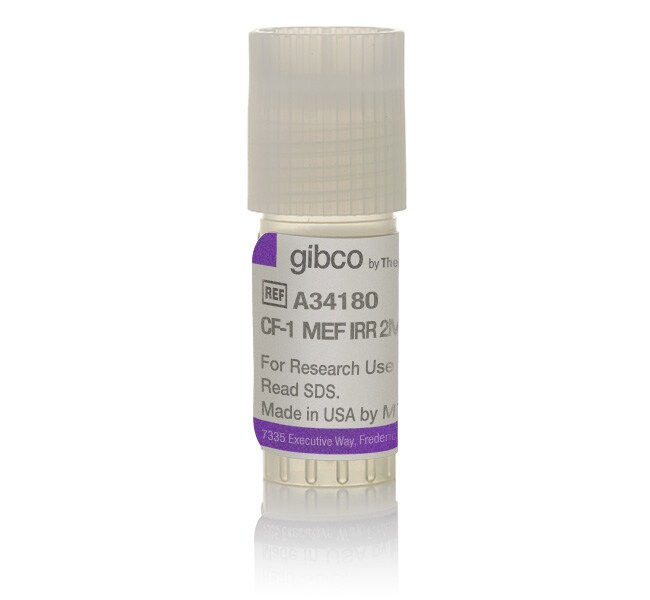
CF1 小鼠胚胎成纤维细胞,经过辐照
CF1 小鼠胚胎成纤维细胞,经过辐照
Gibco™

CF1 小鼠胚胎成纤维细胞,经过辐照

将经过辐照的 Gibco CF1 小鼠胚胎成纤维细胞 (MEFs) 用作滋养层细胞,是为培养用于支持健康未分化人和小鼠胚胎干细胞 (ESC) 及诱导多能干细胞 (iPSC) 的理想选择了解更多信息
Have Questions?
更改视图buttonViewtableView
货号数量
A34180200 万个细胞(2 x 10⁶ 个细胞)
A34181400 万个细胞(2 x 10⁶ 个细胞
货号 A34180
价格(CNY)
-
数量:
200 万个细胞(2 x 10⁶ 个细胞)
将经过辐照的 Gibco CF1 小鼠胚胎成纤维细胞 (MEFs) 用作滋养层细胞,是为培养用于支持健康未分化人和小鼠胚胎干细胞 (ESC) 及诱导多能干细胞 (iPSC) 的理想选择。由 MTI-GlobalStem 制造,等同于 MTI-GlobalStem 货号GSC-6001G 和 GSC-6201G,这些广泛使用的 MEF 细胞是从远交系 CF1 小鼠中分离得到的,通过辐照中止有丝分裂,并经过检测以确保安全和性能。CF1 MEF 是用于培养多能干细胞的传统滋养层细胞;对于源自 ICR 小鼠的 MEF,请参见小鼠 (ICR) 灭活胚胎成纤维细胞

•借助预灭活、即用型 MEF 帮助节省宝贵的时间
•利用经过严格测试的滋养层细胞可靠地培养 ESC 和 iPSC
•信赖广泛使用的产品

借助即用型 MEF 帮助节省时间
经过辐照的 CF1 MEF 有助于避免处理动物实验设施、执行繁琐且耗时的解剖以及日复一日扩增和测试细胞的麻烦,从而节省时间。这些预灭活、即用型滋养层细胞可使您专注于自己的研究。

利用经过严格测试的滋养层细胞进行培养
每批 CF1 MEF 均经过细菌、真菌、支原体以及小鼠病原体检测,以尽可能降低污染风险。每批产品均对其解冻后存活率(通常高于 95 %)进行了检测,能够支持小鼠和人 ES 细胞的培养,以确保具有稳定一致的性能。这些 MEF 已成功用于来自其他物种的 ESC/iPSC 细胞系,但如果将其用于此类应用,应检测其兼容性。

信赖广泛使用的产品
这些 CF1 MEF 已在全球许多实验室中使用,并已被各种出版物引用。它们已成功用于在密度范围为 2 x 10⁴–5.3 x 10⁴ 个细胞/cm2 的条件下支持未分化多能干细胞。

仅供科研使用。不可用于诊断程序。
规格
供体混合供体
数量200 万个细胞(2 x 10⁶ 个细胞)
运输条件用于干冰运输
年龄胚胎
细胞类型Feeder Cells (Mouse Embryonic Fibroblast)
形式冻存
种属小鼠
Unit SizeEach
内容与储存
冻存小鼠胚胎成纤维细胞

储存于液氮中。

常见问题解答 (FAQ)

What is the difference between Mouse (ICR) Inactivated Embryonic Fibroblasts (Cat. No. A24903) and CF1 Mouse Embryonic Fibroblasts, irradiated (Cat. Nos. A34180, A34181)? Can they be used to reprogram fibroblasts?

Mouse (ICR) Inactivated Embryonic Fibroblasts and CF1 Mouse Embryonic Fibroblasts, irradiated are inactivated feeder layer fibroblast cells that are isolated from different mouse strains. Researchers often have a preference for one or the other. Neither of these can be used to reprogram fibroblasts.

Find additional tips, troubleshooting help, and resources within our Cell Culture Support Center.

Is it better to use irradiated mouse embryonic fibroblasts (MEFs) or Mitomycin C-treated MEFs to grow embryonic stem cells?

Either method will work in arresting cell division. However, the irradiation process will ensure that cell division will cease regardless of cell aggregation. Cell clumping can potentially not inactivate all cells when using mitomycin C, as cells within clumps may not be exposed to the mitomycin C. Irradiated cells are preferred by those who have concerns about chemical treatment. Mitomycin C-treated cells are preferred by those who have concerns about DNA damage from irradiation.

What are the differences between CF1, CF6, and DR4 mouse embryonic fibroblasts?

CF1 mouse embryonic fibroblasts do not have drug resistance. CF6 mouse embryonic fibroblasts are resistant to Neomycin/geneticin (G418). DR 4 mouse embryonic fibroblasts are resistant to geneticin (G418), puromycin, hygromycin, and 6-thioguanine.

What is the recommended seeding density for mouse embryonic fibroblasts? Why is the seeding density critical?

We recommend seeding these cells at densities ranging from 2 x 10E4 to 5.5 x 10E4 cells/cm2. A good starting point is 3 x 10E4 cells/cm2. If the feeder cells are too sparse, they may not maintain the pluripotent cells without differentiation, and the pluripotent cells may not attach well. If the feeder cells are too dense, the feeder layer may detach from the plate, and the culture will be lost.

When should mouse embryonic fibroblasts be plated and how long can these cells be used?

These cells should be plated 24 hours prior to plating the ESCs or iPSCs and should be used for only 7-10 days.