Search


引用和文献 (14)
Invitrogen™
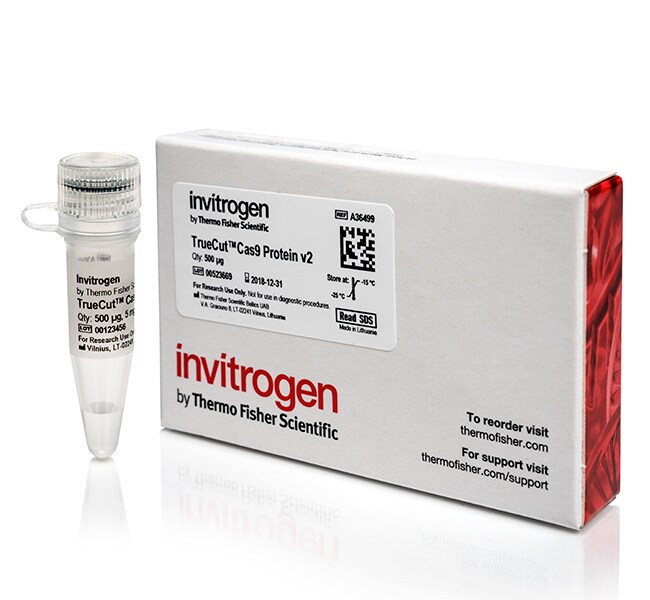
TrueCut™ Cas9 Protein v2
Invitrogen TrueCut Cas9 蛋白 v2 作为新一代的 CRISPR Cas9 工程改造蛋白可为基因编辑带来最大化的效率。其特性包括:•在所有测试细胞系中了解更多信息
Have Questions?
更改视图

| 货号 | 数量 | 最大浓度 |
|---|---|---|
| A36499 | 500 μg | 5 μg/μL |
| A36498 | 100 μg | 5 μg/μL |
| A36497 | 25 μg | 1 μg/μL |
| A36496 | 10 μg | 1 μg/μL |
货号 A36499
价格(CNY)
8,571.00
飞享价
Ends: 26-Sep-2026
11,017.00共减 2,446.00 (22%)
Each
数量:
500 μg
最大浓度:
5 μg/μL
价格(CNY)
8,571.00
飞享价
Ends: 26-Sep-2026
11,017.00共减 2,446.00 (22%)
Each
Invitrogen TrueCut Cas9 蛋白 v2 作为新一代的 CRISPR Cas9 工程改造蛋白可为基因编辑带来最大化的效率。其特性包括:
•在所有测试细胞系中(包括标准、免疫、原代以及干细胞)具有稳定的高编辑效率,其在难度较高的靶基因中的编辑效率高出竞争产品达 2 倍
• 高质量—严格按照 ISO 13485 质量标准生产
• 提供有针对大量细胞类型进行了验证的方案,可有助于您更快实现成功
TrueCut Cas9 蛋白 v2 是一种重组的酿脓性链球菌 Cas9(野生型)蛋白,从大肠杆菌中纯化而来,可用于基于 CRISPR 技术的基因组编辑。Cas9 蛋白可与向导 RNA (gRNA) 形成一种非常稳定的核糖核蛋白 (RNP) 复合物,作为 CRISPR/Cas9 系统的一种组分。核定位信号(NLS)的引入可帮助其入核,增加基因组DNA切割的几率。
•使用脂质体介导转染试剂或电穿孔可直接转染
•省去耗时的克隆步骤
•提供有 2 种浓度:
--1 μg/Lμ(适用于标准编辑情况下)
--5 μg/Lμ(适用于在更困难的情况下优化编辑条件,例如在原代或胚胎细胞中、显微注射或一次筛选多个 gRNA 序列时
--对于定制大小或浓度,请咨询相关销售人员
获取与 TrueCut Cas9 蛋白 v2 配合使用的 CRISPR gRNA 的选项:
1.订购转染即用型 TrueGuide 合成 gRNA
2.仅需四小时便可生成转染即用型 gRNA,包括通过我们的 GeneArt 精确 gRNA 合成试剂盒而完成的模板组装
3.让我们的定制服务团队为您设计、合成与纯化体外 (IVT) gRNA 序列
•在所有测试细胞系中(包括标准、免疫、原代以及干细胞)具有稳定的高编辑效率,其在难度较高的靶基因中的编辑效率高出竞争产品达 2 倍
• 高质量—严格按照 ISO 13485 质量标准生产
• 提供有针对大量细胞类型进行了验证的方案,可有助于您更快实现成功
TrueCut Cas9 蛋白 v2 是一种重组的酿脓性链球菌 Cas9(野生型)蛋白,从大肠杆菌中纯化而来,可用于基于 CRISPR 技术的基因组编辑。Cas9 蛋白可与向导 RNA (gRNA) 形成一种非常稳定的核糖核蛋白 (RNP) 复合物,作为 CRISPR/Cas9 系统的一种组分。核定位信号(NLS)的引入可帮助其入核,增加基因组DNA切割的几率。
•使用脂质体介导转染试剂或电穿孔可直接转染
•省去耗时的克隆步骤
•提供有 2 种浓度:
--1 μg/Lμ(适用于标准编辑情况下)
--5 μg/Lμ(适用于在更困难的情况下优化编辑条件,例如在原代或胚胎细胞中、显微注射或一次筛选多个 gRNA 序列时
--对于定制大小或浓度,请咨询相关销售人员
获取与 TrueCut Cas9 蛋白 v2 配合使用的 CRISPR gRNA 的选项:
1.订购转染即用型 TrueGuide 合成 gRNA
2.仅需四小时便可生成转染即用型 gRNA,包括通过我们的 GeneArt 精确 gRNA 合成试剂盒而完成的模板组装
3.让我们的定制服务团队为您设计、合成与纯化体外 (IVT) gRNA 序列
仅供科研使用。不可用于诊断程序。
规格
编录号NC_002737.2:854751-858857
组分数量100 μL TrueCut Cas9 蛋白 v2 (5 mg/mL)
表达系统大肠杆菌
基因别名cas5, csn1
基因 ID (Entrez)901176
基因符号Spy_1046
分级分子生物学
产品类型Cas9 蛋白 v2
蛋白质形式重组
蛋白标记未标记
数量500 μg
运输条件干冰
经证实的应用基因组编辑
最大浓度5 μg/μL
产品线TrueCut
研究类别基因组编辑
Unit SizeEach
内容与储存
100 µL TrueCut Cas9 蛋白 v2 (5 mg/mL)
储存在 -5 至 -30°C 下。
储存在 -5 至 -30°C 下。
常见问题解答 (FAQ)
What is the molecular weight of TrueCut Cas9 Protein v2?
What is the difference between TrueCut Cas9 Protein (Prototype) and TrueCutCas9 Protein v2?
Is there a specific antibody that you recommend to test the delivery of TrueCut Cas9 Protein v2?
What is the storage buffer composition for TrueCut Cas9 Protein v2 and TrueCut HiFi Cas9 Protein?
Which lipid transfection reagent do you recommend using with TrueCut Cas9 Protein v2 and TrueCut HiFi Cas9 Protein?
引用和文献 (14)
引用和文献
Abstract
Highly efficient RNA-guided genome editing in human cells via delivery of purified Cas9 ribonucleoproteins.
Journal:
PubMed ID:24696461
'RNA-guided engineered nucleases (RGENs) derived from the prokaryotic adaptive immune system known as CRISPR (clustered, regularly interspaced, short palindromic repeat)/Cas (CRISPR-associated) enable genome editing in human cell lines, animals, and plants, but are limited by off-target effects and unwanted integration of DNA segments derived from plasmids encoding Cas9 and guide
Rapid and highly efficient mammalian cell engineering via Cas9 protein transfection.
Journal:
PubMed ID:26003884
'CRISPR-Cas9 systems provide a platform for high efficiency genome editing that are enabling innovative applications of mammalian cell engineering. However, the delivery of Cas9 and synthesis of guide RNA (gRNA) remain as steps that can limit overall efficiency and ease of use. Here we describe methods for rapid synthesis of
Precise Correction of Heterozygous SHOX2 Mutations in hiPSCs Derived from Patients with Atrial Fibrillation via Genome Editing and Sib Selection.
Journal:Stem Cell Reports
PubMed ID:32976766
'Patient-specific human induced pluripotent stem cells (hiPSCs) offer unprecedented opportunities for the investigation of multigenic disease, personalized medicine, and stem cell therapy. For heterogeneous diseases such as atrial fibrillation (AF), however, precise correction of the associated mutation is crucial. Here, we generated and corrected hiPSC lines from two AF patients
Efficient gene knockout in primary human and murine myeloid cells by non-viral delivery of CRISPR-Cas9.
Journal:J Exp Med
PubMed ID:32357367
'Myeloid cells play critical and diverse roles in mammalian physiology, including tissue development and repair, innate defense against pathogens, and generation of adaptive immunity. As cells that show prolonged recruitment to sites of injury or pathology, myeloid cells represent therapeutic targets for a broad range of diseases. However, few approaches
Precise and error-prone CRISPR-directed gene editing activity in human CD34+ cells varies widely among patient samples.
Journal:Gene Ther
PubMed ID:32873924
'Clustered Regularly Interspaced Short Palindromic Repeats (CRISPR) and their associated CRISPR-associated nucleases (Cas) are among the most promising technologies for the treatment of hemoglobinopathies including Sickle Cell Disease (SCD). We are only beginning to identify the molecular variables that influence the specificity and the efficiency of CRISPR- directed gene editing,