Search


引用和文献 (8)
Thermo Scientific™
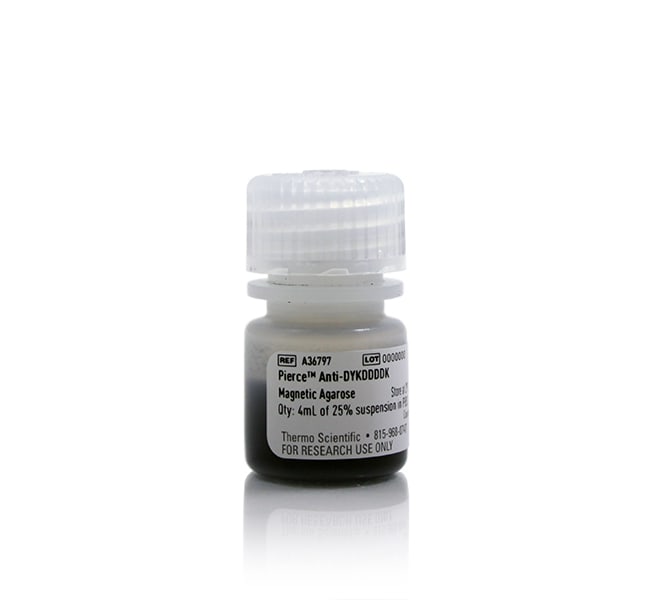
Pierce™ 抗-DYKDDDDK 磁性琼脂糖
Thermo Scientific Pierce 抗-DYKDDDDK 磁性琼脂糖是一种从体外蛋白表达系统、细菌、酵母菌和哺乳动物细胞中进行 DYKDDDDK 标签蛋白纯化和免疫沉淀 (IP)了解更多信息
Have Questions?
更改视图

| 货号 | 数量 |
|---|---|
| A36797 | 4 mL |
| A36798 | 20 mL |
货号 A36797
价格(CNY)
3,574.00
Special offer
Online exclusive
Ends: 27-Nov-2026
5,787.00共减 2,213.00 (38%)
Each
数量:
4 mL
价格(CNY)
3,574.00
Special offer
Online exclusive
Ends: 27-Nov-2026
5,787.00共减 2,213.00 (38%)
Each
Thermo Scientific Pierce 抗-DYKDDDDK 磁性琼脂糖是一种从体外蛋白表达系统、细菌、酵母菌和哺乳动物细胞中进行 DYKDDDDK 标签蛋白纯化和免疫沉淀 (IP) 的快速便捷方法。氨基酸序列 DYKDDDDK(通常称为 FLAG)被高亲和力大鼠单克隆抗体(克隆 L5)识别,该抗体与磁石嵌入的琼脂糖核心颗粒共价连接。
对于蛋白纯化,将磁性琼脂糖添加到含有 DYKDDDDK 标签蛋白的样品中,其中标签位于 N 或 C 端。然后,将捕获的蛋白与上清液磁性分离,洗去非特异性结合蛋白,然后用洗脱缓冲液分离结合的 DYKDDDDK 标签蛋白。使用磁力架或 KingFisher Flex 磁粒子处理器等仪器从溶液中去除磁性琼脂糖。自动仪器对于更高通量的纯化和纯化条件筛选特别有用。
特点包括:
特异性 — 独特的碱基微珠和高特异性抗体可较大限度地减少脱靶结合(低非特异性结合)
高纯度 — 优化的结合-洗涤-洗脱方案可以实现高纯度
高得率 — 特殊抗体偶联方法可实现高得率
快速 — 整个纯化方案通常只需不到40分钟
经济 — 纯化方案能够多次重复使用
通用 — 微珠兼容手动和自动化工作流程(例如 KingFisher 仪器)
Pierce 抗 DYKDDDDK 磁性琼脂糖的特性:
组成:抗 DYKDDDDK 抗体与磁性、高度交联的琼脂糖载体共价连接
磁化:亚铁磁性,剩磁较低
微珠大小:10–40 µm
微珠浓度:25% 浆液(溶于磷酸盐缓冲盐水)、0.01% Tween-20 去污剂、0.02% 叠氮化钠,pH 值为7.2
结合能力:≥3.2 mg DYKDDDDK-tGFP-His 蛋白 (∼32 kDa)/mL 沉淀微珠
对于蛋白纯化,将磁性琼脂糖添加到含有 DYKDDDDK 标签蛋白的样品中,其中标签位于 N 或 C 端。然后,将捕获的蛋白与上清液磁性分离,洗去非特异性结合蛋白,然后用洗脱缓冲液分离结合的 DYKDDDDK 标签蛋白。使用磁力架或 KingFisher Flex 磁粒子处理器等仪器从溶液中去除磁性琼脂糖。自动仪器对于更高通量的纯化和纯化条件筛选特别有用。
特点包括:
特异性 — 独特的碱基微珠和高特异性抗体可较大限度地减少脱靶结合(低非特异性结合)
高纯度 — 优化的结合-洗涤-洗脱方案可以实现高纯度
高得率 — 特殊抗体偶联方法可实现高得率
快速 — 整个纯化方案通常只需不到40分钟
经济 — 纯化方案能够多次重复使用
通用 — 微珠兼容手动和自动化工作流程(例如 KingFisher 仪器)
Pierce 抗 DYKDDDDK 磁性琼脂糖的特性:
组成:抗 DYKDDDDK 抗体与磁性、高度交联的琼脂糖载体共价连接
磁化:亚铁磁性,剩磁较低
微珠大小:10–40 µm
微珠浓度:25% 浆液(溶于磷酸盐缓冲盐水)、0.01% Tween-20 去污剂、0.02% 叠氮化钠,pH 值为7.2
结合能力:≥3.2 mg DYKDDDDK-tGFP-His 蛋白 (∼32 kDa)/mL 沉淀微珠
仅供科研使用。不可用于诊断程序。
规格
柱床容量1 mL
容量4 mL
形式液体
产品规格液体
配方Slurry: 25%
粒径25 to 30 μm
产品线Pierce
产品类型磁性琼脂糖
数量4 mL
运输条件湿冰
固定相抗-DYKDDDDK 单克隆抗体
基质Magnetic Agarose
Unit SizeEach
内容与储存
1 mL 沉淀微珠。4 mL,以 25% 悬浮液(溶于含 0.02% 叠氮化钠的 PBS)形式提供。
在 2–8°C 下储存。
在 2–8°C 下储存。
常见问题解答 (FAQ)
How does Pierce Anti-DYKDDDDK Magnetic Agarose (Cat. No. A36797, A36798) work for purification of DYKDDDK-tagged recombinant proteins?
What is the slurry/suspension percentage for your anti-DYKDDDDK ("FLAG") products?
What is the binding capacity for your Anti-DYKDDDDH Magnetic Agarose?
How do I cleave off the DYKDDDDK ("FLAG") tag after purification?
引用和文献 (8)
引用和文献
Abstract
NUMA1 modulates apoptosis of esophageal squamous cell carcinoma cells through regulating ASK1-JNK signaling pathway.
Journal:Cellular and molecular life sciences : CMLS
PubMed ID:37462735
Esophageal squamous cell carcinoma (ESCC) is a common malignancy worldwide with a low survival rate due to a lack of therapeutic targets. Here, our results showed that nuclear mitotic apparatus protein 1 (NUMA1) transcript and protein levels are significantly upregulated in ESCC patient samples and its high expression predicated poor
A protein complex of LCN2, LOXL2 and MMP9 facilitates tumour metastasis in oesophageal cancer.
Journal:Molecular oncology
PubMed ID:37753805
During malignant tumour development, the extracellular matrix (ECM) is usually abnormally regulated. Dysregulated expression of lysyl oxidase-like 2 (LOXL2), matrix metalloproteinase 9 (MMP9) and lipocalin 2 (LCN2) are associated with ECM remodelling. In this study, protein-protein interaction assays indicated that LCN2 and LOXL2 interactions and LCN2 and MMP9 interactions occurred
RUFY3 and RUFY4 are ARL8 effectors that promote coupling of endolysosomes to dynein-dynactin.
Journal:Nature communications
PubMed ID:35314674
The small GTPase ARL8 associates with endolysosomes, leading to the recruitment of several effectors that couple endolysosomes to kinesins for anterograde transport along microtubules, and to tethering factors for eventual fusion with other organelles. Herein we report the identification of the RUN- and FYVE-domain-containing proteins RUFY3 and RUFY4 as ARL8
Immunoprecipitation Strategies to Isolate RIPK1/RIPK3 Complexes in Mouse Macrophages
Journal:Curr Protoc.
PubMed ID:34106523
Helicase-inactivating BRIP1 mutation yields Fanconi anemia with microcephaly and other congenital abnormalities
Journal:Cold Spring Harb Mol Case Stud
PubMed ID: