Search


引用和文献 (12)
Invitrogen™
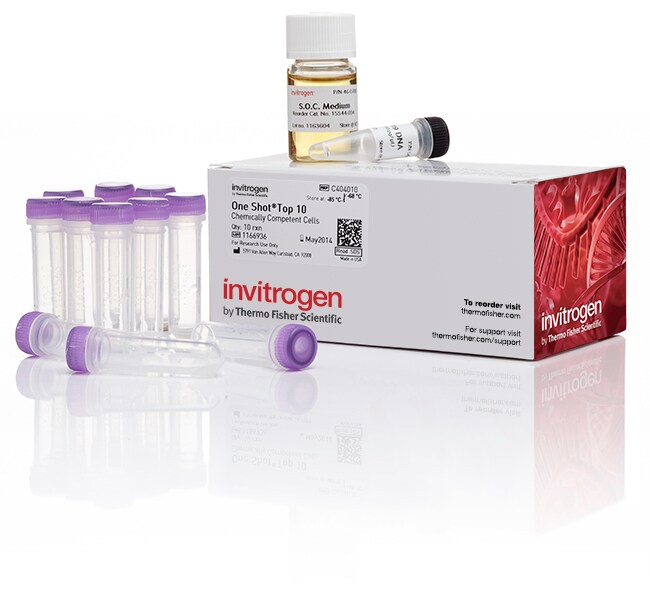
One Shot™ TOP10 化学感受态大肠杆菌
One Shot™ TOP10 化学感受态大肠杆菌提供的转化效率为 1 x 10⁹ cfu/µg 质粒 DNA,适用于高效克隆和质粒增殖了解更多信息
Have Questions?
更改视图

| 货号 | 数量 |
|---|---|
| C404010 | 10 次反应 |
| C404003 | 20 x 50μL |
| C404006 | 40 次反应 |
货号 C404010
价格(CNY)
2,450.00
Each
数量:
10 次反应
价格(CNY)
2,450.00
Each
One Shot™ TOP10 化学感受态大肠杆菌提供的转化效率为 1 x 10⁹ cfu/µg 质粒 DNA,适用于高效克隆和质粒增殖。它们可实现高拷贝数质粒的稳定复制,是随我们的许多克隆试剂盒提供的同一种感受态细胞。One Shot™ TOP10 细胞:
•尽可能增加单管规格克隆效率
• 提供增强的基因组 DNA 克隆能力
易于使用的 One Shot™ 规格
单管单次使用规格可实现转化方案的所有步骤(直至平板接种)在同管中进行,从而有助于节省时间和避免污染。
通用的克隆能力
One Shot™ TOP10 大肠杆菌细胞类似于 DH10B™ 品系,具有以下特点:
• hsdR 用于通过 PCR 扩增高效转化未甲基化 DNA
• mcrA 用于通过基因组制备高效转化甲基化 DNA
• lacZΔM15 用于蓝/白斑筛选重组克隆
• 由于无需进行核酸内切酶 I 的非特异性酶切,endA1 用于在下游应用中获得更清洁的 DNA 制备物和更好的结果,下游应用可获得更好的结果
• recA1 用于降低克隆 DNA 中的非特异性重组
基因型:F- mcrA Δ( mrr-hsdRMS-mcrBC) Φ80lacZΔM15 Δ lacX74 recA1 araD139 Δ( araleu)7697 galU galK rpsL (StrR) endA1 nupG
查找您需要的细胞株和规格
我们还提供许多其他不同的化学感受态细胞和电转感受态细胞的细胞株和规格,帮助满足您的特定转化需求。如果您需要高通量转化,请从我们的 MultiShot™ 格式化感受态细胞集合中选择。
•尽可能增加单管规格克隆效率
• 提供增强的基因组 DNA 克隆能力
易于使用的 One Shot™ 规格
单管单次使用规格可实现转化方案的所有步骤(直至平板接种)在同管中进行,从而有助于节省时间和避免污染。
通用的克隆能力
One Shot™ TOP10 大肠杆菌细胞类似于 DH10B™ 品系,具有以下特点:
• hsdR 用于通过 PCR 扩增高效转化未甲基化 DNA
• mcrA 用于通过基因组制备高效转化甲基化 DNA
• lacZΔM15 用于蓝/白斑筛选重组克隆
• 由于无需进行核酸内切酶 I 的非特异性酶切,endA1 用于在下游应用中获得更清洁的 DNA 制备物和更好的结果,下游应用可获得更好的结果
• recA1 用于降低克隆 DNA 中的非特异性重组
基因型:F- mcrA Δ( mrr-hsdRMS-mcrBC) Φ80lacZΔM15 Δ lacX74 recA1 araD139 Δ( araleu)7697 galU galK rpsL (StrR) endA1 nupG
查找您需要的细胞株和规格
我们还提供许多其他不同的化学感受态细胞和电转感受态细胞的细胞株和规格,帮助满足您的特定转化需求。如果您需要高通量转化,请从我们的 MultiShot™ 格式化感受态细胞集合中选择。
仅供科研使用。不可用于诊断程序。
规格
耐抗生素细菌Yes (Streptomycin)
蓝色/白色筛查是
是否可克隆甲基化 DNA是
克隆不稳定 DNA不适合克隆不稳定DNA
是否含 F' 附加体缺乏 F’附加体
高通量能力不兼容高通量应用(手动)
提高质粒质量是
质粒高拷贝质粒
制备无甲基化 DNA不适合制备未甲基化DNA
产品线One Shot
产品类型感受态细胞
数量10 次反应
减少克隆重组现象是
运输条件干冰
T1 噬菌体 - 抗性 (tonA)否
转化效率级别高效率 (> 10^9 cfu/μg)
产品规格One Shot
种属大肠杆菌
Unit SizeEach
内容与储存
包含:
• One Shot™ TOP10 化学感受态大肠杆菌:11 瓶,每瓶 50 µL
• pUC19 DNA (10 pg/µL):1 样品瓶,50 µL;
•S.O.C. 培养基:1 瓶,6 mL
感受态细胞储存在 -80°C 下。pUC19 DNA 储存在 -20°C 下。SOC 培养基储存在 4°C 或室温下。
• One Shot™ TOP10 化学感受态大肠杆菌:11 瓶,每瓶 50 µL
• pUC19 DNA (10 pg/µL):1 样品瓶,50 µL;
•S.O.C. 培养基:1 瓶,6 mL
感受态细胞储存在 -80°C 下。pUC19 DNA 储存在 -20°C 下。SOC 培养基储存在 4°C 或室温下。
常见问题解答 (FAQ)
TOP10细胞与TOP10F’细胞的区别是什么?
我正在尝试克隆一个毒性可能非常大的插入片段。我使用过DH5α和TOP10细胞进行转化但是没有在平板上得到克隆。你们能为我提供一些建议吗?
你们的大肠杆菌菌株是源于K12菌株吗?
What is the difference between TOP10 and TOP10F' cells?
I am trying to clone an insert that is supposedly pretty toxic. I used DH5? and TOP10 cells for the transformation and got no colonies on the plate. Do you have any suggestions for me?
引用和文献 (12)
引用和文献
Abstract
Subcellular targeting of RGS9-2 is controlled by multiple molecular determinants on its membrane anchor, R7BP.
Journal:J Biol Chem
PubMed ID:16574655
'RGS9-2, a member of the R7 RGS protein family of neuronal RGS (Regulators of G protein Signaling), is a critical regulator of G protein signaling. In striatal neurons, RGS9-2 is tightly associated with a novel palmitoylated protein - R7BP (R7 family Binding Protein). Here we report that R7BP acts to
A single cell density-sensing factor stimulates distinct signal transduction pathways through two different receptors.
Journal:J Biol Chem
PubMed ID:12070170
'In Dictyostelium discoideum, cell density is monitored by levels of a secreted protein, conditioned medium factor (CMF). CMFR1 is a putative CMF receptor necessary for CMF-induced G protein-independent accumulation of the SP70 prespore protein but not for CMF-induced G protein-dependent inositol 1,4,5-trisphosphate production. Using recombinant fragments of CMF, we find
Tight Binding Inhibition of Protein Phosphatase-1 by Phosphatidic Acid. SPECIFICITY OF INHIBITION BY THE PHOSPHOLIPID.
Journal:J Biol Chem
PubMed ID:11856740
'Phosphatidic acid (PA) has been identified as a bioactive lipid second messenger, yet despite extensive investigation, no cellular target has emerged as a mediator of its described biological effects. In this study, we identify the gamma isoform of the human protein phosphatase-1 catalytic subunit (PP1cgamma) as a high affinity in
HSP70-2 is required for CDC2 kinase activity in meiosis I of mouse spermatocytes [published erratum appears in Development 1997 Sep;134(17):3218]
Journal:Development
PubMed ID:9247342
'Cyclin B-dependent CDC2 kinase activity has a key role in triggering the G2/M-phase transition during the mitotic and meiotic cell cycles. The Hsp70-2 gene is expressed only in spermatogenic cells at a significant level. In Hsp70-2 gene knock-out (Hsp70-2(-/-)) mice, primary spermatocytes fail to complete meiosis I, suggesting a link
Disarming the mustard oil bomb.
Journal:Proc Natl Acad Sci U S A
PubMed ID:12161563
Plants are attacked by a broad array of herbivores and pathogens. In response, plants deploy an arsenal of defensive traits. In Brassicaceae, the glucosinolate-myrosinase complex is a sophisticated two-component system to ward off opponents. However, this so-called