Search


引用和文献 (48)
Invitrogen™
CellTracker™ CM-DiI 染料
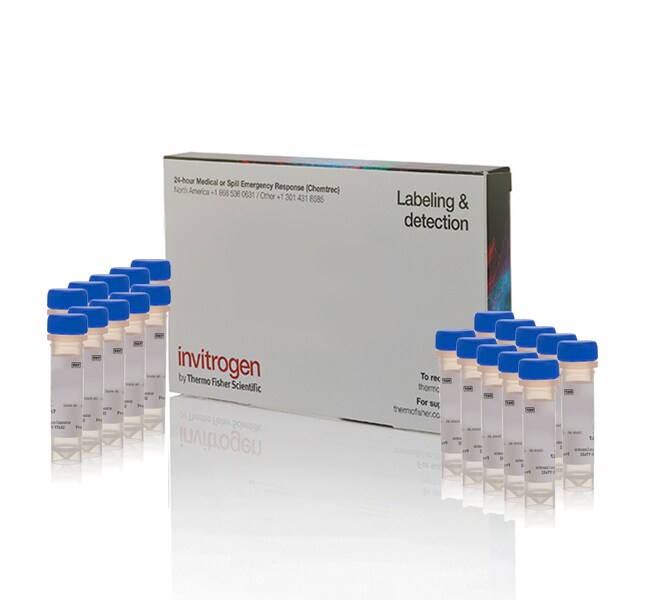
CellTracker™ CM-DiI 是一种非常适合监测细胞运动或位置的荧光染料。此染料保留良好,因此可对细胞运动进行多代追踪。红色激发/发射光谱适用于使用绿色荧光染料和蛋白的多通路技术。是否需要不同的发射光谱或更长时间的追踪?查看我们的其他哺乳动物细胞示踪产品。•易于使用—去除培养基,添加染料,孵育30分钟,进行细胞成像• 荧光信号保留 >72 小时了解更多信息
Have Questions?
更改视图

| 货号 | 数量 |
|---|---|
| C7000 | 20 x 50 μg |
| C7001 | 1mg |
货号 C7000
价格(CNY)
4,279.00
飞享价
Ends: 31-Dec-2026
5,942.00共减 1,663.00 (28%)
Each
数量:
20 x 50 μg
价格(CNY)
4,279.00
飞享价
Ends: 31-Dec-2026
5,942.00共减 1,663.00 (28%)
Each
CellTracker™ CM-DiI 是一种非常适合监测细胞运动或位置的荧光染料。此染料保留良好,因此可对细胞运动进行多代追踪。红色激发/发射光谱适用于使用绿色荧光染料和蛋白的多通路技术。
是否需要不同的发射光谱或更长时间的追踪?查看我们的其他哺乳动物细胞示踪产品。
•易于使用—去除培养基,添加染料,孵育30分钟,进行细胞成像
• 荧光信号保留 >72 小时(通常3至6代)
• 适用于多通路技术的红色激发/发射光谱(最大值为 553/570 nm)
• 低细胞毒性—不影响活力或增殖
CellTracker™ CM-DiI 荧光染料设计用于自由穿过细胞膜进入细胞,在其中转化为细胞膜不可透过性反应产物。CellTracker™ CM-DiI 染料可在活细胞中保留多代。该染料可转移到子细胞中,但不会转移到群体中的相邻细胞中。CellTracker™ CM-DiI 染料设计用于显示荧光至少 72 小时,且染料表现出理想的追踪特性:在工作浓度下保持稳定且无毒性,可稳定保留在细胞中,且在生理 pH 值下可发出明亮的荧光。此外,CellTracker™ CM-DiI 染料的激发和发射光谱与 GFP(绿色荧光蛋白)光谱分离良好,可用于多通路技术。
是否需要不同的发射光谱或更长时间的追踪?查看我们的其他哺乳动物细胞示踪产品。
•易于使用—去除培养基,添加染料,孵育30分钟,进行细胞成像
• 荧光信号保留 >72 小时(通常3至6代)
• 适用于多通路技术的红色激发/发射光谱(最大值为 553/570 nm)
• 低细胞毒性—不影响活力或增殖
CellTracker™ CM-DiI 荧光染料设计用于自由穿过细胞膜进入细胞,在其中转化为细胞膜不可透过性反应产物。CellTracker™ CM-DiI 染料可在活细胞中保留多代。该染料可转移到子细胞中,但不会转移到群体中的相邻细胞中。CellTracker™ CM-DiI 染料设计用于显示荧光至少 72 小时,且染料表现出理想的追踪特性:在工作浓度下保持稳定且无毒性,可稳定保留在细胞中,且在生理 pH 值下可发出明亮的荧光。此外,CellTracker™ CM-DiI 染料的激发和发射光谱与 GFP(绿色荧光蛋白)光谱分离良好,可用于多通路技术。
仅供科研使用。不可用于诊断程序。
规格
颜色黄色
检测方法荧光
激发波长范围553⁄570
适用于(设备)荧光显微镜
产品线CellTracker
数量20 x 50 μg
运输条件室温
标签类型荧光蛋白
产品类型染料
亚细胞定位细胞膜&脂质, Lipids
Unit SizeEach
内容与储存
在冷冻冰箱(-5°C 至 -30°C)中避光储存。
常见问题解答 (FAQ)
我染色两个细胞类群,一种是用CellTracker Green染料,另一种是用CellTracker Red染料,但它看起来像是红色染料的与绿色细胞之间出现了交叉。这是怎么回事?
我试着用CellTracker dyes或CFDA SE对我的细胞进行染色,但是没有观察到很多信号,我该怎么做?
我想用钙黄绿素染料标记整个细胞。我可以借此跟踪我的细胞多久,我可以固定它们吗?
我想用核酸染料来追踪我的细胞,比如DAPI或者Hoechst染料。您有什么建议吗?
我想追踪细胞,但贵司有很多产品可供选择,我该如何选择?
引用和文献 (48)
引用和文献
Abstract
The use of the lipophilic fluorochrome CM-DiI for tracking the migration of lymphocytes.
Journal:J Immunol Methods
PubMed ID:8765171
'In this study we examined the new cell dye CM-DiI for tracking the migration of lymphocytes from blood to lymph. This lipophilic marker intercalates in the plasma membrane like the PKH dyes and older DiI derivatives. The stability and intensity of staining achieved with these dyes is better than most
Characterization of antisera specific to NK1, NK2, and NK3 neurokinin receptors and their utilization to localize receptors in the rat gastrointestinal tract.
Journal:J Neurosci
PubMed ID:8824334
'Understanding the physiological role of tachykinins requires precise cellular and subcellular localization of their receptors. We raised antisera by immunizing rabbits with peptides corresponding to portions of the intracellular tails of the rat neurokinin 1, 2, and 3 receptors (NK1-R, NK2-R, NK3-R). Receptors were localized by immunofluorescence and confocal microscopy.
Interneuron migration from basal forebrain to neocortex: dependence on Dlx genes.
Journal:Science
PubMed ID:9334308
'Although previous analyses indicate that neocortical neurons originate from the cortical proliferative zone, evidence suggests that a subpopulation of neocortical interneurons originates within the subcortical telencephalon. For example, gamma-aminobutyric acid (GABA)-expressing cells migrate in vitro from the subcortical telencephalon into the neocortex. The number of GABA-expressing cells in neocortical slices
Analysis of vertical fluorescence resonance energy transfer from the surface of a small-diameter sphere.
Journal:Biophys J
PubMed ID:9876165
'Fluorescence resonance energy transfer (FRET) measurements have been used to analyze fluorophore separations in a number of varying geometries, including small particles and extended surfaces. This study focuses on the geometry created by a donor extended above the surface of a small sphere (radius < R0), where the acceptors are
Human mesenchymal stem cells exert potent antitumorigenic effects in a model of Kaposi's sarcoma.
Journal:J Exp Med
PubMed ID:16636132
'Emerging evidence suggests that both human stem cells and mature stromal cells can play an important role in the development and growth of human malignancies. In contrast to these tumor-promoting properties, we observed that in an in vivo model of Kaposi''s sarcoma (KS), intravenously (i.v.) injected human mesenchymal stem cells