Search


引用和文献 (8)
Invitrogen™
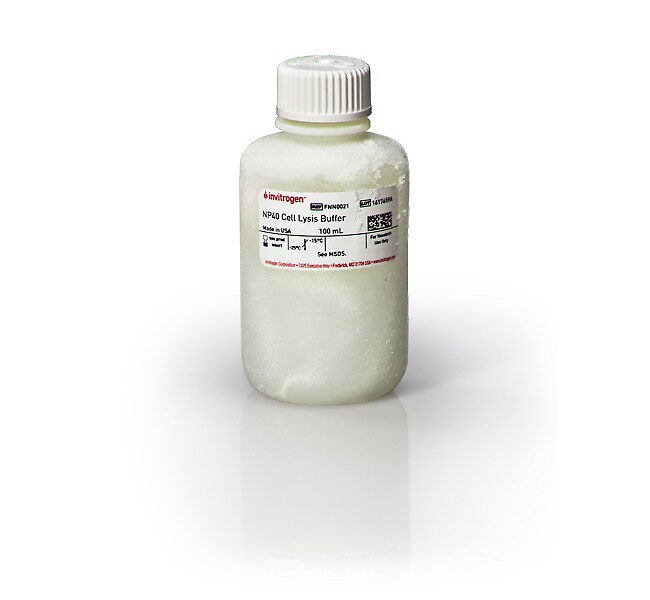
细胞裂解缓冲液 II
细胞裂解缓冲液 II 是一种高质量、即用型裂解缓冲液,适用于制备用于 ELISA、Western 印迹和抗体微珠免疫检测 (Luminex) 应用的细胞提取物。该缓冲液用于总蛋白提取,并利用基于去污剂的裂解方式,无需机械性细胞破碎了解更多信息
| 货号 | 数量 |
|---|---|
| FNN0021 | 100 mL |
货号 FNN0021
价格(CNY)
1,669.00
飞享价
Ends: 31-Dec-2026
2,199.00共减 530.00 (24%)
Each
数量:
100 mL
价格(CNY)
1,669.00
飞享价
Ends: 31-Dec-2026
2,199.00共减 530.00 (24%)
Each
细胞裂解缓冲液 II 是一种高质量、即用型裂解缓冲液,适用于制备用于 ELISA、Western 印迹和抗体微珠免疫检测 (Luminex) 应用的细胞提取物。该缓冲液用于总蛋白提取,并利用基于去污剂的裂解方式,无需机械性细胞破碎。该制剂有助于保留酶检测或免疫检测所需的蛋白结构和功能。
缓冲液配方:50 mM Tris(pH 值 7.4)、250 mM NaCl、5 mM EDTA、50 mM NaF、1 mM Na3VO4、1% 去污剂、0.02% NaN3
该细胞裂解缓冲液不含蛋白酶抑制剂,应在即将使用前补充 1 mM PMSF 和蛋白酶抑制剂混合物。
查看所有可用的 ELISA 裂解缓冲液和试剂。
缓冲液配方:50 mM Tris(pH 值 7.4)、250 mM NaCl、5 mM EDTA、50 mM NaF、1 mM Na3VO4、1% 去污剂、0.02% NaN3
该细胞裂解缓冲液不含蛋白酶抑制剂,应在即将使用前补充 1 mM PMSF 和蛋白酶抑制剂混合物。
查看所有可用的 ELISA 裂解缓冲液和试剂。
仅供科研使用。不可用于诊断程序。
规格
产品类型细胞裂解缓冲液
数量100 mL
运输条件干冰
Unit SizeEach
内容与储存
Store at 2°C to 8°C
常见问题解答 (FAQ)
在我的 ProcartaPlex 检测数据分析过程中,我收到一条警告消息,指出存在高度聚集的珠子。我应该怎么办?
在我的 ProcartaPlex 检测数据分析期间,珠子落在珠子图上珠子区域的下方或左下方。为什么是这样?
在我的 ProcartaPlex 检测数据分析期间,珠子没有出现在门控区域中。发生了什么?
我所有的 ProcartaPlex 检测孔的珠数都不稳定。什么地方出了错?
我的 ProcartaPlex 检测标准曲线的微珠计数正确且规则,但对于我的样品,微珠计数不稳定,我收到一条警告消息,提示“采集中至少有一个区域未达到最大计数”。我应该怎么办?
引用和文献 (8)
引用和文献
Abstract
Cleavage of hyaluronan is impaired in aged dermal wounds.
Journal:Matrix Biol
PubMed ID:23022999
'Changes in extracellular matrix (ECM) are one of many components that contribute to impaired wound healing in aging. This study examined the effect of age on the glycosaminoglycan hyaluronan (HA) in normal and wounded dermis from young (4-6 month-old) and aged (22-24 month-old) mice. HA content and size were similar
Thyroid hormone controls the gene expression of HSV-1 LAT and ICP0 in neuronal cells.
Journal:Cell Res
PubMed ID:20386570
'Various factors/pathways including hormonal regulation have been suggested to control herpes simplex virus type 1 (HSV-1) latency and reactivation. Our computer analysis identified a DNA repeat containing thyroid hormone-responsive elements (TRE) in the regulatory region of HSV-1 latency-associated transcript (LAT). Thyroid hormone (triiodothyronine, T(3)) functions via its receptor TR (thyroid
miRNA-214 is related to invasiveness of human non-small cell lung cancer and directly regulates alpha protein kinase 2 expression.
Journal:
PubMed ID:23929716
'The prognosis of non-small cell lung cancer (NSCLC) is poor, since it has often metastasized to distant organs by the time of diagnosis. Therefore, biomarkers predicting metastasis are crucial. miRNAs play important roles in the regulation of different tumor cell processes, including metastasis. We recently showed that miRNA-214 is linked
miR-205 expression promotes cell proliferation and migration of human cervical cancer cells.
Journal:PLoS One
PubMed ID:23056551
MicroRNAs (miRNAs) are short non-coding RNA regulators that control gene expression mainly through post-transcriptional silencing. We previously identified miR-205 in a signature for human cervical cancer using a deep sequencing approach. In this study, we confirmed that miR-205 expression was frequently higher in human cervical cancer than their matched normal
A preclinical assessment of neural stem cells as delivery vehicles for anti-amyloid therapeutics.
Journal:PLoS One
PubMed ID:22496779
Transplantation of neural stems cells (NSCs) could be a useful means to deliver biologic therapeutics for late-stage Alzheimer's disease (AD). In this study, we conducted a small preclinical investigation of whether NSCs could be modified to express metalloproteinase 9 (MMP9), a secreted protease reported to degrade aggregated Aß peptides that