Search


引用和文献 (28)
Invitrogen™
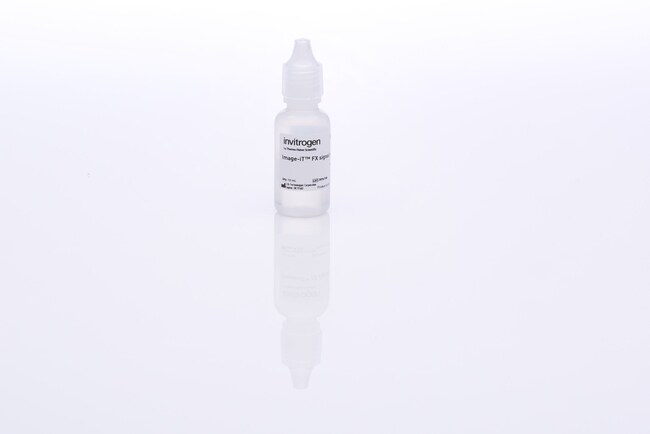
Image-iT™ FX 信号增强剂
Image-iT™ FX 信号增强剂是一种液体,在使用荧光探针染色之前,直接应用于含有固定和透化细胞或组织样品的载玻片或盖玻片。当使用 Image-iT™ FX 信号增强剂时,应用链霉素亲和素、山羊抗小鼠或山羊抗兔 IgG 的荧光偶联物时常见的非特异性荧光了解更多信息
| 货号 | 数量 |
|---|---|
| I36933 | 10 mL |
货号 I36933
价格(CNY)
1,208.00
飞享价
Ends: 31-Dec-2026
1,677.00共减 469.00 (28%)
Each
数量:
10 mL
价格(CNY)
1,208.00
飞享价
Ends: 31-Dec-2026
1,677.00共减 469.00 (28%)
Each
Image-iT™ FX 信号增强剂是一种液体,在使用荧光探针染色之前,直接应用于含有固定和透化细胞或组织样品的载玻片或盖玻片。当使用 Image-iT™ FX 信号增强剂时,应用链霉素亲和素、山羊抗小鼠或山羊抗兔 IgG 的荧光偶联物时常见的非特异性荧光(背景)被大大消除了。
关键属性
•简易方案—在滴瓶中应用现成溶液中的增强剂
•对多种荧光标记有效(参见下文用户手册表 2)
•经济高效—用品足够 50 个标准盖玻片
•与免疫染色实验方案’的其他封闭步骤兼容
减少染料与组织的非特异性结合。
Alexa Fluor™ 染料和许多其他染料具有负电荷修饰,可导致与细胞和组织的非特异性结合。虽然不一定重要,但在低丰度靶标中推动灵敏度限度时可能是一个问题。Image-iT™ FX 信号增强剂可显著减少这种结合,使染色得到显著改善。
是否需要帮助决定您的细胞成像需要哪种产品?参见我们的细胞成像工作流程和决策树。
是否对信噪比不佳感到厌烦?参见我们来自 Molecular Probes 的收集抗淬灭剂和信号增强剂产品™。
仅供研究使用。不得用于任何动物或人类的治疗或诊断。
关键属性
•简易方案—在滴瓶中应用现成溶液中的增强剂
•对多种荧光标记有效(参见下文用户手册表 2)
•经济高效—用品足够 50 个标准盖玻片
•与免疫染色实验方案’的其他封闭步骤兼容
减少染料与组织的非特异性结合。
Alexa Fluor™ 染料和许多其他染料具有负电荷修饰,可导致与细胞和组织的非特异性结合。虽然不一定重要,但在低丰度靶标中推动灵敏度限度时可能是一个问题。Image-iT™ FX 信号增强剂可显著减少这种结合,使染色得到显著改善。
是否需要帮助决定您的细胞成像需要哪种产品?参见我们的细胞成像工作流程和决策树。
是否对信噪比不佳感到厌烦?参见我们来自 Molecular Probes 的收集抗淬灭剂和信号增强剂产品™。
仅供研究使用。不得用于任何动物或人类的治疗或诊断。
仅供科研使用。不可用于诊断程序。
规格
产品线Image-iT
数量10 mL
有效期至少6个月
运输条件室温
产品类型FX 信号增强剂
溶液类型信号增强剂
Unit SizeEach
内容与储存
在室温下储存。
常见问题解答 (FAQ)
当我分析click标记样品时,观测到较高的本底干扰,这是什么原因所致?如何减少本底干扰?
我用了一种神经元特异性抗体标记我的神经元,怎样才能减少非特异性抗体结合?
我在对照细胞的细胞核和线粒体中看到非特异性结合,但是蛋白质结合不足以将其终止。我应该怎么做?
I used Image-iT FX Signal Enhancer solution to get rid of nonspecific nuclear labeling with Alexa Fluor 568 secondary antibody, but I also saw a significant reduction in my specific mitochondrial antibody labeling. Why is this and what can I do?
Can I use the Image-iT FX Signal Enhancer instead of my normal blocking solution (BSA or serum)?
引用和文献 (28)
引用和文献
Abstract
NKT cells are critical to initiate an inflammatory response after Pseudomonas aeruginosa ocular infection in susceptible mice.
Journal:J Immunol
PubMed ID:17617607
'CD4(+) T cells produce IFN-gamma contributing to corneal perforation in C57BL/6 (B6) mice after Pseudomonas aeruginosa infection. To determine the role of NK and NKT cells, infected corneas of B6 mice were dual immunolabeled. Initially, more NKT than NK cells were detected, but as disease progressed, NK cells increased, while
Identification of STAT3 as a substrate of receptor protein tyrosine phosphatase T.
Journal:Proc Natl Acad Sci U S A
PubMed ID:17360477
'Protein tyrosine phosphatase (PTP) receptor T (PTPRT) is the most frequently mutated PTP in human cancers. However, the cell signaling pathways regulated by PTPRT have not yet been elucidated. Here, we report identification of signal transducer and activator of transcription 3 (STAT3) as a substrate of PTPRT. Phosphorylation of a
Displacement of SERCA from SR lipid caveolae-related domains by Bcl-2: a possible mechanism for SERCA inactivation.
Journal:Biochemistry
PubMed ID:16388593
'Bcl-2 exerts its anti-apoptotic effect in part through the regulation of Ca2+ homeostasis at the level of the endoplasmic reticulum. Earlier, we demonstrated that a truncated form of Bcl-2, Bcl-2delta21, interacts with and destabilizes the skeletal muscle sarco/endoplasmic reticulum Ca-ATPase (SERCA) [Dremina, E. S., Sharov, V. S., Kumar, K., Zaidi,
Androgen induces expression of the multidrug resistance protein gene MRP4 in prostate cancer cells.
Journal:Prostate Cancer Prostatic Dis
PubMed ID:17003774
'Multidrug resistance-associated proteins (MRPs) may mediate multidrug resistance in tumor cells. Using a gene array analysis, we have identified MRP4 as an androgen receptor (AR)-regulated gene. Dihydrotestosterone induced MRP4 expression in both androgen-dependent and -independent LNCaP cells, whereas there was little detectable expression in PC-3 or normal prostate epithelial cells.
Constitutive interferon-inducible protein 16-inflammasome activation during Epstein-Barr virus latency I, II, and III in B and epithelial cells.
Journal:
PubMed ID:23720728
'Epstein-Barr virus (EBV), etiologically linked with human B-cell malignancies and nasopharyngeal carcinoma (NPC), establishes three types of latency that facilitate its episomal genome persistence and evasion of host immune responses. The innate inflammasome responses recognize the pathogen-associated molecular patterns which lead into the association of a cytoplasmic sensor such as