Search


引用和文献 (141)
Invitrogen™
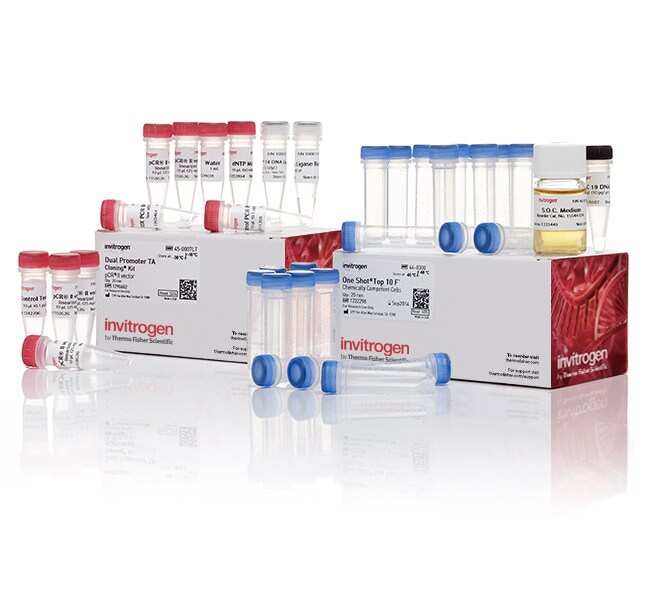
TA Cloning™ 试剂盒,双启动子,含 pCR™II 载体和 One Shot™ TOP10F' 化学感受态大肠杆菌
TA Cloning™ 试剂盒双启动子(含 pCR™II 载体)提供了一种快速的一步法克隆策略,可将 Taq 扩增 PCR了解更多信息
Have Questions?
更改视图

| 货号 | 反应次数 |
|---|---|
| K206001 | 20 次反应 |
| K206040 | 40 次反应 |
货号 K206001
价格(CNY)
3,980.00
飞享价
Ends: 31-Dec-2026
7,957.00共减 3,977.00 (50%)
Each
反应次数:
20 次反应
价格(CNY)
3,980.00
飞享价
Ends: 31-Dec-2026
7,957.00共减 3,977.00 (50%)
Each
TA Cloning™ 试剂盒双启动子(含 pCR™II 载体)提供了一种快速的一步法克隆策略,可将 Taq 扩增 PCR 产物直接插入质粒载体中。pCR™II 载体的 T7 和 Sp6 启动子可在体外转录插入片段,产生正义链或反义链产物。TA Cloning 试剂盒双启动子使用 pCR™II 克隆载体和 ExpressLink™ T4 DNA 连接酶,在十五分钟的室温连接步骤中生成连接产物。反应通常产生 >80% 包含插入片段的重组体。
TA Cloning™ 试剂盒双启动子的特点:
•快速且方便 — 15分钟、室温连接
• 高效 — 蓝/白斑筛选和 >80% 含正确插入片段的克隆体
• 灵活 — 可选择卡那霉素或氨苄青霉素抗性,实现灵活的抗生素选择
• 轻松 — 无需对 PCR 产物进行任何酶修饰
• 流程简化 — 不需要使用包含限制性位点的 PCR 引物
pCR™II 载体提供:
• 3'-T 突出端,用于直接连接 Taq 扩增 PCR 产物
• T7 和 Sp6 启动子,用于体外 RNA 转录和测序
• 两侧具有 EcoR I 位点的通用性多位点接头,可方便地切除插入片段
• M13 正向和反向引物位点,用于测序
TA Cloning™ 的工作原理
Taq 聚合酶具有非模板依赖性活性,可在 PCR 产物的 3' 末端引入单脱氧腺苷 (A)。该试剂盒中提供的线性化载体具有单个 3' 脱氧胸苷 (T) 残基。这使得 PCR 插入片段高效地与载体连接。
试剂盒配置
TA Cloning™ 试剂盒提供多种配置:含 One Shot™ INVF' 化学感受态大肠杆菌(K2050-01 和 K2050-40)、含 One Shot™ TOP10F' 化学感受态大肠杆菌(K2060-01 和 K2060-40)以及不含感受态细胞(K2750-20 和 K2750-40),分 20 和 40 次反应试剂盒规格。
TA Cloning™ 试剂盒双启动子的特点:
•快速且方便 — 15分钟、室温连接
• 高效 — 蓝/白斑筛选和 >80% 含正确插入片段的克隆体
• 灵活 — 可选择卡那霉素或氨苄青霉素抗性,实现灵活的抗生素选择
• 轻松 — 无需对 PCR 产物进行任何酶修饰
• 流程简化 — 不需要使用包含限制性位点的 PCR 引物
pCR™II 载体提供:
• 3'-T 突出端,用于直接连接 Taq 扩增 PCR 产物
• T7 和 Sp6 启动子,用于体外 RNA 转录和测序
• 两侧具有 EcoR I 位点的通用性多位点接头,可方便地切除插入片段
• M13 正向和反向引物位点,用于测序
TA Cloning™ 的工作原理
Taq 聚合酶具有非模板依赖性活性,可在 PCR 产物的 3' 末端引入单脱氧腺苷 (A)。该试剂盒中提供的线性化载体具有单个 3' 脱氧胸苷 (T) 残基。这使得 PCR 插入片段高效地与载体连接。
试剂盒配置
TA Cloning™ 试剂盒提供多种配置:含 One Shot™ INVF' 化学感受态大肠杆菌(K2050-01 和 K2050-40)、含 One Shot™ TOP10F' 化学感受态大肠杆菌(K2060-01 和 K2060-40)以及不含感受态细胞(K2750-20 和 K2750-40),分 20 和 40 次反应试剂盒规格。
仅供科研使用。不可用于诊断程序。
规格
细菌或酵母菌株TOP10F ́
细胞类型化学感受态大肠杆菌
克隆方法TA克隆
适用于(应用)PCR克隆
包括线性化 pCRII 载体、ExpressLink T4 DNA 连接酶、5X ExpressLink T4 DNA 连接缓冲液、dNTP、10X PCR 缓冲液、无菌水、对照品、One Shot TOP10F' 化学感受态大肠杆菌、S.O.C. 培养基和超螺旋对照质粒。
反应次数20 次反应
产品线One Shot
产品类型克隆试剂盒
促进剂T7, SP6
数量20 reactions
载体pCRII
产品规格试剂盒
Unit SizeEach
内容与储存
本试剂盒含有线性化 pCR™II 载体、ExpressLink™ T4 DNA 连接酶、5X ExpressLink™ T4 DNA 连接缓冲液、dNTP、10X PCR 缓冲液、无菌水和对照品。感受态细胞试剂盒包含 One Shot™ 化学感受态大肠杆菌、S.O.C. 培养基和一种超螺旋对照质粒。
在 -80°C 下储存 One Shot™ 大肠杆菌。所有其他组分储存在 -20°C 下。正确存放时,所有试剂均可保证 6 个月的稳定。
在 -80°C 下储存 One Shot™ 大肠杆菌。所有其他组分储存在 -20°C 下。正确存放时,所有试剂均可保证 6 个月的稳定。
常见问题解答 (FAQ)
我可以使用TOP10F’感受态细胞对包含ccdB基因的TOPO载体进行转化吗?
Can I use TOP10F' competent cells for transformation of my TOPO vector that contains the ccdB gene?
Have you compared in vitro transcription levels between SP6 and T7 promoters in your pCRII vectors?
引用和文献 (141)
引用和文献
Abstract
LMP-1, a LIM-domain protein, mediates BMP-6 effects on bone formation.
Journal:Endocrinology
PubMed ID:9832452
Glucocorticoids can promote osteoblast differentiation from fetal calvarial cells and bone marrow stromal cells. We recently reported that glucocorticoid specifically induced bone morphogenetic protein-6 (BMP-6), a glycoprotein signaling molecule that is a multifunctional regulator of vertebrate development. In the present study, we used fetal rat secondary calvarial cultures to determine
Glycoprotein IIb Leu214Pro mutation produces glanzmann thrombasthenia with both quantitative and qualitative abnormalities in GPIIb/IIIa.
Journal:Blood
PubMed ID:9473221
Glanzmann thrombasthenia is an inherited bleeding disorder due to a functional reduction or absence of platelet GPIIb/IIIa (alphaIIbbeta3) integrin receptors. Based on a prolonged bleeding time and absence of platelet aggregation in response to physiologic agonists, a 55-year-old white man was diagnosed as having Glanzmann thrombasthenia. The patient's platelet fibrinogen
Type IV collagen is detectable in most, but not all, basement membranes of Caenorhabditis elegans and assembles on tissues that do not express it.
Journal:J Cell Biol
PubMed ID:9166416
Type IV collagen in Caenorhabditis elegans is produced by two essential genes, emb-9 and let-2, which encode alpha1- and alpha2-like chains, respectively. The distribution of EMB-9 and LET-2 chains has been characterized using chain-specific antisera. The chains colocalize, suggesting that they may function in a single heterotrimeric collagen molecule. Type
Distribution and cloning of eukaryotic mRNAs by means of differential display: refinements and optimization.
Journal:Nucleic Acids Res
PubMed ID:8341601
Differential display has been developed as a tool to detect and characterize altered gene expression in eukaryotic cells. The basic principle is to systematically amplify messenger RNAs and then distribute their 3' termini on a denaturing polyacrylamide gel. Here we provide methodological details and examine in depth the specificity, sensitivity
Cloning and characterization of a naturally occurring antisense RNA to human thymidylate synthase mRNA.
Journal:Nucleic Acids Res
PubMed ID:8493092
Based upon reverse transcription and polymerase chain reaction results with human KB cell RNA, a cDNA (i.e., 3'rTS1, 1557 nt) with complementarity to thymidylate synthase mRNA was cloned and sequenced. Northern blot analysis showed that 3'rTS1 corresponded to a cytoplasmic 1.8 kb RNA found in several tumor cell lines. The