Search


引用和文献 (7)
Invitrogen™
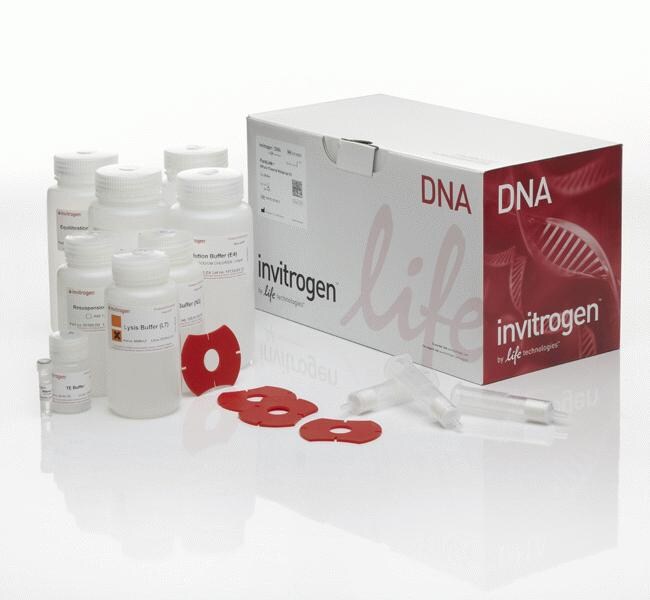
PureLink™ HiPure 质粒中提试剂盒
PureLink™ HiPure 质粒中提试剂盒设计用于从大肠杆菌中分离转染级质粒 DNA。中提试剂盒方案通常可从 15–25 mL 细菌培养物中获得 100–350 µg了解更多信息
Have Questions?
更改视图

| 货号 | 数量 | Includes |
|---|---|---|
| K210005 | 50 次制备 | |
| K210004 | 25 次制备 |
货号 K210005
价格(CNY)
4,059.00
飞享价
Ends: 31-Dec-2026
5,175.00共减 1,116.00 (22%)
Each
数量:
50 次制备
价格(CNY)
4,059.00
飞享价
Ends: 31-Dec-2026
5,175.00共减 1,116.00 (22%)
Each
PureLink™ HiPure 质粒中提试剂盒设计用于从大肠杆菌中分离转染级质粒 DNA。中提试剂盒方案通常可从 15–25 mL 细菌培养物中获得 100–350 µg 质粒 DNA,纯度与两次通过氯化铯梯度获得的纯度相当。
PureLink™ HiPure 质粒中提试剂盒的优势包括:
•省力省时 — 无需额外步骤即可去除内毒素和其他污染物
• 高纯度、低内毒素产物 — 纯度足以转染哺乳动物细胞
• 多功能性 — 可纯化任何类型和大小的质粒 DNA,包括 BAC、杆粒和 ssM13 DNA
用于质粒纯化的阴离子交换色谱
PureLink™ HiPure 质粒 DNA 纯化试剂盒使用获得专利的阴离子交换树脂将质粒 DNA 纯化至相当于两次通过 CsCl 梯度的水平。该树脂兼具出众的容量以及快速流速、高分离度、高得率和高效内毒素去除功能。质粒制备通常可在 2 小时内完成。
无污染物 DNA
与氯化铯梯度方案不同,PureLink™ HiPure 质粒纯化系统不使用有机溶剂、溴化乙锭或氯化铯,所有这些试剂操作和处理时均较为麻烦。通常,使用 PureLink™ HiPure 质粒中提试剂盒制备的质粒 DNA 的 A260/A280 比大于1.80,表明合理情况下该 DNA 不含可能干扰下游应用的蛋白。内毒素水平通常在 0.1–1 EU/µg 以内,这使得该质粒 DNA 成为哺乳动物细胞转染的理想选择
PureLink™ HiPure 质粒中提试剂盒的优势包括:
•省力省时 — 无需额外步骤即可去除内毒素和其他污染物
• 高纯度、低内毒素产物 — 纯度足以转染哺乳动物细胞
• 多功能性 — 可纯化任何类型和大小的质粒 DNA,包括 BAC、杆粒和 ssM13 DNA
用于质粒纯化的阴离子交换色谱
PureLink™ HiPure 质粒 DNA 纯化试剂盒使用获得专利的阴离子交换树脂将质粒 DNA 纯化至相当于两次通过 CsCl 梯度的水平。该树脂兼具出众的容量以及快速流速、高分离度、高得率和高效内毒素去除功能。质粒制备通常可在 2 小时内完成。
无污染物 DNA
与氯化铯梯度方案不同,PureLink™ HiPure 质粒纯化系统不使用有机溶剂、溴化乙锭或氯化铯,所有这些试剂操作和处理时均较为麻烦。通常,使用 PureLink™ HiPure 质粒中提试剂盒制备的质粒 DNA 的 A260/A280 比大于1.80,表明合理情况下该 DNA 不含可能干扰下游应用的蛋白。内毒素水平通常在 0.1–1 EU/µg 以内,这使得该质粒 DNA 成为哺乳动物细胞转染的理想选择
仅供科研使用。不可用于诊断程序。
规格
洗脱体积5 ml
最终产品类型BAC DNA、质粒 DNA
适用于(应用)下一代测序、转染、克隆、测序、转化、核酸标记、PCR、体外转录
高通量能力不兼容高通量应用(手动)
反应次数50 次制备
质粒<40kb,低拷贝质粒、高拷贝质粒、BAC
制备规模100-200 μg(中等规模)质粒 DNA
产品线PureLink
产品类型质粒 MidiPrep 试剂盒
纯度转染级
数量50 次制备
样品类型细菌培养
运输条件室温
系统类型PureLink™
靶标BAC DNA、质粒 DNA
测试时间2小时
产量350 μg
产品规格色谱柱
分离技术阴离子交换树脂
Unit SizeEach
内容与储存
• 200 mL 重悬缓冲液 (R3)
• 1.5 mL RNase A
• 200 mL 裂解缓冲液 (L7)
• 200 mL 沉淀缓冲液 (N3)
• 2 x 250 mL 平衡缓冲液 (EQ1)
• 2 x 500 mL 洗涤缓冲液 (W8)
• 250 mL 洗脱缓冲液 (E4)
• 30 mL TE 缓冲液
• 50 个 HiPure 柱
• 10 个柱支架
所有组分均在室温下储存。
• 1.5 mL RNase A
• 200 mL 裂解缓冲液 (L7)
• 200 mL 沉淀缓冲液 (N3)
• 2 x 250 mL 平衡缓冲液 (EQ1)
• 2 x 500 mL 洗涤缓冲液 (W8)
• 250 mL 洗脱缓冲液 (E4)
• 30 mL TE 缓冲液
• 50 个 HiPure 柱
• 10 个柱支架
所有组分均在室温下储存。
常见问题解答 (FAQ)
我使用PureLink HiPure试剂盒得到低产量甚至零产量的质粒DNA,虽然吸光值读数显示可测。请问有什么建议可以解决这一问题?
我用完了PureLink HiPure质粒纯化试剂盒中的缓冲液。我可以单独购买这些缓冲液吗?
使用PureLink柱纯化试剂盒从一种endA+菌株得到的质粒DNA在限制性内切酶消化后发生了降解。对于这种情况有什么建议吗?
使用PureLink柱纯化系统得到的质粒出现额外的条带。这可能是由于什么原因引起的?
柱纯化后得到的质粒DNA内存在颗粒。有什么建议吗?
引用和文献 (7)
引用和文献
Abstract
Structural basis for ADAM17 activation by the iRhom1 pseudoprotease.
Journal:Cell reports
PubMed ID:42024498
The a disintegrin and metalloproteinase (ADAM)-17 releases pro-inflammatory cytokines, including tumor necrosis factor-α, and several epidermal growth factor receptor ligands from cells. ADAM17 is post-translationally regulated by the inactive rhomboid pseudoproteases iRhom1 and iRhom2, and dysregulation of this signaling axis contributes to diseases ranging from chronic inflammation to cancer. Here,
Tools for genetic engineering and gene expression control in Novosphingobium aromaticivorans and Rhodobacter sphaeroides.
Journal:Applied and environmental microbiology
PubMed ID:39324814
Alphaproteobacteria have a variety of cellular and metabolic features that provide important insights into biological systems and enable biotechnologies. For example, some species are capable of converting plant biomass into valuable biofuels and bioproducts that have the potential to contribute to the sustainable bioeconomy. Among the Alphaproteobacteria, Novosphingobium aromaticivorans, Rhodobacter
Protocol to evaluate the inflammatory response in human macrophages induced by SARS-CoV-2 spike-pseudotyped VLPs.
Journal:STAR protocols
PubMed ID:36853685
The excessive release of pro-inflammatory cytokines in COVID-19 patients is deleterious to organs. The contribution of SARS-CoV-2 spike protein (S) to the inflammatory response is essential to understand its pathogenesis and virulence. Here, we present a protocol to produce and characterize HIV- and SARS-CoV-2-based virus-like particles and then evaluate the inflammatory
CRISPR/Cas9-mediated tissue-specific knockout and cDNA rescue using sgRNAs that target exon-intron junctions in Drosophila melanogaster.
Journal:STAR protocols
PubMed ID:35719725
In this protocol, we take CRISPR/Cas9 and Gal4/UAS approaches to achieve tissue-specific knockout in parallel with rescue of the knockout by cDNA expression in Drosophila. We demonstrate that guide RNAs targeting the exon-intron junction of target genes cleave the genomic locus of the genes, but not UAS-cDNA transgenes, in a
The inhibitory receptor TIM-3 limits activation of the cGAS-STING pathway in intra-tumoral dendritic cells by suppressing extracellular DNA uptake.
Journal:Immunity
PubMed ID:33979578
Blockade of the inhibitory receptor TIM-3 shows efficacy in cancer immunotherapy clinical trials. TIM-3 inhibits production of the chemokine CXCL9 by XCR1( ) classical dendritic cells (cDC1), thereby limiting antitumor immunity in mammary carcinomas. We found that increased CXCL9 expression by splenic cDC1s upon TIM-3 blockade required type I interferons