Search


引用和文献 (4)
Invitrogen™
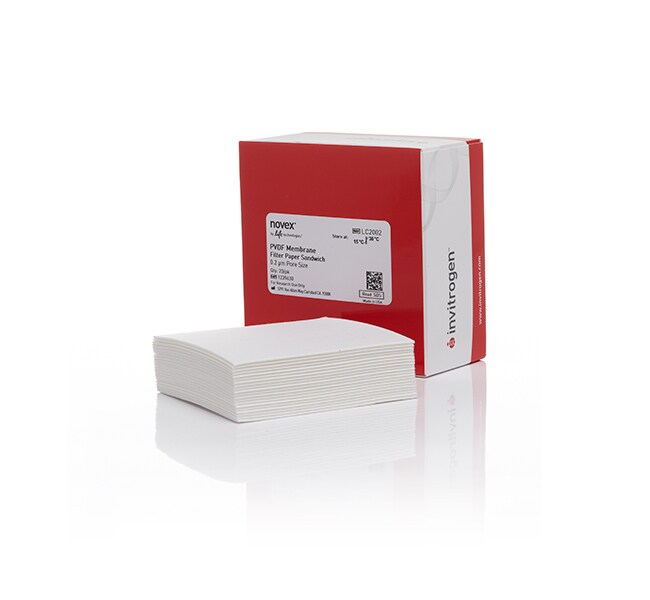
PVDF/滤纸三明治,0.2 μm,8.3 x 7.3 cm
PVDF/过滤纸三明治结构(0.2 µm)具有出色的结合特性,适用于 Western 印迹、斑点印迹试验以及其他蛋白质或核酸方法(如蛋白测序)。0.2了解更多信息
| 货号 | 数量 |
|---|---|
| LC2002 | 20 membrane/filter paper sandwiches |
货号 LC2002
价格(CNY)
2,172.00
飞享价
Ends: 31-Dec-2026
3,633.00共减 1,461.00 (40%)
Each
数量:
20 membrane/filter paper sandwiches
价格(CNY)
2,172.00
飞享价
Ends: 31-Dec-2026
3,633.00共减 1,461.00 (40%)
Each
PVDF/过滤纸三明治结构(0.2 µm)具有出色的结合特性,适用于 Western 印迹、斑点印迹试验以及其他蛋白质或核酸方法(如蛋白测序)。0.2 µm 孔径使这些膜适用于少量蛋白(低至 10 皮摩尔)的蛋白分析、氨基酸分析和小分子量蛋白和肽转印。
参见所有膜和滤纸›
特点
•膜:聚偏二氟乙烯 (PVDF)
•滤纸厚度:0.8 mm
•结合容量:较大球蛋白为 50–150 µg/cm2;较小肽为 >150 µg/cm2
•重新标记特性:是
•预活化:需要使用 100% 酒精(甲醇、乙醇或异丙醇)
•兼容性:与通常使用的转印条件和检测方法(如染色、化学发光和放射性同位素示踪)兼容
•耐久性:与大多数有机溶剂、酸和温和碱兼容
参见所有膜和滤纸›
特点
•膜:聚偏二氟乙烯 (PVDF)
•滤纸厚度:0.8 mm
•结合容量:较大球蛋白为 50–150 µg/cm2;较小肽为 >150 µg/cm2
•重新标记特性:是
•预活化:需要使用 100% 酒精(甲醇、乙醇或异丙醇)
•兼容性:与通常使用的转印条件和检测方法(如染色、化学发光和放射性同位素示踪)兼容
•耐久性:与大多数有机溶剂、酸和温和碱兼容
仅供科研使用。不可用于诊断程序。
规格
数量20 membrane/filter paper sandwiches
运输条件室温
尺寸 (长 x 宽)7.3 cm x 8.3 cm
产品规格夹心
长度(公制)8.3 cm
材质PVDF
孔径0.2 μm
产品线Novex
厚度0.8 mm
宽度(公制)7.3 cm
Unit SizeEach
内容与储存
在室温下储存。
常见问题解答 (FAQ)
我使用Coomassie Blue对PVDF膜进行染色后,发现背景上有奇怪的旋涡状图案。可能原因是什么?
我将蛋白质转印到PVDF膜上后,转印效率很低。你们有何建议?
你们的PVDF和硝化纤维素膜能否用于Li-COR仪器?
我正在计划做斑点印迹实验,但我的样品中含有乙腈。你们的PVDF和硝化纤维素膜是否耐受乙腈?
我该如何降低PVDF免疫印迹膜的背景?
引用和文献 (4)
引用和文献
Abstract
Reaction mechanism, evolutionary analysis, and role of zinc in Drosophila methionine-R-sulfoxide reductase.
Journal:J Biol Chem
PubMed ID:12145281
Methionine residues in proteins are susceptible to oxidation, and the resulting methionine sulfoxides can be reduced back to methionines by methionine-S-sulfoxide reductase (MsrA) and methionine-R-sulfoxide reductase (MsrB). Herein, we have identified two MsrB families that differ by the presence of zinc. Evolutionary analyses suggested that the zinc-containing MsrB proteins are
The brain-derived neurotrophic factor enhances synthesis of Arc in synaptoneurosomes.
Journal:Proc Natl Acad Sci U S A
PubMed ID:11842217
Protein synthesis in neurons is essential for the consolidation of memory and for the stabilization of activity-dependent forms of synaptic plasticity such as long-term potentiation (LTP). Activity-dependent translation of dendritically localized mRNAs has been proposed to be a critical source of new proteins necessary for synaptic change. mRNA for the
CREB-binding protein/p300 co-activation of crystallin gene expression.
Journal:J Biol Chem
PubMed ID:11943779
Although some of the transcription factors that are required for expression of crystallins during lens development have been identified, the molecular interactions that contribute to enhanced crystallin expression are not yet well defined. In this study, we designed experiments to test whether the co-activators CREB-binding protein (CBP) and/or p300 interact
Oligomeric and fibrillar species of amyloid-beta peptides differentially affect neuronal viability.
Journal:J Biol Chem
PubMed ID:12058030
Genetic evidence predicts a causative role for amyloid-beta (A beta) in Alzheimer's disease. Recent debate has focused on whether fibrils (amyloid) or soluble oligomers of A beta are the active species that contribute to neurodegeneration and dementia. We developed two aggregation protocols for the consistent production of stable oligomeric or