Search
Invitrogen
AXIN2 Monoclonal Antibody (J.415.10)
{{$productOrderCtrl.translations['antibody.pdp.commerceCard.promotion.promotions']}}
{{$productOrderCtrl.translations['antibody.pdp.commerceCard.promotion.promocode']}}: {{promo.promoCode}} {{promo.promoTitle}} {{promo.promoDescription}}. {{$productOrderCtrl.translations['antibody.pdp.commerceCard.promotion.learnmore']}}
{{$ctrl.translations['antibody.pdp.skuNotes.additionalInformation']}}:
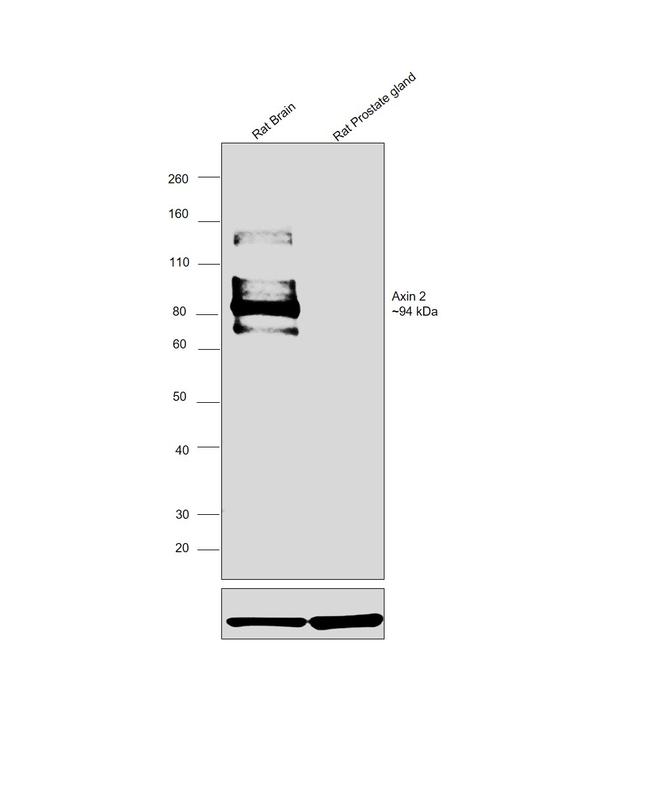
图: 1 / 5
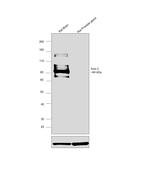
AXIN2 Antibody (MA5-15015) in WB
Western blot was performed using Anti-AXIN2 Monoclonal Antibody (J.415.10)(Product # MA5-15015) and a 94 kDa band corresponding to AXIN2 was observed across tissues tested. Tissue extracts (30 µg lysate) of Rat Brain (Lane 1), Rat Prostate (Lane 2) were electrophoresed using NuPAGE™ 4-12% Bis-Tris Protein Gel (Product # NP0321BOX). Resolved proteins were then transferred onto a Nitrocellulose membrane (Product # LC2001) by iBlot® 2 Dry Blotting System (Product # IB21001). The blot was probed with the primary antibody (1:1000 dilution) and ... View More
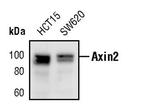
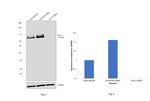
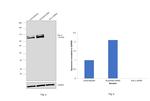
Please note: We are reviewing Western blot images included in the antibody testing data in our catalog, including those provided by third parties. Unless expressly labeled or annotated as “raw-unedited”, Western blot images included in the antibody testing data in our catalog may have been edited, optimized or otherwise adjusted for presentation.


产品信息
MA5-15015
产品规格
种属反应
Human
已发表种属
Human
宿主/亚型
Rabbit
/ IgG
分类
Monoclonal
类型
Antibody
克隆号
J.415.10
抗原
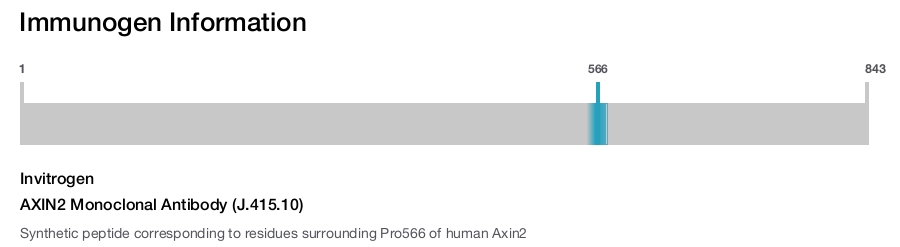
Synthetic peptide corresponding to residues surrounding Pro566 of human Axin2
偶联物
Unconjugated
Unconjugated
Unconjugated
形式
Liquid
浓度
183 µg/mL
规格
18.3 µg
纯化类型
Affinity chromatography
保存液
0.01M HEPES, pH 7.5, with 0.15M NaCl, 100µg/mL BSA, 50% glycerol
内含物
<0.02% sodium azide
保存条件
-20°C
运输条件
Ambient (domestic); Wet ice (international)
RRID
产品详细信息
It is not recommended to aliquot this antibody.
This antibody is not cross-reactive with Axin1.
靶标信息
The Axin-related protein, Axin2, presumably plays an important role in the regulation of the stability of beta-catenin in the Wnt signaling pathway, like its rodent homologs, mouse conductin/rat axil. In mouse, conductin organizes a multiprotein complex of APC (adenomatous polyposis of the colon), beta-catenin, glycogen synthase kinase 3-beta, and conductin, which leads to the degradation of beta-catenin. Apparently, the deregulation of beta-catenin is an important event in the genesis of a number of malignancies. The AXIN2 gene has been mapped to 17q23-q24, a region that shows frequent loss of heterozygosity in breast cancer, neuroblastoma, and other tumors. Mutations in this gene have been associated with colorectal cancer with defective mismatch repair.
仅用于科研。不用于诊断过程。未经明确授权不得转售。
生物信息学
蛋白别名: Axin like protein; axin-like protein; AXIN2; axis inhibition protein 2; conductin; DKFZp781B0869; MGC10366; MGC126582
基因别名: AXIL; ODCRCS
UniProt ID: (Human) Q9Y2T1
Entrez Gene ID: (Human) 8313
aortic valve morphogenesis
mitral valve morphogenesis
protein localization
negative regulation of cell proliferation
dorsal/ventral axis specification
positive regulation of epithelial to mesenchymal transition
negative regulation of Wnt signaling pathway
regulation of mismatch repair
positive regulation of proteasomal ubiquitin-dependent protein catabolic process
odontogenesis
proteasome-mediated ubiquitin-dependent protein catabolic process
maintenance of DNA repeat elements
positive regulation of fat cell differentiation
mRNA stabilization
cell development
response to steroid hormone
canonical Wnt signaling pathway
regulation of centromeric sister chromatid cohesion
cellular response to dexamethasone stimulus
negative regulation of canonical Wnt signaling pathway
regulation of extracellular matrix organization
Disclaimer

Clicking the images or links will redirect you to a website hosted by BenchSci that provides third-party scientific content. Neither the content nor the BenchSci technology and processes for selection have been evaluated by us; we are providing them as-is and without warranty of any kind, including for use or application of the Thermo Fisher Scientific products presented.

